Get Full Government Meeting Transcripts, Videos, & Alerts Forever!
Get email alerts on the Municipal Budget topic
No spam. Unsubscribe anytime.
Board reviews capital budget, warns some funds could dry up if development slows
Summary
City staff presented a proposed capital budget focused on finishing existing projects tied to a 2019 property-tax pledge (the "1875" list). Staff warned road-impact and adequate-facilities fees that fund many projects depend on permit activity and could decline if development or a sewer moratorium reduces permitting.
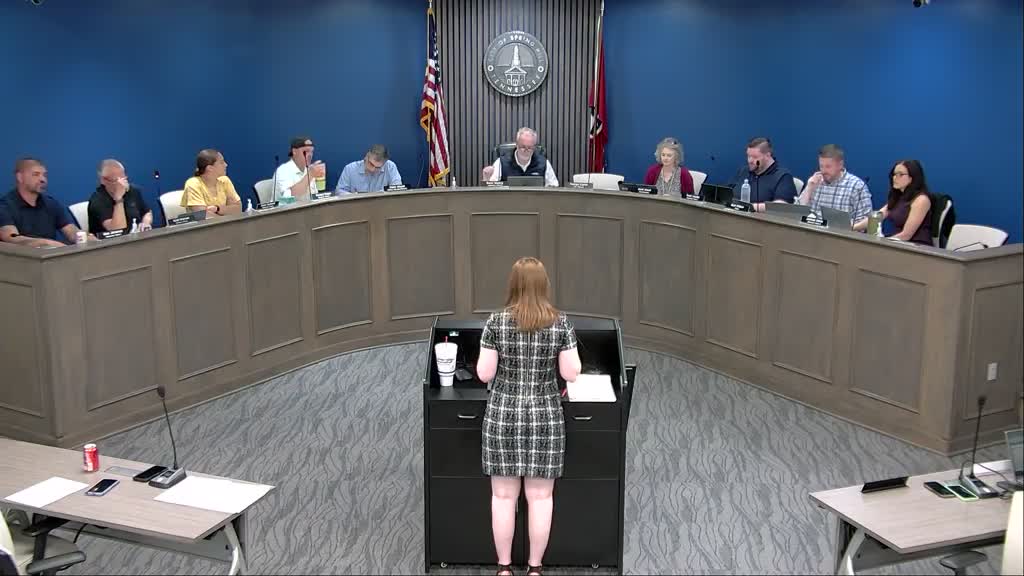
Rebecca Holden, staff member, presented the city’s proposed capital budget at the Board of Mayor and Aldermen budget work session, emphasizing the package is meant to finish projects already started rather than add new projects.
The proposed capital projects fund referenced throughout the presentation is the so-called “1875” fund, a financing mechanism funded primarily by a 2019 property-tax increase. Mayor Fitter explained that the 2019 increase was memorialized in resolution 19-40 and dedicated “solely to the projects listed on 1875,” and thus that fund must be used for that defined set of projects until the related debt is retired.
Holden said the 3.11 (1875) capital projects fund is “primarily funded with 37% of property taxes” and that the budget includes the previously discussed property-tax increment. She told the board the majority of next year’s capital spending is to finish ongoing projects and that remaining appropriations for projects will be carried forward via budget amendments when work continues into the next fiscal year.
On specific requests, staff identified individual project budget needs: $1.7 million additional for Buckner Lane (ongoing, out to bid), $95,000 for owner’s-representative services on the I‑65 interchange (Volgert contract covering remaining three years of a 10‑year engagement), and a roughly $2.8 million balance to complete Fire Station 4. Holden said the 3.13 capital fund shows a deficit driven primarily by finishing Fire Station 4, and she proposed using fund balance/transfers already committed from the general fund to close that deficit.
Staff also described how funds 01/24 (road impact fees) and 01/25 (adequate facilities fees) collect development-related revenues and transfer those revenues into capital fund 03/13 for spending. Holden warned that those revenue streams are sensitive to permit activity and “as we move into that moratorium phase, all that money’s gonna dry up, because you’re not gonna have permits coming through.” She urged caution about committing projects that rely on permit-driven revenue.
Board members asked about cost estimates and contingencies. Holden said engineers under contract (examples named in the meeting: Corradino Group, Gerald Bolden, and Neil Schafer) provide the estimated probable costs during design and that bids will produce final prices; she said the city typically includes a 10% contingency and, for construction-manager‑at‑risk contracts, uses a guaranteed maximum price structure.
Other project requests in the proposal included design-only funding for Jim Warren Road ($1.2 million), a $1 million request to replace the playground at Harvey Park (consolidating prior partial budget to a round $1,000,000), $2.75 million for CSA/City Hall renovations (coding error corrected in staff spreadsheets), and a $2 million request for Bellagio (project code 48030). Staff noted that projects shown as “roll from FY 24‑25” are ongoing and will be carried into next year via the normal budget-amendment process.
Why this matters: the presentation framed the capital budget as a short-term continuation of existing work, not a program of new spending. Board members pressed staff to provide current permit counts and updated cost estimates month-to-month so the board can reprioritize projects if development-driven revenue falls. Staff committed to reconciling committed parkland lines and to providing engineers’ estimates and bids as they become available.
Several board members also asked that staff circulate the original 1875 resolution and its attachment—Mayor Fitter noted the resolution includes project names, cost estimates and a financing plan—so members have a clear list of what revenue is eligible for the dedicated fund.
The session included multiple follow-up items for staff, including circulation of the 1875 project list, updated cost estimates, and ongoing monthly tracking of permit-driven revenue for the impact-fee and adequate-facilities funds.