Get Full Government Meeting Transcripts, Videos, & Alerts Forever!
Get email alerts on the County Budget topic
No spam. Unsubscribe anytime.
Scotland County commissioners weigh $1.6 million budget shortfall; consider benefit savings, capital deferrals and equipment leases
Summary
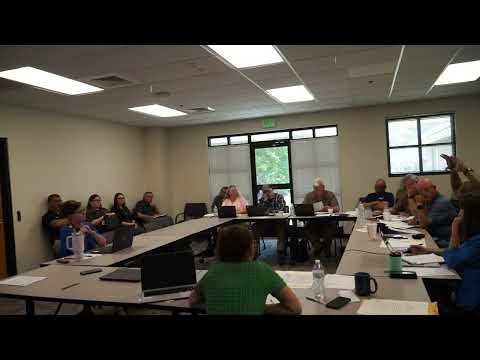
Scotland County commissioners discussed how to close a roughly $1.6 million projected operating shortfall and reviewed a list of capital requests during a budget work session.
Scotland County commissioners discussed how to close a roughly $1.6 million projected budget shortfall and reviewed a list of capital requests during a budget work session. Commissioners and staff examined potential savings from employee turnover and temporary suspension of benefit outlays, capital deferrals, and leasing alternatives for heavy equipment and fleet replacements.
County staff presented projections premised on an assumed 2% cost‑of‑living adjustment that are still short by about $1.6 million. Commissioners discussed relying in part on attrition savings — temporarily not paying health insurance premiums, 401(k) matches and other per‑employee costs while positions are vacant — and noted the county’s recent turnover history, which staff estimated at about 33% overall. Staff said that, using conservative assumptions about how long positions remain vacant, attrition could produce substantial savings but acknowledged the approach carries risk if expected vacancies do not occur or essential departments (for example EMS) cannot operate with reduced staffing.
Why it matters: commissioners said they prefer avoiding tapping the county’s fund balance this year and instead want to exhaust other options first, such as targeted cuts, reallocations and capital‑spending decisions, with an eye toward reassessing next year if revenue or staffing patterns change.
Key budget options and clarifications - Turnover and benefits: Staff estimated recent turnover near 33% and illustrated that savings from not paying health insurance and employer retirement matches for vacancies could be material — staff cited figures on the order of hundreds of thousands to more than $1 million depending on assumptions. Commissioners repeatedly cautioned that relying on attrition is risky if vacancies do not materialize or if certain departments cannot operate without filled positions. - Revenue uncertainties: The projection includes variables such as ad valorem collections and sales tax; staff noted some revenue lines (for example restricted state allocations for the Health Department and DSS) cannot legally be used for general operating needs and that miscellaneous revenue assumptions (including lease/debt‑service adjustments tied to a lease described as the “Skoll lease”) are sensitive to debt‑service calculations. - Grant writer: Commissioners discussed that revenue generated by a county grant writer is unlikely to supplant core operating costs; grant funding is more apt to support discrete equipment and programmatic items and typically includes associated expenses.
Capital requests and fleet/equipment priorities - EMS ambulance remount and equipment: Commissioners reviewed an ambulance remount estimate in the roughly low‑to‑mid $100,000s to about $200,000 range for a single remount and discussed purchasing a Lucas 3 automated chest‑compression device through grant opportunities. Commissioners expressed a willingness to cover one high‑priority remount this year (no formal vote recorded) and flagged the equipment as a candidate for grant funding. - Sheriff’s fleet and equipment: The sheriff’s vehicle budget was discussed as a discrete allocation (staff mentioned $546,000 in three allotments as the pool for vehicles). Commissioners said the sheriff (identified in discussion as the person who will decide number and outfitting of cars) controls vehicle assignment within that appropriation. - Radios and public‑safety backups: Commissioners discussed two‑way radios for DSS and the county’s need to retain legacy UHF/VHF radios as a backup to the state Viper system. Staff emphasized the county owns local UHF/VHF frequencies and must maintain continuity of operations in case the state system is taken temporarily offline for maintenance. - Library/bookmobile: Commissioners agreed to repurpose a landfill van as a temporary library outreach/ delivery vehicle, direct staff to transfer it to the library, and provide an estimated $2,500 for upfitting and branding. Staff said the existing bookmobile has low community usage and a generator with unresolved electrical issues; a generator replacement was estimated at about $25,000 but staff warned an electrical fault may still render replacement impractical. - Landfill equipment and leasing: Commissioners discussed leasing heavy equipment as a strategy to reduce capital outlays and maintenance burdens. Staff recommended exploring lease options (based on a peer visit to Robeson County); commissioners directed landfill staff (named as Beth and Thomas during discussion) to examine lease vs. purchase and to prioritize equipment needs within the enterprise fund. - Other capital items: Animal control, SCATS (transit) vehicles (staff said ~90% of SCATS replacements are federally funded), a SCATS bus and van, public‑buildings requests (bucket and grapple/tractor), and a soccer field turf remediation quote (~$20,000) were reviewed and in many cases flagged for later prioritization or deferral.
Decisions, directions and next steps Commissioners emphasized they do not want to draw down the general fund balance this year if alternatives exist. Specific directions recorded in the meeting (no formal roll‑call votes recorded in the transcript) included: - Prioritize at least one ambulance remount and pursue grant funding for related equipment (direction to staff). - Transfer a landfill van to the library for interim bookmobile/delivery use and allocate approximately $2,500 for upfitting and branding (direction to staff). - Allow landfill leadership (Beth and Thomas) latitude to prioritize enterprise‑fund vehicle and equipment needs, and investigate leasing options where appropriate (direction to staff). - Continue to evaluate attrition and benefits‑savings scenarios as a way to close part of the $1.6 million gap, with the caveat that critical services (EMS, AMS) cannot sacrifice minimum staffing.
What was not decided The meeting produced no recorded formal motions or final votes on budget adoption, benefit suspensions, or capital purchase authorizations in the transcript provided. Commissioners repeatedly instructed staff to return with refined numbers and options rather than committing to fund‑balance draws or final expenditures.
Context and history Commissioners and staff referenced prior discussions about the bookmobile, the Viper radio transition and the county’s ongoing reliance on federal and state grant funding for specific programs (for example SCATS). Several items — especially large capital purchases and lease vs. buy decisions for landfill equipment — were identified as multi‑year choices that staff will continue to analyze.
Ending Staff will return with more precise revenue projections, clarification of restricted vs. unrestricted revenue lines, and cost estimates for prioritized capital items. Commissioners said they expect to revisit fund‑balance and permanent budget changes next year if revenue or turnover patterns alter the county’s fiscal outlook.