Get Full Government Meeting Transcripts, Videos, & Alerts Forever!
Get email alerts on the Digital Equity topic
No spam. Unsubscribe anytime.
Assembly committee advances bill to set statewide floor for low‑income home internet
Summary
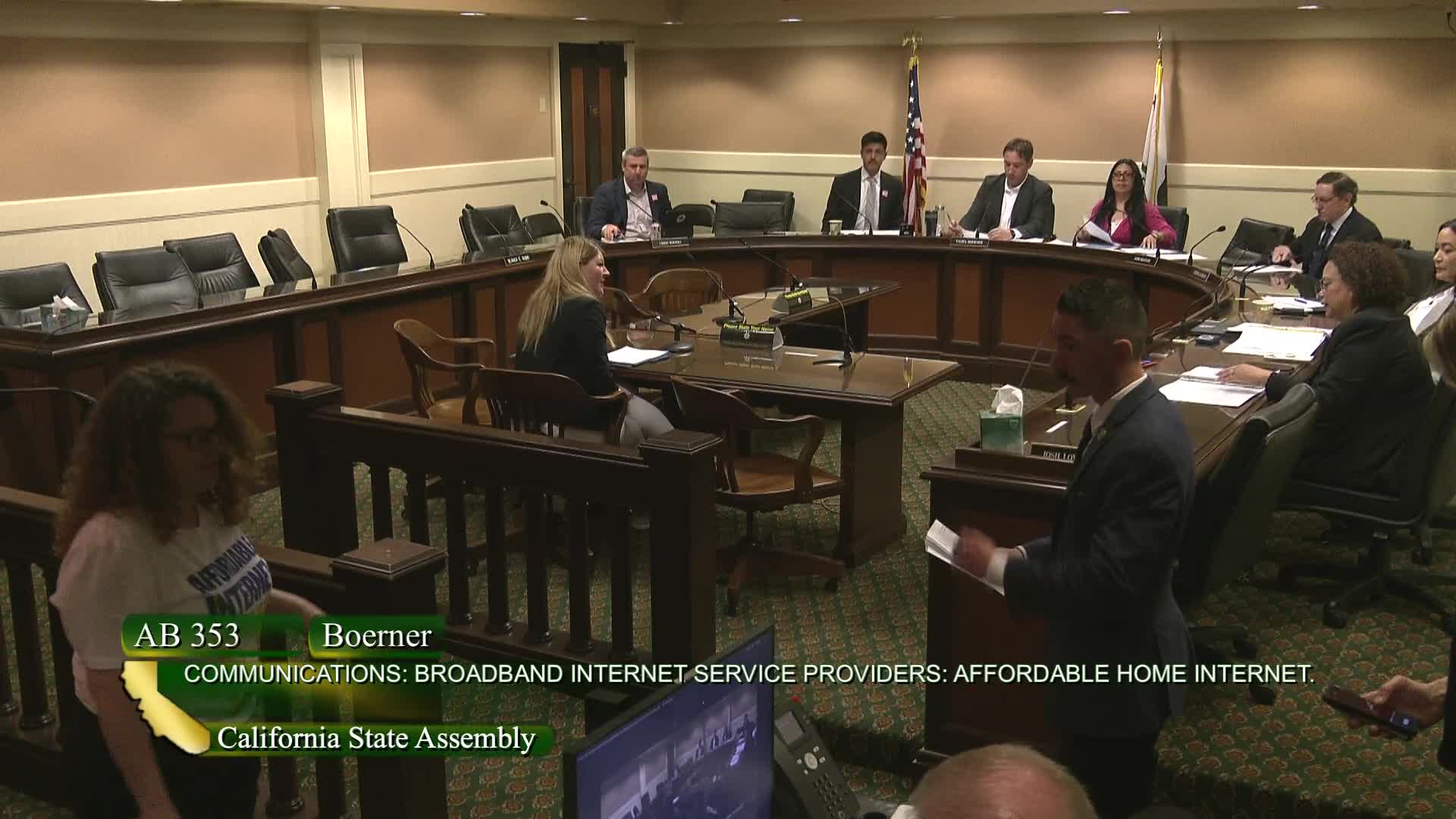
The Communications and Conveyance Committee on Thursday advanced AB 353, the Affordable Home Internet Act, a bill intended to require covered Internet providers to offer an affordable, minimum‑speed plan to qualifying low‑income households.
The Communications and Conveyance Committee on Thursday voted to advance AB 353, the Affordable Home Internet Act of 2025, a measure intended to guarantee low‑cost home broadband for qualifying low‑income households.
Assemblymember Tasha Boerner, chair of the committee and author of the bill presentation, said the law targets households left without federal support after the Affordable Connectivity Program expired: “The market for low‑income Californians to access broadband has failed, and that’s why we’re doing this,” she said.
Nut graf: AB 353 would require covered internet service providers to make an affordable, minimum‑speed broadband plan available to qualifying households. The committee accepted amendments and recommended the bill be referred to the Appropriations Committee; debate centered on eligibility criteria, caps, impacts on small or rural ISPs and how to avoid unintended market distortions.
Proponents from digital equity coalitions and education nonprofits urged adoption. Shana England, director of the Digital Equity Los Angeles Coalition, said millions of Californians dropped subscriptions after federal support ended and that broadband costs remain a barrier: “Establishing a floor for fast, reliable, and affordable Internet is a common sense, straightforward, and urgent solution,” she said.
Adrian Sandoval of GPSN (a Los Angeles education intermediary) described survey data showing families list home internet as a top priority and said cost remains the largest barrier to access. Supporters said the measure is needed to ensure students can complete schoolwork and households can access telehealth and work remotely.
Industry and broadband trade groups opposed the bill’s price‑cap approach. Jeremy Crandall of CTIA, the wireless industry trade association, described wireless pricing trends and said an artificial price mandate risks reducing provider investment and consumer choice. Rural and regional build‑out interests, including the Golden State Connect Authority and county representatives, warned that mandatory price caps could undermine local projects that rely on revenue to service bonds for fiber build‑out.
Committee members pressed the author on exemptions and the threshold for small ISPs; the committee analysis included an option to exempt providers with fewer than 50,000 subscribers or where the provider is the only option in the area. Vice Chair Hoover and others said additional work was needed to align eligibility proxies and to protect small, locally important providers.
Ending: The committee voted to pass AB 353 as amended and referred it to Appropriations. Members and stakeholders signaled further negotiations as the bill moves forward, particularly over eligibility proxies, treatment of fixed wireless providers and exemptions for small or sole providers in low‑density areas.
Votes at a glance: Committee recorded multiple ayes and at least one no (Hoover) during the roll call for the committee’s due‑pass motion; the chair announced the bill would be placed on call for additional votes while amendments are finalized.