Get Full Government Meeting Transcripts, Videos, & Alerts Forever!
Get email alerts on the Telecommunications topic
No spam. Unsubscribe anytime.
Assembly committee advances bill to phase out copper landlines with CPUC oversight
Summary
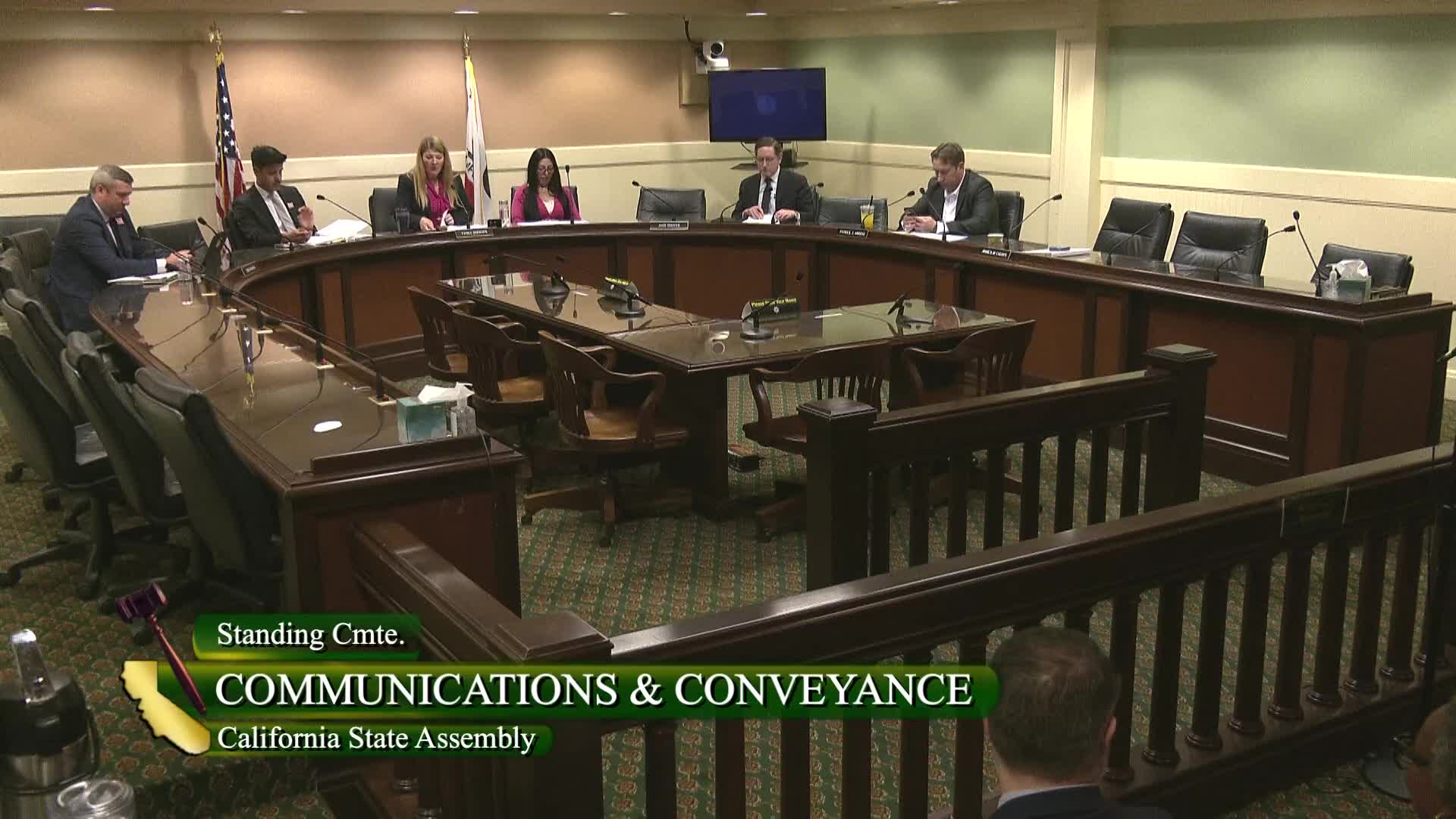
The Communications and Conveyance Committee of the California State Assembly on Thursday approved AB 470, a bill from Assemblymember Tina McKenner to create a pathway for telecommunication companies to transition customers off legacy copper landlines where modern alternatives exist.
The Communications and Conveyance Committee of the California State Assembly on Thursday approved AB 470, a bill from Assemblymember Tina McKenner to create a pathway for telecommunication companies to transition customers off legacy copper landlines where modern alternatives exist.
McKenner opened the hearing saying AB 470 would protect public safety while encouraging private investment: “AB 470 puts consumers first by guaranteeing that no household will lose access to telephone service,” she said, and described committee amendments she accepted as author amendments.
Nut graf: The bill establishes criteria under which a carrier could request relief from the carrier-of-last-resort obligation — a statutory duty to serve customers in a provider’s territory — if the California Public Utilities Commission (CPUC) finds an area is “well served.” The committee added a challenge process and a Tier 2 advice-letter step at the CPUC before any carrier relief takes effect; the committee then voted the measure out as amended and referred it to the Appropriations Committee.
Supporters told the committee the bill is meant to modernize public safety communications and avoid investments in obsolete copper infrastructure. Terry Nicole Baca, vice president of legislative affairs for AT&T California, told the committee the bill “does not turn off anyone’s copper landline service” and described the measure as a phased, multi‑year transition designed to prevent customers from losing 911 access.
Mark Ghilarducci, the immediate former director of the Governor’s Office of Emergency Services, testified in support, saying public safety systems increasingly depend on modern networks: “No one should be left without access to communications or 911 services especially during an emergency.” The bill’s author and proponents cited the January 2025 Los Angeles County fires — which McKenner said destroyed more than 18,000 structures and forced more than 150,000 evacuations — as an example of why modernized warning and connectivity systems matter.
Opponents argued AB 470 risks allowing carriers to abandon service areas before viable alternatives exist and raised particular concern for rural and wildfire‑prone communities. Regina Costa of TURN (The Utility Reform Network) said AT&T has sought relief from the carrier obligation before and warned the legislation could enable companies to “shrink [their] service territory.” Rural advocates and public witnesses told the committee they rely on copper landlines during power outages and other emergencies.
Committee amendments expanded the CPUC’s role in the proposed process: the bill requires notice to affected households and establishes a third‑party verification and a Tier 2 advice‑letter approval step at the CPUC for carrier relinquishment requests in areas the carrier claims are “well served.” The amendments also require alternative services to include at least one wireline option and comparably priced alternatives, and to include availability of subsidized lifeline service as part of the test for being “well served.”
The committee debate repeatedly returned to two themes: how to protect households that rely on copper service and how to ensure workers — including Communication Workers of America members — are not left out of the transition. McKenner said she has met with labor and invited CWA to negotiate workforce protections to be included in future amendments.
Ending: The committee approved AB 470 as amended by a committee vote and sent it to Appropriations. The record as taken in the hearing shows the committee adopted a due‑pass recommendation; the committee also left the CPUC with a defined role in verifying conditions before any carrier may be relieved of the carrier‑of‑last‑resort obligation.
Votes at a glance: The committee voted to pass AB 470 as amended and refer it to Appropriations. Recorded yea votes in the committee roll included: Berner, Aarons, Bonta, Colosa, Castillo, Lowenthal and Rubio; Garcia was recorded as voting no. (Final committee tally announced in the hearing: 8 yeas, 1 nay.)