Get Full Government Meeting Transcripts, Videos, & Alerts Forever!
Get email alerts on the Health Care topic
No spam. Unsubscribe anytime.
Senate finance committee advances HHS omnibus: 20% premium subsidy, MCO assessment, facility-fee ban amid intense debate
Summary
The Minnesota Senate Finance Committee recommended passage of the Health and Human Services omnibus (Senate File 2669) on a 7–5 roll-call after extended debate over a 20% premium subsidy, assessments on health plan companies of up to 2.8% to fund that subsidy, a hospital-directed payment program and a prohibition on some facility fees.
The Minnesota Senate Finance Committee voted 7–5 to recommend passage of Senate File 2669, the Health and Human Services omnibus bill, after extended debate over a premium subsidy program, provider funding, and a proposed ban on certain facility fees.
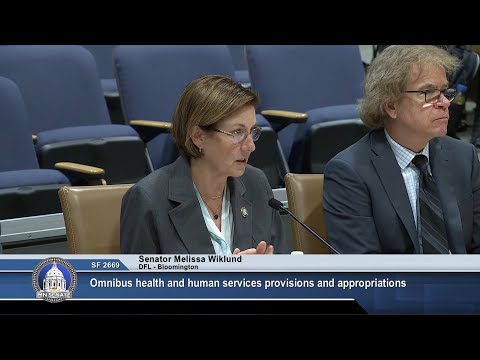
Senator Kelly Wicklund, the bill author in committee, walked members through multiple provisions that would reshape state health financing if enacted. The committee considered several high-profile items: a premium subsidy that would reduce enrollees’ premiums by 20 percent; authorization of an annual assessment on health plan companies (defined by statute) of up to 2.8 percent to fund the subsidy and other items; a hospital-directed payment program designed to draw federal funds through a structured application; and a statutory prohibition on some facility fees assessed by provider-based clinics, with several carve-outs.
The premium subsidy provisions would operate as follows, as lawmakers discussed repeatedly in committee: the subsidy equals 20 percent of an enrollee’s gross health-insurance premium and would be reflected at the carrier level; management and Budget (MMB) would make payments to health carriers for eligible individuals and those payments are to be made “by September 30 for the prior calendar year.” The bill imposes an annual assessment on health plan companies to raise the amount necessary to cover the subsidy. As counsel described it, “health plan companies” are defined by cross-reference to chapters in statute governing health carriers and include insurance companies, nonprofit health service plan corporations (e.g., Blue Cross), health maintenance organizations, fraternal benefit societies and joint self-insurance employee health plans.
Senator Julian Dames questioned whether the assessment would apply to out-of-state sales by Minnesota-domiciled carriers. Legal counsel said the applicable statute applies only to plans sold to Minnesota residents or that cover Minnesota residents, so the assessment would not be broad-based to non-Minnesota sales.
MNsure, the state’s marketplace, is authorized in the bill to temporarily operate the subsidy with “existing resources and available processes” through Jan. 1, 2027, using manual workarounds for the program’s first year; the bill contemplates contracting for an automated process to be in place for later open enrollment cycles. Committee staff described a phased implementation: manual processes to enable subsidy payments for plan year 2026, with an outside contractor and integrated technology expected to support the program by 2028 open enrollment.
Members pressed fiscal and legal staff repeatedly about the fiscal note. Senator Pratt and others noted that the committee had a preliminary or incomplete fiscal note in the packet, and Senate staff acknowledged that portions prepared by Commerce and Minnesota Management and Budget were not completed at the time the committee considered the bill. Senator Pratt urged an actuarial study before implementation, citing prior experience where cost assumptions proved too low.
The bill also includes a hospital-directed payment program that would require an application to federal authorities to secure additional federal matching funds; committee counsel said the state would not implement such a program unless federal approval allowed the additional federal dollars to be drawn down.
The committee spent substantial time on a proposed statutory prohibition on certain facility fees charged by provider-based clinics. Senator Kelly Pratt offered amendment A61 to repeal the prohibition and instead require that health plans cover facility fees and that out-of-pocket payments count toward enrollee deductibles and other cost-sharing. A61 was brought for roll-call and failed. Debate on facility fees included competing claims about hospital financial impacts: committee discussion referenced an estimate that the prohibition could reduce hospital revenue by roughly $1 billion statewide and that one community hospital (Shakopee) faced a $5 million impact if the prohibition remained; supporters of the ban said the measure protects patients from surprise facility bills and called for better transparency and reporting.
Other contested items included a scope-of-practice provision for optometrists seeking limited injection authority; Senator Wicklund said she would continue discussions with interested parties. Senator Wicklund also said the bill contains carve-outs for certain codes and for affiliated critical-access hospitals to reduce unintended impacts.
On motions and roll-call votes, the committee recorded the following: - A roll-call vote to adopt amendment A61 (Senator Pratt’s amendment to repeal the facility-fee prohibition and mandate coverage) failed (roll call recorded in transcript; amendment not adopted). The transcript records individual member votes for A61. - A motion to table the bill (moved by Senator James) failed on roll call. - Final recommendation: Senate File 2669 as amended passed the committee on a roll-call vote, 7–5. The transcript records the roll-call tally: Ayes — Marty, Friends, Champion, Mohammed, Murphy, Pappas, Wicklund; Nays — Pratt, Dames, Draheim, Howe, Jasinski.
Senator James and others said they could not support the bill without additional fiscal detail and expressed concern about the program’s potential effects on premiums, insurers’ revenues, and rural hospitals’ financial viability. Senator Wicklund replied that the bill’s components serve distinct policy goals — increasing Medical Assistance rates, creating a premium subsidy alternative to reinsurance, and pursuing federal-directed payment opportunities — and said agencies involved (MNsure, MMB, Department of Commerce) had advised the committee they could implement the program by staged manual-to-automated processes.
After the roll call, the committee recommended passage of the HHS omnibus and adjourned to reconvene the next morning.