Get Full Government Meeting Transcripts, Videos, & Alerts Forever!
Get email alerts on the Attorney General Office Feeding Our Future topic
No spam. Unsubscribe anytime.
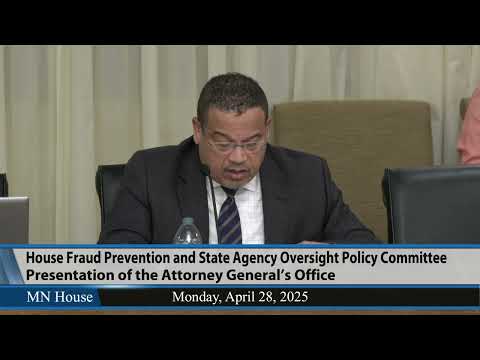
Attorney General Keith Ellison defends office role, describes Feeding Our Future response and charities oversight
Summary
Attorney General Keith Ellison told the Minnesota Legislature's Fraud Prevention and State Agency Oversight Committee at a May 1, 2025 hearing that the Office of the Attorney General represents over 100 state agencies, assists county prosecutors when requested, enforces consumer and charities laws, and cooperated with federal prosecutors in the Feeding Our Future prosecutions.
Attorney General Keith Ellison told the Minnesota Legislature's Fraud Prevention and State Agency Oversight Committee at a May 1, 2025 hearing that the Office of the Attorney General (AGO) represents more than 100 state agencies, assists county prosecutors when requested, enforces consumer, antitrust and charities laws, and cooperates with federal prosecutors on large fraud matters.
Ellison said his office defended the Minnesota Department of Education (MDE) in litigation tied to the Feeding Our Future case and later assisted federal investigators after search warrants and indictments followed. "In Minnesota, the Attorney General is not the chief law enforcement officer. In our model of state government, the Minnesota Attorney General is the state's chief legal officer," he told the committee. He also said of his contact with individuals who later were indicted in the Feeding Our Future case: "I did nothing for them and took nothing from them."
The AG emphasized why the office both defends agencies and pursues fraud: agency representation preserves state functions and protecting taxpayer dollars, while charities and fraud enforcement prevent diversion of funds. He described the AGO's charities division and the Medicaid Fraud Control Unit, citing staffing and financial figures the office provided.
Why it matters: the Feeding Our Future prosecutions involved federal indictments and convictions stemming from alleged fraud in USDA-funded school nutrition programs during the pandemic; the committee pressed the AG about whether his December 2021 meeting with community members who later were charged created any conflict or improper intervention on behalf of those attendees.
Ellison's overview and details Ellison summarized four core AGO functions: representing state agencies in litigation and administrative matters; assisting county attorneys in felony prosecutions when requested under state law (he cited "section 8.01" as the statutory referral authority); serving on several state boards; and enforcing consumer protection, antitrust and charities laws. He said roughly 40% of the AGO's approximately 430 employees are attorneys, and that the office represents 30 partner agencies that are billed and about 70 agencies represented without direct billing.
He gave specific program and financial figures the AGO provided to the committee: the current hourly billing rate for AGO attorneys is $163 and $103 for non-attorney staff; over the past six years the office says it has returned about $2.1 billion to the state and households through settlements, restitution and recoveries; the Medicaid Fraud Control Unit has spent about $5 million over five years and won roughly $53 million in restitutions and recoveries; the AGO reported having secured hundreds of millions for tobacco and opioid-related funds and other consumer recoveries.
Feeding Our Future, the December 2021 meeting, and cooperation with federal prosecutors Ellison described a December 11, 2021 meeting in which people who identified themselves as small-business operators from the East African community raised concerns about doing business with state agencies. He said he met with them in good faith, did not provide legal assistance or make promises, and rejected an apparent suggestion that they would contribute to his campaign. He told the committee that after the meeting his staff informed him of an active federal investigation; search warrants were executed in January 2022, and federal indictments followed later that year.
Ellison said the AGO's response was to cooperate with the FBI and U.S. Department of Justice when asked so as not to jeopardize the federal case. He told members the federal indictments grew from an initial 49 to about 70 and the office is aware of 45 convictions to date. He stressed that county attorneys have primary jurisdiction over felony prosecution in Minnesota and that the AGO's criminal roles are triggered by referral or assignment.
Charities enforcement and dissolutions Ellison and Carol (Kerry) Washington, manager of the AGO's charities division, described the office's civil authorities over charities and nonprofit fundraising. Washington told the committee the charities division has used civil enforcement tools (including assurances of discontinuance and court actions) and has involuntarily dissolved more than 30 fraudulent charities since 2019; she said some dissolved entities had been "inactive" on the Secretary of State rolls and that the AGO sought court-ordered dissolution to prevent future reactivation. She said dissolution actions are referred to the Secretary of State for formal deactivation.
Committee members pressed the AGO on how the office verifies that court-ordered dissolutions stop an entity's operations in practice, and how the office tracks transfers of assets required by settlement. Washington said compliance monitoring and investigative techniques are sensitive and vary by case, and the AGO treats compliance seriously but did not provide detailed investigative methods in the public hearing.
Data classification and transparency questions Lawmakers asked whether closed investigative data about organizations could be made public to aid oversight. Washington and Ellison said data classification depends on case circumstances and resolution; they stated that neither active nor inactive investigative data is publicly available under the AGO's interpretation of existing data-practices rules. Ellison declined to pre-commit to supporting legislative changes but said the office would respond to specific proposals.
Medicaid Fraud Control Unit and other enforcement work Ellison described Minnesota's Medicaid Fraud Control Unit as one of the federally funded units in the country and said federal grant conditions limit the unit to investigating provider fraud, abuse, neglect and financial exploitation in covered settings. He reported the federal grant covers about 75% of the unit's funding and reiterated the unit's results and dollar recoveries reported to the committee. The committee indicated it expects a future, separate briefing by the Medicaid Fraud Control Unit on operational details and lessons learned.
Questions from lawmakers and follow-ups Committee members repeatedly asked why Ellison met with the individuals who were later indicted and whether that contact signaled improper advocacy for grant recipients rather than protecting state agencies and taxpayer funds. Ellison replied that elected officials routinely meet constituents, that he had no knowledge at the time that meeting participants were fraudsters, that he asked staff to investigate after the meeting, and that his office ultimately cooperated with federal prosecutors. He reiterated: "I did nothing for them and took nothing from them." Several legislators sought follow-up records (including whether specific defendants had made campaign contributions and whether written follow-up from the meeting was received); Ellison and AGO staff agreed to check records and follow up with the committee.
Formal action taken The committee approved the minutes from its April 7 meeting at the start of the session. No other formal votes or motions were recorded during the hearing.
Ending The committee said it plans further oversight and invited the Medicaid Fraud Control Unit and AGO charities staff to return for more detailed briefings on investigations, monitoring and data practices. Lawmakers also indicated they may pursue legislative changes to data disclosure and grant pre-award screening.
Direct quotes (selected) "In Minnesota, the Attorney General is not the chief law enforcement officer. In our model of state government, the Minnesota Attorney General is the state's chief legal officer." — Attorney General Keith Ellison
"I did nothing for them and took nothing from them." — Attorney General Keith Ellison
"They've been issued the death penalty for charities." — Carol Washington, manager, AGO charities division
Sources and scope This article summarizes testimony and committee discussion during a public meeting of the Minnesota Legislature's Fraud Prevention and State Agency Oversight Committee at which Attorney General Keith Ellison presented an agency overview and answered questions about Feeding Our Future, the AGO's charities enforcement, and the Medicaid Fraud Control Unit. The committee recorded and discussed an audio recording and an unofficial transcript; in committee members' statements they referenced media reports, court orders, federal indictments and AGO press materials. The AGO provided staffing and financial figures reported above.