Get Full Government Meeting Transcripts, Videos, & Alerts Forever!
Get email alerts on the Labor Rights topic
No spam. Unsubscribe anytime.
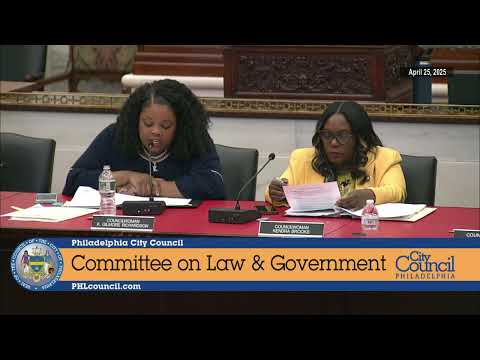
Committee approves amendments to Power Act, forwards bill 250,065 to full council
Summary
The Committee on Law and Government of Philadelphia City approved amendments to bill 250,065 and reported the bill to the full council with a favorable recommendation, voting to suspend the rules to permit first reading at the next council session.
The Committee on Law and Government of Philadelphia City approved amendments to bill 250,065 and reported the bill to the full council with a favorable recommendation, voting to suspend the rules to permit first reading at the next council session.
The committee chair, Gilmore Richardson, read a summary of amendments before members voted. Council member Brooks moved the amendment and Council member Phillips seconded; the committee approved the amendment and later approved reporting the bill as amended to council for first reading.
The changes summarized for the record modify several parts of the Power Act, including: shifting the burden of proof so a worker must show they did not receive required notice of rights before any extension of the statute of limitations; aligning the Power Act's statute of limitations with those used by the federal government and several large U.S. cities; and narrowing the definition of retaliation so an employer is liable only when a worker's protected activity was a factor in an adverse action. The summary also removes a requirement that an employer's adverse action be for "just cause," requires disclosure of a complainant's identity when necessary to give an employer a fair opportunity to respond, and removes employer intent to harass from the definition of adverse action.
The amendments adjust employer and complaint handling provisions for the city's Bad Actors Database: a company must now have three or more labor violations before placement on the database; the employer's location must be listed to avoid attributing violations to other franchise locations; and an employer may be removed from the database when there is a meaningful ownership change. The record also notes an enforcement-related allowance for the administration to extend employer timelines for producing records related to complaints.
Separately, the amendments create a small-employer carve-out and establish notice-and-cure periods for certain claims under the Domestic Workers Bill of Rights: a 15-day cure period is required before certain rights-of-action related to retaliation or willfulness can be brought (unless willful misconduct or retaliation is alleged), and a 30-day cure period is required for written-notice, contract-notification, damages, and record-keeping provisions tied to that bill of rights.
No detailed vote roll call was recorded in the transcript; committee members indicated approval by voice. After the votes, Chair Gilmore Richardson closed the meeting, noting there were no further questions or public commenters and concluding the committee's business.
Next steps: the committee reported bill 250,065 as amended to the full council for first reading at the next council session, per the committee's motion to suspend the rules.