Get Full Government Meeting Transcripts, Videos, & Alerts Forever!
Get email alerts on the Business Regulation topic
No spam. Unsubscribe anytime.
Philadelphia licenses committee holds hearing on tighter license suspensions and naming illegal tobacco sales a nuisance after residents testify about smoke‑sh0
Summary
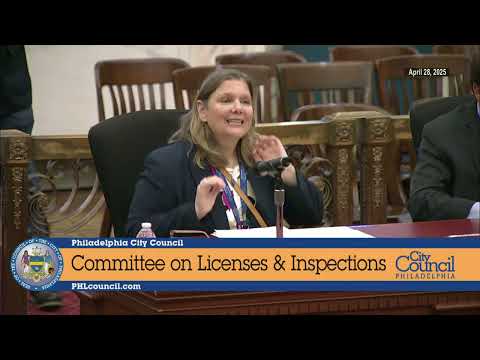
The Philadelphia City Council Committee on Licenses and Inspections convened a public hearing that focused on two ordinances: bill 250123, which would amend the health code to allow suspension of licenses or permits when a business's physical layout or operations significantly differ from approved plans, and bill 250151, which would add the illegal sale of tobacco products to the city's list of nuisance behaviors.
The Philadelphia City Council Committee on Licenses and Inspections convened a public hearing that focused on two ordinances: bill 250123, which would amend the health code to allow suspension of licenses or permits when a business's physical layout or operations significantly differ from approved plans, and bill 250151, which would add the illegal sale of tobacco products to the city's list of nuisance behaviors.
Dawn Kieswetter, director of Environmental Health Services for the Philadelphia Department of Public Health, testified in support of both bills on behalf of Commissioner Cheryl R. Nelson and described how the measures would change enforcement options available to the health department. "The proposed bill would allow the health department to declare a business that violates tobacco sales laws 3 times within a 12 month period, a chronic nuisance," Kieswetter said, adding that the department has been coordinating with the Law Department and the Department of Licenses and Inspections on a process to revoke licenses for repeat offenders through a notice-of-violation process.
Kieswetter told committee members the health department already issues Philadelphia Code violation notices to retailers who sell tobacco to minors and for sales of loose tobacco products and that retailers with three or more CVNs for tobacco sales to a minor are not eligible to renew their Philadelphia Tobacco Retailer Permit. On the changes to licensing tied to physical layouts, she said inspections focus on the parts of an establishment that affect food preparation and public health: "If you never fried food before... and you were to all of a sudden put in a fryer in your establishment, that would be a significant change. You would need to have an exhaust hood," Kieswetter said.
Why it matters: the bills would broaden enforcement tools available to city agencies. Bill 250123 would let the health department pursue suspension when a business's altered layout affects food safety or other health standards. Bill 250151 would allow the city to treat persistent illegal tobacco sales as a chronic nuisance, enabling stronger administrative penalties against repeat violators.
Residents and neighborhood business representatives used the hearing to describe the effects of nuisance businesses in commercial corridors. Thera Martin, representing the Allegheny West Foundation and the North 20th Street Business Quarter, described multiple smoke shops, three "stop-and-go" corner stores and a set-aside gaming hall on North 20th Street, and said those businesses draw loitering, public urination and what she described as youth access to tobacco and other illegal products. "We often witness youth under the age of 18 coming in and out of these smoke shops," Martin said, describing repeated incidents of public disorder and one shooting on the corridor in 2018.
Other witnesses from the Ogontz Avenue and East Oak Lane area echoed those concerns. Elliot Booker and Jamal Holmes, local business owners and community leaders, said stores opened in their blocks without visible zoning notice or neighborhood outreach and alleged sales of loose out-of-state cigarettes and drug paraphernalia. Whitney Blunden, listed in testimony as overseer of Restoration Ministries, submitted written remarks saying a new variety store at 5950 Ogontz Avenue opened without community notice and that neighbors had raised concerns about permits and construction activity.
Committee members asked clarifying questions about how the health department would determine a "significant" change to an approved plan and what enforcement steps would look like in practice. Kieswetter responded that determinations are context-dependent and focus on operations that affect food safety or sanitary conditions, giving examples such as introducing a fryer or beginning fresh food preparation where previously only prepackaged food was sold.
No votes or final actions were recorded on either bill during the hearing. Committee staff noted bill 250150 was being held at the sponsor's request and was not heard that day.
What comes next: the hearing provided testimony for the committee's consideration; the health department said it will work with partner agencies on implementation details if the ordinances advance. No formal vote or committee recommendation was announced at the hearing.