Get Full Government Meeting Transcripts, Videos, & Alerts Forever!
Get email alerts on the Permanent Housing Prevention topic
No spam. Unsubscribe anytime.
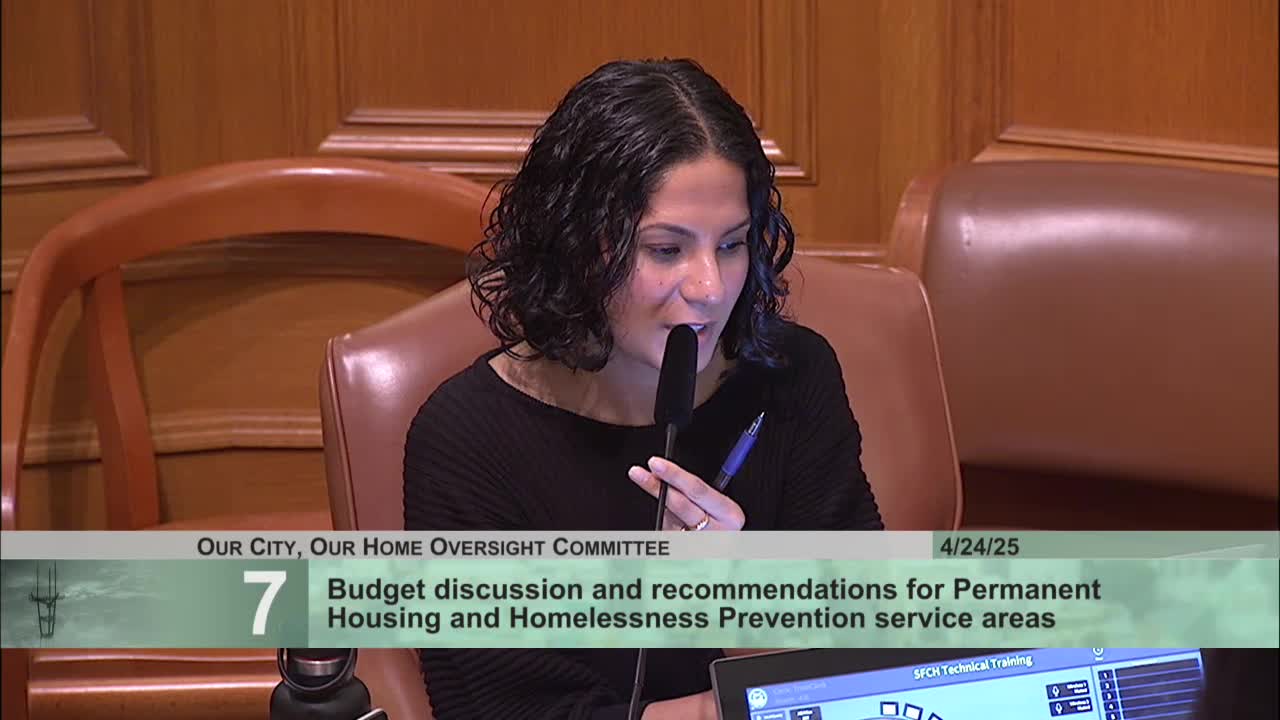
OCO committee endorses family and TAY rapid‑rehousing expansions, Bayview subsidy and prevention data request
Summary
The OCO Oversight Committee on April 24 recommended that the mayor and Board of Supervisors adopt HSH’s budgeted funding levels for permanent housing and prevention programs and approved targeted expansions: a $1 million Bayview subsidy and multi‑year rapid‑rehousing expansions for TAY and families funded from projected surplus dollars.
The Our City, Our Home Oversight Committee voted April 24 to forward a package of recommendations to the mayor and Board of Supervisors that would: keep HSH’s proposed funding levels for permanent housing and prevention programs; add a $1 million ongoing Bayview flexible subsidy; and leverage large one‑time surplus amounts to expand rapid rehousing subsidies for transitional age youth (TAY) and families.
Key elements of the recommendation package (as adopted): - Adult/general permanent housing: fully fund HSH’s recommended programs and add a $1,000,000 ongoing expansion of the Bayview flexible subsidy (Lehi/Bayview pool) to address needs among unhoused single adults in the Bayview/Hunters Point area. - TAY permanent housing: fully fund HSH’s TAY programs and leverage approximately $10,000,000 to $11,000,000 of projected surplus to expand rapid‑rehousing subsidies by roughly 50 youth for five years (committee discussion referenced an estimated spend of about $40,000 per youth per year in HSH planning numbers). - Family permanent housing: fully fund family permanent housing programs and leverage approximately $30,000,000 to $31,000,000 of projected surplus to expand rapid‑rehousing subsidies by approximately 125 families for five years (committee and provider testimony referenced a planning figure around $47,000 per family per year). - Homelessness prevention: fully fund prevention programs at proposed HSH levels and request departments provide outcome data beyond encounter counts so the committee can better assess program impact.
Committee rationale and testimony: Committee members emphasized a focus on families and TAY because PIT‑count data and local casework show rising homelessness among those groups. Member Shifrin said the family investments "were a priority" and described the harms children face when families cycle through cars and hotels. Larkin Street and HESPA representatives praised the 5‑year subsidy model for TAY, noting research and practice data suggesting multi‑year supports help young people transition to independence.
Multiple providers and people with lived experience urged the committee to approve the package. Speakers described the difference that longer subsidies make for children’s stability, school continuity and parents’ ability to pursue education and work; several providers reiterated per‑family and per‑youth cost estimates used by HSH staff during liaison discussions.
Vote and next steps: The committee voted to forward the package as a single set of recommendations. Member Walton moved the consolidated package and Member Haddix seconded. Roll call recorded a majority in favor; Vice Chair D'Antonio recused on some housing items due to earlier recusals, and Member Jackson and others were absent or recused where noted. The committee emphasized these are recommendations to the mayor and Board of Supervisors; HSH will determine contracting and program deployment if the mayor and supervisors adopt the recommendations.
Implementation caveats: Committee members noted specificity (per‑unit annual cost assumptions and multi‑year subsidy lengths) and suggested language that allows HSH flexibility if hotel/unit costs or contract conditions change. The prevention recommendation specifically asks departments to provide more outcome measures so the committee can monitor program effectiveness beyond encounter counts.