Get Full Government Meeting Transcripts, Videos, & Alerts Forever!
Get email alerts on the State Budget Omnibus topic
No spam. Unsubscribe anytime.
Senate advances state and local government omnibus; panel approves additions for Secretary of State, grant oversight and capital-mall projects
Summary
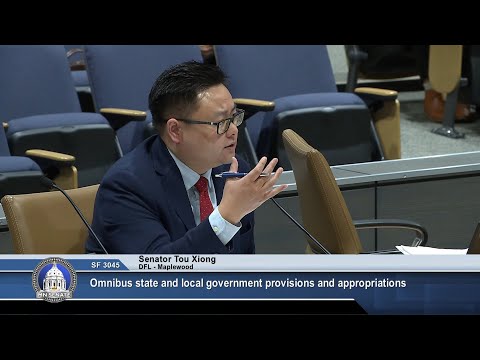
The Minnesota Senate Finance Committee on April 23 considered Senate File 3045, the state and local government omnibus budget, adopting amendments that increase operating funding for several agencies, reappropriate capital-area funds, and direct a short-term review of grant-administration practices.
The Minnesota Senate Finance Committee on April 23 considered Senate File 3045, the state and local government omnibus budget, approving a series of amendments that add operating funding for state agencies, reappropriate capital-area funds and direct work on grant-administration policy.
Committee fiscal staff presented a detailed spreadsheet showing agency-by-agency changes. Nonpartisan fiscal analyst Mr. Erickson described a range of items in the bill: operating adjustments to the legislature, the attorney general’s office and many boards and councils; an appropriation for the secretary of state; grant changes at the Department of Administration; and several smaller increases for cultural and advisory councils.
Senator Sean (bill sponsor) and staff explained that the bill “focuses on maintaining stability across state operations, modernizing our core systems and strengthening public oversight.” Committee members debated several late-filed amendments that affected appropriations and statutory language.
Amendment A-38 increased the secretary of state’s operating budget by about $1.22 million and corrected technical revenue language. Senator Friends moved the A-38 amendment; the committee adopted it after debate. Secretary of State Steve Simon later thanked the committee for the operating adjustment, noting his office remains a net contributor to the general fund and that increased operational pressure comes from higher volume of filings and rising postage costs: “business filings are up 25% in the last few years,” Simon said, and “postage is up 23% in the last few years.” He also highlighted program needs such as the address‑confidentiality Safe at Home program.
The committee considered several other amendments of note:
- A-30 repealed language (Subdivision 14 of Minnesota Statutes section 16B.98) that automatically allows agencies to retain a statutory share (commonly cited as up to 5% or 10%) of certain grant appropriations for administration; supporters said repealing the default gives legislators and chairs discretion to set administration allowances case-by-case. The committee adopted the repeal.
- A-32 canceled an unspent $5 million balance in a capital-area community vitality account and reappropriated those funds for capital-mall improvements and community vitality grants; the amendment specified $3 million to Ramsey County for sheriff-public-safety/community programming and $2 million to the Saint Paul Foundation for community grants, and was adopted.
- A-36 created a short-term working group (with a small appropriation) to develop best-practice recommendations for how the legislature should decide when to use direct appropriations, competitive grants, or procurement contracts; the amendment was requested in part by the Minnesota Council of Nonprofits and was adopted.
- A-37 removed a statutory minimum-parking requirement for the Capitol area, giving local authorities more flexibility on parking design; the committee adopted the amendment.
Committee witnesses included Deputy Commissioner Bridal Rayton of Minnesota Management and Budget (MMB), MNIT Commissioner Derek Tombs, Department of Administration Commissioner Tamar Grumbaugh, and Secretary of State Steve Simon. Testimony highlighted operational cost pressures such as increasing health‑care contributions, FICA/Medicare, IT and utility costs, and the need for grant-administration resources.
Members also debated funding increases for several ethnic and cultural councils (African Heritage, Latino Affairs, Council for Asian Pacific Minnesotans, LGBTQIA2S+ Council), with one amendment proposed by Senator Pratt to equalize increases across councils failing on a recorded voice vote.
Later in the day the committee voted to insert the contents of the elections omnibus (Senate File 3096, previously laid on the table) into the state and local government omnibus. The clerk recorded 6 ayes and 4 nays on that motion and it prevailed. The committee then recommended passage of the omnibus, as amended, and instructed staff to make technical and conforming changes.
The omnibus bill contains a broad mix of operating adjustments, one‑time appropriations and policy changes affecting numerous state agencies, and includes targeted items such as a $250,000 grant for the Minnesota Orchestra and a $220,000 grant for the History Theater. Members repeatedly questioned whether larger structural decisions — hiring, long-term service levels and local government fiscal impacts — were being addressed at the same time the bill added agency operating adjustments.