Get Full Government Meeting Transcripts, Videos, & Alerts Forever!
Get email alerts on the Water Conservation topic
No spam. Unsubscribe anytime.
Boerne expands water-rebate program, outlines drought rules and capital upgrades as summer approaches
Summary
City of Boerne officials reported expanded water-rebate offerings, summer education workshops and ongoing drought planning, and said carbon filtration and a nutrient-removal pilot remain in the capital plan as the city prepares for peak seasonal demand.
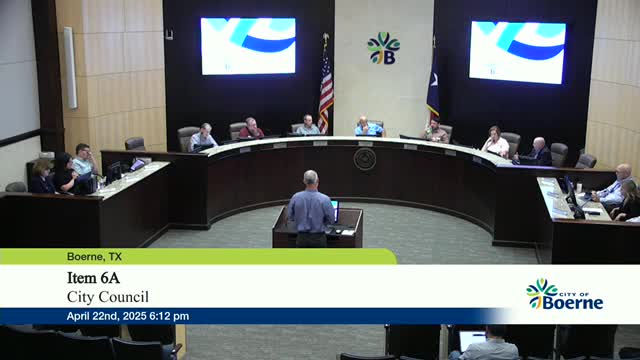
City of Boerne officials on the council’s regular meeting provided updates on their water-conservation rebate program, upcoming workshops, drought-stage restrictions and longer-term treatment projects as the community heads into the summer peak season.
Ryan Bass, who presented the update for utilities, said Boerne issued more than 72 approved rebates in the past year totaling $2,600 as administered through the city’s online intake and Smartsheet system; the most popular rebate has been irrigation-system consultations performed by state-licensed irrigators. Bass said those consultations commonly find low-pressure zones, damaged or buried sprinkler heads and other issues that, when corrected, improve system efficiency.
The city will expand the rebate program this year to include a turf-grama reduction rebate: a $150 payment to property owners who permanently remove at least 200 square feet of irrigated turf and replace it with native, drought-tolerant plantings or xeriscape; any irrigation components within that area must be permanently taken offline and capped. Applications will require an upfront narrative and site photos for eligibility review and follow-up photographic documentation upon completion.
Staff described two water-related workshops planned for the summer: a Texas Watershed Steward workshop focused on turf management and surface-water quality, and a Texas Well Owner Network event that will allow well owners to drop off water samples for on-site analysis and results at the workshop. Those events will be hosted at the library in partnership with the Cal Creek Groundwater Conservation District and Texas A&M AgriLife Extension.
City staff also reviewed the relationship between the city’s year-round conservation policy and drought-stage restrictions required by the Texas Commission on Environmental Quality (TCEQ). The city’s year-round policy already discourages midday watering by permitting irrigation only in evening and early-morning hours; drought-stage restrictions are designed to reduce peak-day demand, which staff said drives operational limits more than annual consumption. Staff said Stage 1 restrictions limit irrigation to one designated weekday per week when in effect.
Utilities staff presented data showing the city uses far less than its total permitted annual withdrawal in a typical year but can exceed production capacity on peak days in hot weather, which is why restrictions target peak demand. Staff also discussed water-supply management: the city purchases surface-water base flow from the Guadalupe-Blanco River Authority (GBRA), uses city wells and Boerne City Lake for peaking, and operates reclaimed-water infrastructure in limited areas.
On treatment and capital projects, staff said carbon filtration remains in the Capital Improvements Program. The project had previously been estimated in preliminary documents at roughly $400,000–$500,000; staff said current expectations are higher and offered a ballpark of $1.5 million to $2 million as the program’s design and affordability work continues. Staff also discussed a pilot treatment approach combining ozone and biological nutrient removal; reverse osmosis (RO) at municipal scale was described as cost-prohibitive in the tens of millions of dollars and operationally complex because of brine disposal requirements.
Officials said the city will continue public education and enforcement steps (complaint handling and notices) when restrictions are in place. Council members pressed for continued outreach and noted interest in additional conservation measures such as HVAC condensate recapture and targeted rebates for narrow turf strips between curb and sidewalk; staff said they will study those ideas further.
No formal council action on drought restrictions or treatment projects occurred at the meeting; staff confirmed those items remain under review and that any restrictions would be the subject of future staff recommendation and council action if warranted.