Get Full Government Meeting Transcripts, Videos, & Alerts Forever!
Get email alerts on the Employment Contracts Limitations topic
No spam. Unsubscribe anytime.
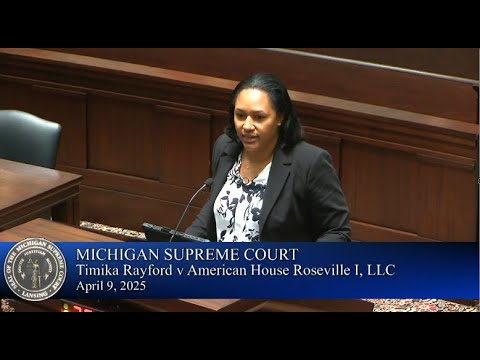
Michigan Supreme Court hears challenge to six‑month contractual limitations in employment case Raiford v. American House
Summary
The Michigan Supreme Court heard oral argument in Tamika Raiford v. American House Roseville LLC over whether employers may enforce contract terms that shorten the time an employee has to sue, with petitioner’s counsel urging protection for employees facing adhesion‑style agreements and appellee’s counsel urging enforcement under long‑standing precedent.
The Michigan Supreme Court heard oral argument in Tamika Raiford v. American House Roseville LLC over whether employers may enforce contract provisions that shorten the time employees have to bring employment discrimination and related claims.
Carla Eakins, counsel for petitioner Tamika Raiford, told the court that employment contracts and post‑hire boilerplate create ‘‘traps’’ that prevent employees from exercising their right to a jury trial and to pursue discrimination claims, particularly because many workers do not realize they must act quickly. Eakins argued the Court should either carve out employment from controlling precedent or adopt a reasonableness rule that protects employees from adhesion terms. "Most people . . . don't understand what do you mean they can do this and what do you mean they can do that?" she said, arguing employees often learn about limitations only after they have missed them.
Daniel Waslowski, counsel for appellee American House Roseville, replied that the dispute is procedural and that Michigan precedent requires enforcement of unambiguous contractual provisions unless they violate law or public policy. Waslowski told the justices there is no arbitration clause in the record and the case concerns only a contract that shapes the procedural timing for bringing claims, not a waiver of substantive rights. He emphasized stare decisis—citing Rory and Clark—and warned that a reasonableness inquiry would supplant legislative policy and redraw broad areas of contract law. "There is nothing in the Michigan Constitution, nothing that suggests that limiting the contractual limitations period for a statutorily created cause of action . . . violates Michigan public policy," he said.
The attorneys debated how, or whether, courts should treat employment contracts differently from other consumer or insurance contexts. Eakins urged special scrutiny in employment because employees often sign boilerplate terms after beginning work, e‑signature stacks are routine, HR coordinates with legal counsel, and hourly workers lack access to counsel. She proposed that contractual limitations periods should not be permitted to contract employees out of statutory protections in adhesion situations and argued that the default three‑year period many rely on should not be reduced by private employers.
Waslowski countered that adopting a reasonableness test or a categorical rule for employment would invalidate many contracts and create uncertainty. He said traditional contract defenses—duress or unconscionability—remain available when appropriate but that unequal bargaining power alone does not render a contract unenforceable. He also argued that even under a reasonableness standard, the facts of this case would leave Raiford's claims time barred: appellee noted the employee filed two years and nine months after the adverse action and that a six‑month contractual period would therefore bar the suit.
The justices asked whether reasonableness inquiries would devolve into fact‑intensive litigation and whether a bright line (for example, the default statutory ceiling) should be treated as a floor in the employment context. Counsel discussed federal decisions—such as the Sixth Circuit’s Logan decision limiting the enforceability of shortened limitations in Title VII/ADA matters because of EEOC exhaustion rules—but appellee noted federal schemes with mandatory administrative exhaustion differ from Michigan law.
Both sides cited a string of state precedents (Rory, Clark, Camelot, Timco, McMillan) and court rules (MCR 2.508) in arguing either to preserve the existing rule favoring enforcement or to permit courts to apply reasonableness in employment cases. Eakins warned that summary judgment practice has increasingly disposed of employment claims early; Waslowski responded that the court should not replace legislative policy with judicial reasonableness standards.
The argument ended with rebuttal time reserved by petitioner and final remarks from counsel. The Court took the case under advisement; no decision was announced at argument.