Get Full Government Meeting Transcripts, Videos, & Alerts Forever!
Get email alerts on the Land Use Development topic
No spam. Unsubscribe anytime.
San Ramon council continues hearing on Bishop Ranch FAR change after debate over affordable housing plan
Summary
City Council held a lengthy public hearing on a proposed reduction to the Downtown Mixed Use (DMU) North minimum site-wide floor-area-ratio (FAR) that Sunset Development says would enable a larger standalone affordable-housing project; council accepted public testimony and continued the hearing to April 22 for more information.
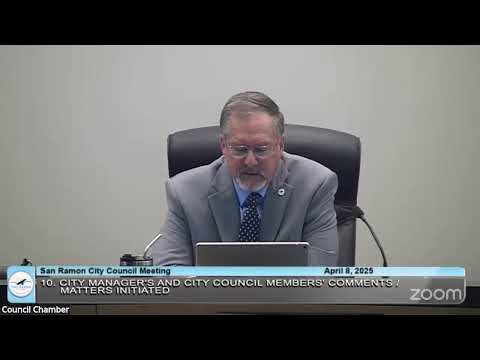
San Ramon City Council on April 8 heard a detailed staff report and applicant presentation on a proposed amendment to the city General Plan and zoning rules that would reduce the DMU North minimum sitewide floor-area-ratio (FAR) from 1.25 to 0.5, then voted to continue the public hearing to April 22 for additional information and responses to council questions.
Planning Services Division Manager Lauren Barr told council the request would not change the city's housing-element certification and that FAR is a form-and-massing standard, not a density standard. "This particular reduction in FAR ... would not result in any additional impacts beyond those already analyzed in the EIR," Barr said. She described the history: the 1.25 FAR was set after a general-plan ad hoc process in 2022 and reiterated that the change is meant to give developers flexibility under varying market conditions.
Applicant Stephanie Hill, representing Sunset Development, said the FAR and the dwelling-units-per-acre ranges do not align for 100% residential projects in DMU North and that the mismatch has forced developers to rely on the state density-bonus process for approvals. Hill said Sunset's plan would enable an alternate affordable-housing approach that consolidates affordable units into standalone rental buildings operated by experienced affordable-housing providers. "We are proposing 2 to 3 story residential communities transitioning to 5 to 7 story elevator-serve residential communities," Hill said, and she described a proposal to shift some affordable units that would otherwise be scattered across multiple market projects into a dedicated affordable development operated by an agency such as Eden Housing.
During public comment, residents raised a range of concerns. Robert Klingner, a local resident, questioned whether new housing would be matched by jobs and services and said parking and neighborhood impacts needed more study. Jim Blickenstaff, a longtime resident, urged attention to parks and setbacks if density changes are adopted. Shirod Kathrani asked for transparency about who benefits financially from any zoning changes and urged that inclusionary housing remain a priority.
Councilmembers pressed staff and the applicant on several points: whether single-story, ownership homes for older residents could still be delivered under the proposed standards; how on-site versus off-site affordable-unit approaches affect the quantity and timing of affordable homes; and whether the reduced FAR might depress retail or commercial redevelopment. Staff and the applicant said a lower minimum FAR is intended to permit a wider range of building types and could reduce costs and barriers to redevelopment, while the upper FAR remains unchanged so higher-intensity projects remain permitted.
Hill provided example figures during the discussion: two DMU North projects currently in review (BR7 and BR11) total roughly 400 units, and a 15% inclusionary requirement would produce roughly 55 affordable units on-site; the standalone affordable building Sunset proposed at 2453 Camino Ramon would include about 98 affordable units, and, if implemented with an increased inclusionary percentage on remaining sites, could raise the total quantity of affordable homes delivered in the area. Hill said the developer would seek to increase the affordable share from 15% to 20% for certain tradeoffs and emphasized that standalone rental affordable developments can access different public funding sources that can speed delivery.
After additional questions from council, Mayor Armstrong called for a motion to continue the public hearing to April 22 to allow staff and the applicant to provide more detailed answers to council's technical and fiscal questions. The motion to continue the hearing to April 22, 2025 passed 5-0 (mover: Vice Mayor Burrows; second: Councilmember Rubio).
The public hearing will remain open and the council asked staff to return with follow-up analyses, including quantified comparisons between FAR options, clarification on how any off-site affordable-unit strategy would be implemented under the city's inclusionary housing rules, and details on timing and funding for the proposed standalone affordable project. The council explicitly declined to take final action at the April 8 meeting.
What happens next: staff and the applicant will prepare the material requested by council and return on April 22 for additional public testimony and a second hearing; council has not indicated a decision deadline beyond that continued hearing.