Get Full Government Meeting Transcripts, Videos, & Alerts Forever!
Get email alerts on the Maternal Health topic
No spam. Unsubscribe anytime.
City Council leaders press for $15.7M maternal health investment amid stark racial disparities
Summary
Council leaders and advocates at a City Hall event during Black Maternal Health Week urged state and city action to address maternal mortality in New York City, citing 50–60 pregnancy-related deaths a year and a sixfold higher risk for Black New Yorkers.
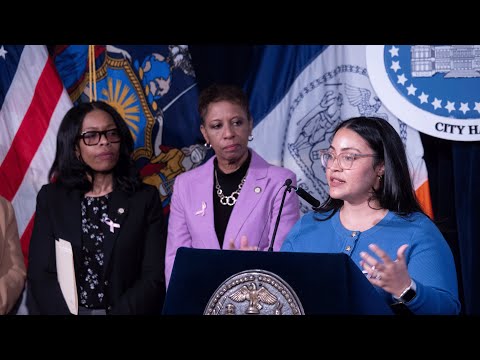
Deputy Speaker Diana Ayala and Speaker Adrienne Adams joined council members, midwives and advocates at City Hall during Black Maternal Health Week to push state and city budget actions aimed at reducing maternal mortality and addressing racial disparities in pregnancy outcomes.
The event highlighted that New York City records about 50 to 60 pregnancy-related deaths each year and that Black New Yorkers are about six times more likely than white New Yorkers to die of pregnancy-related causes. "Every loss of a life represents a family and a community torn apart from needless and preventable tragedy," Speaker Adrienne Adams said, asking the room to observe a moment of silence for recent maternal deaths.
The council's maternal health steering committee, convened by Speaker Adams six months earlier, is advancing specific state and city policy priorities. Those state-level proposals cited at the event include full reimbursement of telehealth services for community health centers, annual increases to temporary disability insurance benefits to match paid family leave, and automatic Medicaid authorization for at-home blood pressure monitors for pregnant people without a prescription. "This is being considered by many states to empower pregnant people to monitor their blood pressure at home," Adams said.
Locally, council members called for targeted investments in the city budget. Council Member Jennifer Gutierrez said the council is seeking a baseline investment of $15,700,000 to restore previously cut funding and expand services, including a demand to restore $12,300,000 in cuts and a separate $5,000,000 request for New York City Health + Hospitals to place at least one maternal-health-focused psychologist in every maternity department. "We need sustained targeted investment to truly move the needle," Gutierrez said.
Speakers and public-health experts at the event emphasized mental health and continuity of care as central concerns. Patricia Lofman, a midwife and member of the New York City Department of Health and Mental Hygiene (DOHMH) maternal mortality review committee, said that after reviewing more than 250 cases the committee found racism is a primary driver of disparities and that the leading causes of pregnancy-associated death are cardiovascular conditions followed by mental health conditions. "Over 90 percent of pregnancy-associated deaths due to mental health conditions were considered preventable," Lofman said, citing overdose and suicide as major contributors.
Lofman also identified clinical skill and quality of care, and lack of continuity and care coordination as frequent contributing factors. She urged a sustained, coordinated response across hospitals, local government and the state, saying that addressing systemic racism requires redistribution of resources and institutional changes.
Council leaders credited recent local laws and pilot programs while stressing that laws alone are not sufficient. Gutierrez noted the passage of the Newborn Navigator Act and a citywide mental-health awareness campaign for new and expecting parents, but said funding and implementation must follow. The council also pointed to expanded doula services and other investments as positive steps.
Organizers said the steering committee will continue stakeholder engagement with advocates, providers and elected officials and will press for the listed budget and policy changes. The council has submitted legislative proposals to state lawmakers and said it will keep maternal health a priority in the upcoming city budget process.
Community advocates and the speakers framed the effort as urgent and long-term: "It won't happen overnight, but we must continue making progress and ensure that our mothers are safe," Deputy Speaker Diana Ayala said.
The event concluded with the steering committee's commitment to ongoing work; no formal vote or council action was taken at the event itself.