Get Full Government Meeting Transcripts, Videos, & Alerts Forever!
Get email alerts on the Wildfire Mitigation And Utility Liability topic
No spam. Unsubscribe anytime.
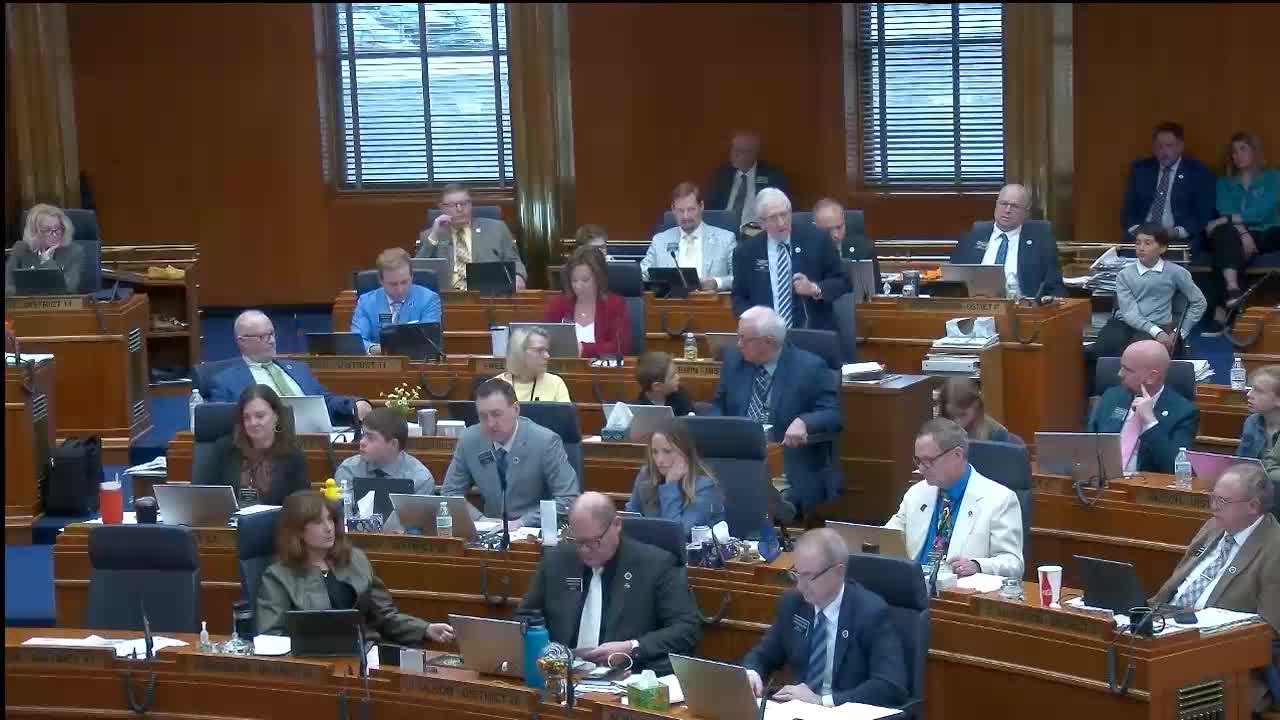
House passes wildfire mitigation and utility-liability bill after reconsideration
Summary
After a successful motion to reconsider, the House passed Senate Bill 23 39, which creates a framework for utility wildfire mitigation plans and limits strict liability for qualified utilities that file and comply with plans; final House vote was 62-28.
The North Dakota House reconsidered and then passed Senate Bill 23 39, a measure creating a statutory framework for wildfire mitigation plans for qualified utilities and limiting courts' use of strict liability in wildfire-related suits. The House recorded a final vote of 62 yea and 28 nay to declare the bill passed.
The measure establishes that preparation, publication and compliance with a qualified utility's wildfire mitigation plan yields a rebuttable presumption that the utility exercised a reasonable standard of care. Representative Kameen summarized the presumption on the floor: "the preparation and publishing of and compliance with the qualified utilities wildfire mitigation plan constitutes a rebuttable presumption that the qualified utility exercise a reasonable standard of care." Proponents said the bill codifies existing court precedent and incentivizes utilities to file mitigation plans meeting national safety standards (for example, the National Electrical Safety Code and industry vegetation-management standards), while opponents said the measure could shift the burden onto wildfire victims and does not make plan filing mandatory.
Supporters, including Representative Doctor and Representative Porter, said codification would provide regulatory stability for utilities and encourage proactive mitigation. Representative Jay Olson said recent fires demonstrated the danger: "Last fall, over 100,000 acres burned," and argued the bill gives tools to act before disasters strike. Representative Clement and others explained the bill's legal rationale, saying it moves courts away from strict liability (a standard that finds liability without proving negligence) toward negligence-based filings in wildfire cases.
Opponents raised concerns that the bill does not require utilities to file mitigation plans to receive protections and that the measure could make it harder for property owners to recover damages. Representative m Ruby (D. Ruby in transcript) and others urged caution and requested votes in recorded roll-call form; proponents responded that a utility that does not file a compliant plan would not receive the rebuttable presumption and would remain fully subject to negligence-based claims.
Procedural history: the measure was advanced from committee with recommended amendments; the House first voted to reconsider a prior failure and then took final consideration. A conference committee record and committee votes were discussed on the floor (committee vote 9 yeas, 3 nays according to the Energy and Natural Resources Committee report). On final consideration the clerk recorded 62 yea and 28 nay; the bill was declared passed by the House.