Get Full Government Meeting Transcripts, Videos, & Alerts Forever!
Get email alerts on the Public Works topic
No spam. Unsubscribe anytime.
Hartford Public Works requests modest FY26 increases to sustain sidewalk repairs, stormwater work and sign replacements
Summary
Director Christopher Hayes told the council the Department of Public Works’ FY26 request is largely flat but includes targeted increases for MS4 stormwater compliance, equipment services and continued sidewalk repairs after a sharp uptick in panels replaced during FY25.
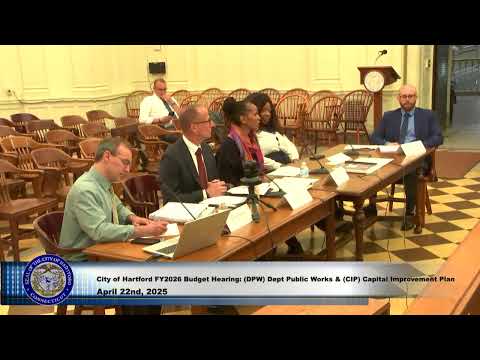
Director Christopher Hayes told the Operations Management Budget and Government Accountability Committee that the Department of Public Works (DPW) is maintaining its 234-person staff level and seeking modest, targeted funding increases in fiscal 2026 to sustain ongoing programs.
Hayes said the department has expanded in‑house training and career tracks, including internal CDL certification and promotions for six employees who completed the program. He described the department as “not only the third largest department in the city, but we're one of the legs of the first responder stool,” and stressed DPW’s role alongside police and fire.
Why it matters: DPW manages sidewalks, street signs, pavement, stormwater compliance and the city’s forestry program. Council members pressed on whether the city or private property owners are responsible for repairing residential sidewalks, how much of the sidewalk backlog the budget will address, and how the department will meet new stormwater (MS4) obligations.
Budget details and sidewalk backlog DPW reported repairing 925 sidewalk panels in the first six months of FY25, compared with 405 in a similar period in FY24, a 28% increase in panels repaired. Hayes said the department currently has more than 1,000 outstanding residential sidewalk repair requests and estimates roughly $10 million in needed work. DPW is conducting a citywide sidewalk assessment under a grant to identify the worst locations and said it will prioritize the most dangerous panels and the oldest requests as funds allow.
Hayes said the recommended FY26 operating adjustments include roughly $630,657 in net increases largely tied to salary adjustments and an equipment/facilities allocation. Specifically, he identified roughly $500,000 added to the sundries budget to help comply with MS4 obligations and U.S. Army Corps of Engineers flood‑control requirements, and about $200,000 for equipment services to offset rising parts and repair costs.
On the question of whether the city intends to revert to property‑owner assessments or liens for residential sidewalks, Hayes said the practice has changed: “My understanding is it's been determined that the city cannot do that and that the city is obligated to repair when possible.” Councilman Gail raised the historical use of sidewalk liens; Hayes and others described current practice as city‑led repairs, with longer‑term funding to be considered as general fiscal health improves.
Street signs, reflectivity and inventories DPW reported 400 signs are in production and already being installed, with broader work ongoing to replace more than 2,000 signs citywide because of updated reflectivity standards. Hayes said a $40,000 allocation handled the initial 400 installations and additional CIP funds of $100,000 were added to support the first round. He agreed to provide council members with a written breakdown of how far existing appropriations go and how many additional signs remain to be purchased and installed.
Stormwater (MS4) compliance and MOU with MDC Hayes described an MOU reached with the Metropolitan District Commission (MDC) and said the city must scale its MS4 stormwater testing and catch‑basin maintenance. He characterized MS4 as the EPA stormwater quality permit administered through the Connecticut Department of Energy and Environmental Protection (DEEP) and said funds in FY26 will support interdepartmental work to meet permit and water‑quality testing requirements.
Forestry: prune-first policy Under Forestry Director Sophia Rodbell, Hayes said the division is shifting from a “remove first” to a “prune first” approach. He reported pruning of 717 trees and removal of 151 trees so far in FY25, compared with 570 removals and 359 prunings in FY24. The department emphasized pruning and targeted removals to preserve canopy where possible.
Contractors and field inspections DPW described expansion of its engineering inspection division with two road inspector technician positions added in FY25. Hayes said the department will deploy three permit inspectors to hold contractors accountable for road cuts and repairs and will use an AI camera system (Violytics) to detect potholes and damaged signs for automated reporting.
Homeless encampments and blight remediation Hayes said DPW’s blight remediation team performs cleanups after outreach and relocation by HHS and public‑safety partners; the team also maintains roughly 240 city‑owned properties. He told the council blight teams and park crews are increasingly tasked with encampment cleanups, which affects routine park maintenance workloads.
What’s next Council members requested follow‑up detail on sidewalk inventory and funding, street‑sign spending, and the MS4‑related work. Hayes said the department will provide written responses and lists of VET‑purchased equipment and planned sign replacements.
Ending note: The DPW presentation closed with councilmembers pressing for more detail on priorities and a pledge from DPW to supply the requested breakdowns for oversight and scheduling.