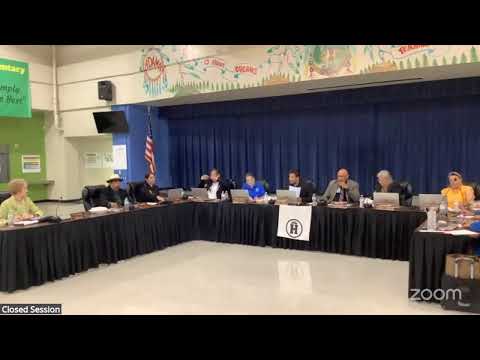
Harlandale ISD trustees hear mixed STAR results; district plans new curriculum and coaching after math declines
Loading...
Summary
Harlandale Independent School District officials on Tuesday told the board of trustees that spring benchmark results showed gains in several tested subjects but a notable decline in mathematics, and they outlined steps the district will take including stronger instructional coaching, a k–8 math curriculum planning grant and a phased rollout of a new reading curriculum.
Harlandale Independent School District officials on Tuesday told the board of trustees that spring benchmark results showed gains in several tested subjects but a notable decline in mathematics, and they outlined steps the district will take including stronger instructional coaching, a k–8 math curriculum planning grant and a phased rollout of a new reading curriculum.
District staff led a data presentation on student outcomes, saying science, biology, social studies and parts of English language arts showed measurable increases on district STAR benchmarks. Justin Postles, the district’s secondary English language arts coordinator presenting mathematics data, told trustees that “the meets performance decreased by 5.7%” districtwide in middle‑school math when comparing STAAR 2024 to the 2025 district benchmark; high‑school Algebra I meets performance fell by 10.9 percentage points across the district.
Why it matters: board members said math performance is a major concern because it affects state accountability, long‑term college and career readiness and the district’s ability to attract and retain students. District leaders described targeted interventions — including daily pacing guides, progress tracking with high‑reliability assessments, teacher coaching and a district‑level plan to adopt a new k–8 math curriculum through a planning grant — as the next actions.
What the board heard - Science and biology: Matthew Simons, the district’s secondary coordinator for science, reported districtwide gains in eighth‑grade science and high‑school biology meets levels, and singled out specific campuses with strong growth (for example, Frank Tejeda and Leal showed substantial gains in several measures). Simons attributed gains to professional development on the new TEKS, incorporation of new item types and instructional coaching focused on “productive struggle.” - Social studies: Rubina Pantoja and other secondary leaders reported modest districtwide increases in U.S. History and eighth‑grade social studies meets scores, with variation across campuses; some campuses posted double‑digit growth and others declined. - English/ELAR: Secondary ELAR officials reported small district gains in meets and increased emerging‑bilingual growth at the meets level. The district invested roughly $47,000 in an ELAR supplement to support writing instruction and used AI scoring tools and a pilot of an AI platform for students, with data‑privacy protections, to speed teacher feedback on extended constructed responses. - Mathematics: Postles said decreases were largest in middle‑school math and Algebra I, with emergent bilingual and special‑education subgroups also showing declines in meets percentages. He said Early College High School and one other campus showed gains amid the broader downward trend.
District response and plans District leaders said they are pursuing multiple responses: expanding instructional coaching that prioritizes “productive struggle” (less teacher‑led scaffolding and more student sense‑making), implementing daily pacing guides, and using high‑reliability interim assessments aligned to STAR. The district will participate in a planning grant (referred to during the meeting as the LASSO planning grant) to select and prepare for adoption of a k–8 math curriculum; the planning year will precede implementation.
Dr. Chris Galloway, from Texas Strategic Leadership (TSL), and curriculum leaders presented a landscape analysis of classroom instruction and materials. TSL’s classroom walkthroughs found that many classrooms used supplemental materials outside the district core and that research‑based instructional strategies and universal design practices were unevenly implemented across grade levels.
On curriculum materials, the district said it will move toward adopting the Bluebonnet reading curriculum next year and that tier‑1 instruction will need to align to the adopted curriculum. Miss Casey (assistant superintendent for curriculum and instruction) told trustees that when Bluebonnet is adopted, principals were instructed that tier‑1 instruction should use the Bluebonnet materials and that other supplemental materials previously used for core instruction are being collected and restricted from tier‑1 use.
Walkthrough findings and classroom practice TSL and district staff reported results from 5‑minute classroom walkthroughs across four campuses (Adams, Leal, Harlandale Middle and Harlandale High). Key findings presented by Miss Casey and Dr. Galloway included: - Students generally were on task in most classrooms observed; observers noted a positive classroom climate and regular encouragement from teachers. - Use of universal design for learning (UDL) and content‑based language supports was low at the secondary level and higher at elementary: observers recorded UDL components in 18% of RLA classrooms districtwide and in 13% of math classrooms; at the elementary level UDL appeared in roughly one‑third of RLA classrooms and 25% of math classrooms. - In elementary classrooms observers saw content‑based language supports in about 58% of RLA classrooms and 54% of math classrooms; RB (research‑based) instructional strategies were observed in 27% of elementary reading classrooms and 71% of elementary math classrooms. At the secondary level, RBs and UDL were substantially lower (single‑digit percentages in many categories).
TSL emphasized that a consistent curriculum with aligned training and walkthrough feedback can reduce teachers’ need to seek supplemental materials and help raise grade‑level rigor and collaborative student discourse.
Board reaction and next steps Board members repeatedly asked for campus‑level differentiation in supports. Trustee Cavazos asked why campuses differed and whether there were common resource needs; district leaders emphasized that strong campus leadership (principals) is a key driver of improved classroom practice.
Officials said they will return with progress updates after the curriculum planning phase and after additional walkthrough cycles. The district also asked the board to continue monitoring student progress publicly at meetings to maintain accountability.
At the meeting’s close, presenters thanked campuses for testing preparations; board members wished students luck on upcoming state assessments.
Sources: Presentation and Q&A during the Harlandale ISD Board of Trustees meeting (April 22, 2025) with Justin Postles, Matthew Simons, Miss Casey, Dr. Chris Galloway and Mr. Littlefield.