Get Full Government Meeting Transcripts, Videos, & Alerts Forever!
Get email alerts on the Emergency Services Budget topic
No spam. Unsubscribe anytime.
Cochise County supervisors review emergency services budget amid federal grant uncertainty
Summary
The Cochise County emergency management office presented a $465,394 FY‑26 budget proposal and warned that cuts or manual reviews of federal grants could shift hundreds of thousands of dollars onto the county general fund and put staffing at risk.
Cochise County emergency manager Dan DeShawn told the Board of Supervisors at a work session that the proposed FY 2026 emergency management budget totals $465,394 and is increasingly dependent on federal grants that may be cut or placed under manual review.
DeShawn said the county currently expects a partial reduction in the Emergency Management Performance Grant (EMPG) that historically has required a 50 percent local match. "These funds are to be used to build capacity, not necessarily maintain that capacity," DeShawn said, adding that the county is planning for a possible change that could shift the match rate toward roughly 42 percent or reduce the award further.
The issue matters because the county currently funds two emergency management positions that are approximately split between grant reimbursement and county general fund dollars. If the EMPG is reduced or eliminated, supervisors were told, the general fund would be asked to cover more of recurring personnel and operating costs — a change staff and supervisors said could add roughly six figures to the county’s general‑fund burden, depending on final award amounts and accounting of reimbursements.
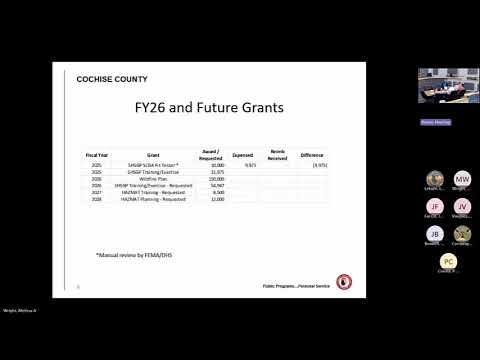
DeShawn summarized the office’s grant picture: a one‑time $150,000 award for a Community Wildfire Protection Plan (CWPP) (a contractor/GIS scope with a 90/10 grant/general‑fund split), a recurring training and exercise grant (listed at $21,975), and other planning and hazmat grants requested for later years. He said several federal and state grants the county applies for are currently "under manual review by FEMA and DHS," and that the county would not know final EMPG award amounts until May or June in a normal year — but that "I don't think this is a normal year," given broader federal funding uncertainty.
Supervisors and staff spent several minutes clarifying how the budget is presented. DeShawn said the FY‑26 proposed total expense for emergency management is $465,394 and that the general‑fund component of that request was shown as about $293,000 on the department handout. In discussion, staff and supervisors debated reimbursement timing and the net effect on the general fund if EMPG funding decreased or vanished; during the exchange DeShawn said that, "if the grant went away, the general fund would be requested to kick in $1.16" (referring to $116,000), and later the group calculated a possible net impact of about $147,000, reflecting different ways of subtracting expected reimbursements. The figures were discussed as estimates during the session rather than final totals.
DeShawn described work the office conducts to maintain readiness: multiple exercises per year ranging from tabletop drills to functional radio‑communications tests involving hospitals and dispatch centers, and active‑shooter training with outside instructors and role players. He said some larger past projects — for example, radio maintenance work completed in 2021 — were funded through multijurisdictional grant awards.
On staffing, DeShawn confirmed the office currently has two employees. He and supervisors discussed whether the positions are appropriately coded as grant‑funded or general‑fund employees; DeShawn said both positions are effectively split 50/50 between grant reimbursement and county funding and that if grant funding disappears the county would need to decide whether to fully absorb those costs.
No formal action or vote was taken during the work session. DeShawn said he would review records and could provide after‑action reports and files when available. Board members asked staff to continue monitoring federal grant decisions and to return with final award information when it is received.
The board closed the short work session after about 20–25 minutes of budget discussion and did not adopt changes to the FY‑26 proposal during the meeting.