Get Full Government Meeting Transcripts, Videos, & Alerts Forever!
Get email alerts on the Budget Override topic
No spam. Unsubscribe anytime.
Easton officials present $7.3 million override plan as non‑override school budget approved
Summary
Easton town and school officials told residents Thursday night that a sudden, multi‑million‑dollar jump in fixed costs — most notably health insurance — created a budget shortfall the town cannot close without either a large use of reserves or voter approval of an override.
Easton town and school officials told residents Thursday night that a sudden, multi‑million‑dollar jump in fixed costs — most notably health insurance — created a budget shortfall the town cannot close without either a large use of reserves or voter approval of an override.
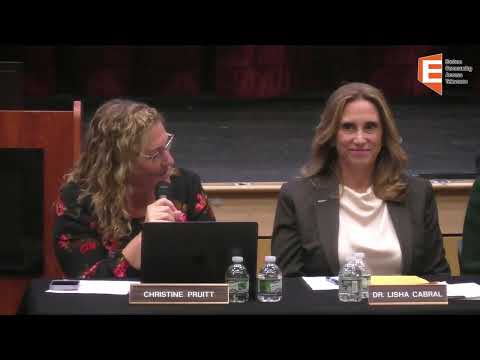
Town Administrator Connor Reed and Superintendent Dr. Cabral presented a draft $7.3 million operating override that would restore many school and municipal cuts, create a dedicated override stabilization fund and expand tax relief for seniors and veterans; at the same meeting the Easton School Committee voted to approve a non‑override FY26 operating budget of $51,539,255 that balances next year’s spending through deeper cuts and the use of reserves.
Reed told the joint audience that Easton’s preliminary gap for FY26 began at roughly $6.36 million and has been reduced to about $2.3 million so far through departmental cuts and reserve use, but that the remaining shortfall would still force some of the largest service reductions since the 2008 recession. He said two factors explain why Easton reached this point: a one‑time structural weakness from being a “minimum aid” school district (state aid has lagged inflation for years) and an extraordinary $3.6 million increase in fixed costs in the last two years — about $2 million of that in health insurance alone.
The administration’s draft override package contains six main elements: restore school and town department cuts, eliminate the planned $3.5 million draw on reserves in FY26, restore $727,000 for town departments, increase tax abatements/exemptions for seniors, veterans and people with disabilities (the proposal would add a 30% increase in the requested overlay to boost relief), reinstate a $40,000 recurring OPEB contribution in the insurance budget, and set aside $800,000 for a narrowly defined override stabilization fund to smooth future insurance and wage pressures.
Dr. Cabral said the school department would prioritize restorations to classroom and specialist teachers, course offerings, student support staff (paras, nurses, counselors), summer learning/enrichment programs and basic facilities and security needs if override revenue becomes available. She warned that the "amount restored" would not necessarily equal the amount cut, because hiring and programming decisions are constrained by enrollment, timing and how positions were vacated (many were eliminated after retirements or incentive departures).
School staff and committee members pressed for more detail on several cuts the administration proposed in its non‑override budget. Committee members and parents focused on reductions in nursing staff and instructional coaching at elementary schools. School leaders said the projected nursing force for next year would leave some half‑day rotations with only one registered nurse in a building, though administrators said they believed coverage could be managed by a combination of a nurse coordinator, LPN support, creative scheduling and building‑level triage. Multiple committee members and parents raised concerns about medically fragile students (including those with Type 1 diabetes) and urged the committee and administration to ensure double coverage at schools where younger, high‑need students live.
Special education and student support drew sustained attention. Director of Special Education (Director Davidson) reviewed an expansion of a Therapeutic Learning Center (TLC) sub‑separate program planned for the high school to serve students currently tuitioned out of district and to reduce out‑of‑district tuition and transportation costs over time; school leaders said they expect the program to allow some students to return from more expensive placements. Committee members and advocates urged more early intervention to reduce the long‑term fiscal and human costs created when students’ needs grow without timely in‑district supports.
Other operational details raised during committee Q&A included rising transportation costs (regular, special‑education and McKinney‑Vento/homeless transports), uncertainty about federal grants that currently support paraprofessionals and summer programs, and the district’s rising number of multilingual learners (an increase of about 38 students in two years) that requires added staffing and teacher supports.
Reed emphasized that even a successful override would not immediately return the district to its prior, fully staffed condition; rather, the $7.3 million proposal is framed as a multi‑year stabilization plan backed by the PACE (Promoting a Sustainable Easton) community compact that recommended restoring services while pursuing system‑level efficiencies and legislative advocacy on state formulas.
Next steps, schedule and voting: Reed and the administration urged residents to review online materials and attend outreach events. Key dates given at the meeting were a joint public hearing on April 29 (select board, school committee and finance committee), a PACE open house on May 7, annual town meeting on May 19 (where a contingent appropriation would be considered) and the override ballot on June 10. Reed stressed that both town meeting and the ballot play distinct legal roles: town meeting must appropriate the funds (contingent on ballot approval), and voters must authorize the tax increase at the ballot for an override to take effect.
Votes at a glance: During the same meeting the Easton School Committee recorded several formal votes: - FY26 non‑override operating budget approved: motion made and seconded in committee; outcome: approved (committee recorded unanimous "all in favor"). - Donation approved: the committee approved a donation of tricentennial blankets for OA seniors (donation value cited at $7,588) and authorized distribution to graduates; outcome: approved. - ADA / McKinney‑Vento transportation contract approved for remainder of FY25, amount not to exceed $126,000: outcome: approved. Leaders said this contract will be covered by transfers within the current year budget because McKinney‑Vento transportation has already exceeded its FY25 budget. - Easton Public Schools Educator Week proclamation (May 5–9) approved: outcome: approved. - Revision to the superintendent’s contract approved at the committee’s request to reflect a 0% increase for FY26 in the absence of an override or other new revenue: outcome: approved.
Officials urged residents to weigh the financial impact of an override vote, including proposed increases in tax relief for qualifying seniors and veterans, against the scale of service reductions the non‑override budget would impose. The administration also pledged continued advocacy at the state level for reforms to the foundation formula, minimum‑aid rules, circuit‑breaker special‑education funding and transportation policy.
Why this matters: Easton officials described FY26 as a “perfect storm” — years of constrained state aid combined with a sudden spike in health insurance and pension assessments — that left little room to absorb the cost increases without either deep program cuts, heavy reliance on reserves or a tax override. The committee’s approval of a non‑override budget kept operations running for FY26 but shifted the decision about restoring services to voters at town meeting and on the June ballot. Voters will decide whether to authorize a temporary tax increase to stabilize town and school services or accept the deeper cuts that district leaders say will reach many classroom and support positions.
What to watch next: joint public hearings (April 29), PACE open house (May 7), annual town meeting (May 19) and the override ballot (June 10).