
Wentzville academic services reviews assessments, curricula and Reading Success Plans amid push for more teacher planning time
Get AI-powered insights, summaries, and transcripts
Subscribe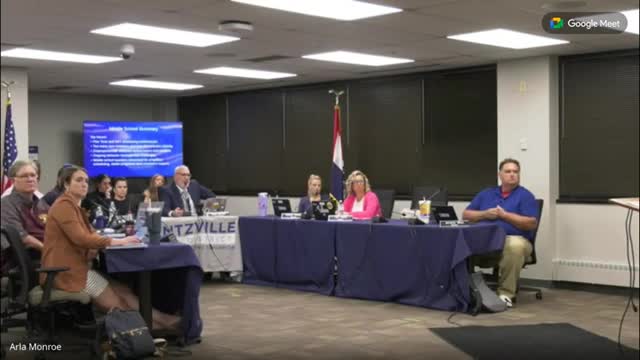
Summary
District academic services presented year-three program evaluation covering attendance, curriculum updates, standards-based grading, assessment platform rollout and the district's Reading Success Plans (RSPs); board and staff discussed supports for teachers, measures of student growth and next steps for assessment and professional learning.
The Wentzville R-IV academic services department presented a year-three program evaluation and outlined efforts to streamline assessments, expand curriculum review and implement Missouri's Reading Success Plans.
The presentation, delivered by staff from the district's academic services team, summarized four district school improvement plan (CSIP) goals: attendance and engagement, a six-year curriculum review cycle, achievement and growth, and college-and-career readiness. "People keep saying they want time," one presenter said, describing repeated teacher requests for planning and collaboration time.
The district reported progress on multiple fronts. Curriculum updates have moved from 34% complete to 52% (170 of 325 courses), with a goal to reach 100% within the six-year cycle. The district said it will begin training on a centralized assessment platform, MasteryConnect, that staff say will let teachers build and share common formative assessments aligned to standards and curriculum.
On achievement, the district reported growth on the state'aligned measures: the districtwide MPI rose from 396 (02/2022) to 403 (02/2024), and math moved from 397.9 to 407.7 in the most-recent comparison. The presentation said designation at or above 400 is the state'defined "target" rating. District leaders described the most significant gains as occurring in math and science.
Reading Success Plans (RSPs), the state-mandated remediation process introduced three years ago, featured prominently. Academic services staff described how RSPs are identified and serviced across teams: classroom teachers provide tier 1 and tier 2 instruction; reading interventionists provide daily, intensive interventions (about 30 to 40 minutes a day); and literacy coaches support teachers' practices. "Literacy coaches actually don't work directly with students. They're there to support teachers," said Kim (reading intervention lead).
Presenters shared multi-year RSP counts: the district added about 730 students identified with RSPs from the first to second year of the program, and an increase of about 326 students in the most recent year (with a caveat that kindergarten qualifying does not occur until November). The district said it has exited 303 students from RSPs in grades 1 through 7 and is monitoring another 235 students on tier 1 intervention who could be released after winter diagnostics.
Staff described exit criteria: students must demonstrate proficiency on two consecutive diagnostics in all qualifying domains to exit an RSP. The district also noted it does not age students out of RSPs; students who have not met exit criteria remain on plans as they progress through grades.
Board members asked about teacher workload, use of PLC time, and whether the volume of data and assessment tools overloads teachers. "We tell ourselves all the time, like, keep the model, keep it simple," said one member of academic services about the department's attempt to simplify reports before they reach teachers. Presenters said they are exploring schedule changes (for example, reallocating part of a full professional development day to PLC work) and have already discussed options with the Wentzville NEA.
The presentation also described district-wide supports: 99 teachers are in the Beginning Teacher Assistance Program (BTAP) and mentor program; four technology coaches support Canvas and digital resources across 25 buildings and 1,745 classrooms; and the district provides in-house LETRS training for literacy. The academic services team said they will continue to align curriculum, assessments and proficiency skills and emphasized a strategy of "go deep, not wide" for professional learning to avoid continually layering new initiatives onto teachers.
In question-and-answer, board members pressed for clarity about data comparisons across years and buildings, cohort growth measures, and how assessment changes (such as a new ELA adoption) affect short-term scores. Staff said growth scores calculated by the state will be presented with the APR and that the district will provide building-level data in coming meetings.
The district closed the presentation by noting follow-up actions: rollout of MasteryConnect training, ongoing curriculum updates (40 curricula were slated to come for board review by spring), continued work on RSP step 2 and the district's comprehensive literacy plan, and further data reporting. Academic services leaders asked the board for time to continue reviewing the data and for flexibility while they test schedule and reporting adjustments.
Ending: Board members thanked staff for the presentation and said they would continue to monitor progress and expect additional building-level data and the APR at a future meeting.