
Cochise County supervisors review near-final draft of comprehensive plan, raise water, energy and economic concerns
Get AI-powered insights, summaries, and transcripts
Subscribe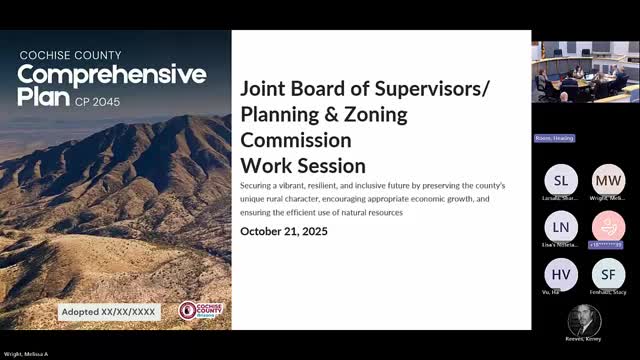
Summary
Cochise County officials on Tuesday reviewed a near-final draft of the county's comprehensive plan, a 20-year roadmap that county planning staff say is intended to guide growth, protect rural character and direct investments in infrastructure and services.
Cochise County officials on Tuesday reviewed a near-final draft of the county's comprehensive plan, a 20-year roadmap that county planning staff say is intended to guide growth, protect rural character and direct investments in infrastructure and services.
Planning staffer Christine said the draft draws on more than a year of work and public outreach. "This plan is a roadmap for how the County will grow and develop over the next 20 years," she told the board, adding that staff had "engaged with over 400 residents directly" and held nine public meetings during the draft process.
Supervisors and planning commissioners used the work session to probe and recommend changes across multiple chapters. Major discussion topics included Cochise County's heavy reliance on groundwater, competing views about large-scale renewable energy projects versus traditional or emerging alternatives, and economic opportunities tied to a planned commercial port of entry, rail reuse and airport capacity.
Why it matters
The plan sets countywide priorities on water, energy, housing, transportation and economic development. Supervisors said changes made here could affect permitting and investment decisions and shape where infrastructure is built, which in turn influences insurance availability, business recruitment and long-term fiscal health.
What the draft says (staff summary)
Christine presented required and optional plan elements. Key points she highlighted: - Land use: concentrate growth where infrastructure exists; protect rural and scenic character; support heritage tourism and compatible development near military lands. - Transportation: preserve freight rail corridors, support the US Bike Route 90 and a connected pedestrian/bike network, and maintain county airports for general aviation and emergency use. - Water: the county is "almost entirely groundwater dependent," with "well over 95%" of water coming from aquifers such as the Upper San Pedro Valley and the Wilcox Basin. The draft proposes a five-point strategy including conservation, reuse, artificial recharge and watershed protection. - Energy: the draft emphasizes renewable energy siting and community benefits while also discussing efficiency and grid resilience. - Public services and facilities, housing and economic development: chapters address emergency services, housing affordability and strategies to diversify the economy beyond government employment.
Board and public discussion
Supervisors and attendees focused on several recurring themes. - Fort Huachuca and economic resilience: several speakers warned that Cochise County's economy is heavily dependent on government and defense spending tied to Fort Huachuca and urged the county to plan for possible federal force-structure changes. A supervisor said the county should develop alternatives in advance rather than wait until "the train is on top of us." - Energy: some supervisors and commenters objected to language they perceived as prioritizing large-scale solar and wind farms, which they said can disrupt landscapes and provide limited local economic benefit. Several speakers urged the plan to explicitly include natural gas and emerging small modular reactors (described in the meeting as "small batch reactors") as viable options, citing power density and grid reliability. Planning staff acknowledged the draft currently emphasizes solar and wind but said other technologies are included in the energy chapter. - Water: multiple speakers stressed that groundwater dependence and declining aquifer levels are the County's most pressing challenge. The draft's water strategies (conservation, recharge and coordination with partners) were discussed as necessary but requiring firm implementation details. - Port of entry, rail and airports: attendees urged stronger and more prominent language about the proposed new commercial port of entry and reuse of rail lines (including potential service along Highway 191) as a driver of trade and manufacturing. Participants noted that Benson and Cochise County airport facilities can support larger freight aircraft and that better rail connections could shift truck traffic off highways. - PM10 air-quality designation: county staff and Jackie (planning/air-quality staff) confirmed Cochise County has an active PM10 nonattainment issue tied to historical smelter and other sources; Arizona Department of Environmental Quality (ADEQ) monitoring and state implementation planning remain relevant to industrial siting and the port of entry. - Fire services and insurance: multiple supervisors raised concerns that fragmented, under-resourced fire districts and lack of countywide coverage make insurance unaffordable for some residents and hinder commercial development. The board discussed conceptual options including a countywide fire service or coordinated mutual-aid model; staff and supervisors noted pension, funding and operational questions would need detailed study. - Health care and hospital districts: speakers noted past attempts to form a Douglas-area hospital district and said hospital access can strongly influence local recruitment and retention.
Quotations from the meeting
"This plan is a roadmap for how the County will grow and develop over the next 20 years," Christine said during her presentation.
"The PM10 is still active. ADEQ does come out and do studies almost every year," Jackie said when asked about air-quality constraints near the proposed port and industrial areas.
Next steps and procedural items
Christine told the board the draft will go to the Planning and Zoning Commission on Nov. 12; staff must conduct a 60-day review with required agencies and adjacent jurisdictions before additional public hearings. Planning staff said there will be a minimum of two public hearings (per state requirements) before any board adoption in resolution form.
What the county did not decide
No formal vote or adoption occurred at Tuesday's work session. The session was for review and comment; the record shows supervisors and members of the public asked for wording changes, additions to the economic-development and energy sections, and clearer references to water protections and emergency services. Staff said they would incorporate comments and return with a more detailed presentation in November.
Context and numbers from the draft and discussion
- Public outreach so far: more than 400 residents engaged directly and nine public meetings. - Growth rate cited in the draft: about 0.27% annually. - Education/veterans: the draft notes about one-quarter of residents hold a bachelor's degree or higher and roughly 18.6% of residents are veterans, a point raised to emphasize workforce strengths tied to Fort Huachuca. - Water dependence: staff said "well over 95%" of county water is groundwater. - Process timeline: planning staff requested authorization to post the draft for the required 60-day review; the Planning and Zoning Commission hearing is scheduled for Nov. 12.
Who spoke (selected)
- Christine — planning staff (presenter). First referenced at approximately 00:01:35 in the meeting record. - Jackie — planning/air-quality staff (commented on PM10/ADEQ monitoring). - Jerry Gonzalez — Planning & Zoning commissioner (present as part of the panel). - Kim Debut — Planning & Zoning commissioner (panel member). - Robert Montgomery — Planning & Zoning commissioner (panel member). - Supervisor Antonari — Supervisor (District 3) (present). - Supervisors Krasme and Crosby were recorded as absent. - Several other supervisors, commissioners and members of the public (identified in the transcript variously by first name or as online commenters) offered comments during the session.
Ending
Staff said it will revise the draft based on today's comments, post the draft for the statutorily required 60-day review, and return with targeted changes and an updated presentation at upcoming Planning and Zoning and Board of Supervisors hearings.
(Reporting note: quotes are verbatim where attributed to named speakers in the meeting transcript; paraphrased material tracks discussion and procedural statements from the work session.)