Get Full Government Meeting Transcripts, Videos, & Alerts Forever!
Get email alerts on the Lhpp Grant Audit topic
No spam. Unsubscribe anytime.
Commission orders forensic review after debate over $3.8 million HHS grant tied to local partnership
Summary
Following public praise for the Lauderhill Health and Prosperity Partnership and sharp public questioning about how a $3.8 million HHS health‑communication grant was spent, the commission voted to hire a financial expert to audit the grant; language was amended to target the HHS award rather than a single partner organization.
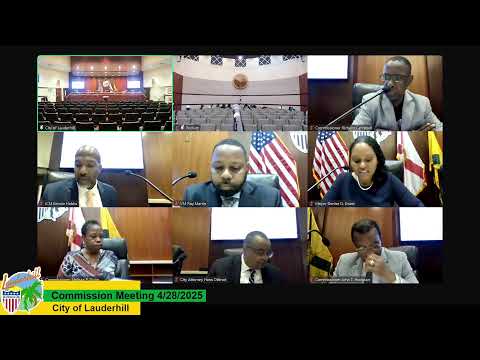
The Lauderhill City Commission voted unanimously (5–0) to retain a financial expert to perform a forensic review of the city’s $3.8 million federal health‑communications award (an HHS grant related to COVID communication and vaccine outreach) after heated public comments and extended discussion on April 28.
Background and what commissioners heard Commissioner Melissa P. Dunn presented the Lauderhill Health and Prosperity Partnership (LHPP) and its funders at the start of the meeting, noting grant investments from the Health Foundation of South Florida, Health Foundation of Broward County, the National League of Cities and others. LHPP leaders and partner representatives — including Lorraine Champ of the Health Foundation of South Florida, Nicholas Hessing from the Children’s Services Council of Broward County, Marie Rumble (Royal Palm Elementary principal) and Constance Armstrong of Banyan Community Health — described the partnership’s neighborhood hubs, youth and small‑business programs, health fairs, and violence‑prevention work.
Shortly thereafter a separate but related item drew heated public attention: an audit request focused on a $3.8 million HHS grant. Public commenters, including long‑time residents and community activists, said accounting for the award appeared incomplete, citing invoices, large payments to outside vendors and gift‑card purchases. Commissioner Richard Campbell summarized documentation he said showed $1.6 million in grant funds had not been reimbursed by the federal funder and asked for an independent review. Several speakers said staff files were incomplete and key grant personnel who managed the grant were no longer employed by the city.
Commission and staff responses Interim City Manager Kenny Hobbs and finance staff described a complex procurement and reimbursement process. Staff said the city’s grants administration unit — now in Finance — managed the HHS award; Finance officials confirmed they had submitted some federal reimbursement requests in late 2023 but could not confirm the full status of other paperwork during the meeting. City staff also said S. Nelson and Associates (a marketing/communications vendor) and Nova Southeastern University (as a minority‑serving research partner named in the grant) had roles in grant work and contracting.
Motion, amendment and vote Commissioner Campbell and Commissioner Dunn proposed a resolution directing the city to hire a financial expert to conduct a forensic audit of the grant records. During public deliberations commissioners debated whether the resolution should single out LHPP or instead direct a broader audit. Commissioner Dunn proposed amending the resolution to remove language that named LHPP and to broaden the audit to all city grants from 2020–2025; that amendment failed to receive a second. Commissioners then amended the motion to clarify it targeted the HHS award in question and to remove direct references to LHPP. The final motion (as amended) directed the city manager to retain an external financial consultant to examine the HHS grant and related expenditures. The amended motion passed 5–0.
Other related action Separately, the commission later adopted a second resolution (4–1) directing that the city’s Finance Department be the sole administrative home for grant management going forward; the commission recorded one vote against that policy (Commissioner Dunn) and four votes in favor. At the April 28 meeting commissioners and staff agreed to provide the results of the forensic review when completed and to cooperate with state or federal inquiries.
Why it matters Residents and advocates said they turned to the commission because they had not seen evidence that grant‑funded services reached Lauderhill neighborhoods. Proponents of LHPP said the partnership has delivered neighborhood health activities, school supports and small‑business assistance funded by outside foundations; they warned that politicizing the partnership could jeopardize future investments. The commission’s forensic review aims to clarify the financial record for the HHS grant and recommend reforms to city grant management and procurement.
Next steps The city will solicit proposals and engage an external financial expert; staff will provide the scope and timeline for the audit, report findings to the commission and, where appropriate, work on corrective measures. The governor’s office and other agencies had also contacted the city seeking information about how federal health funds were used; city staff said they would cooperate with any formal state or federal review.