Get Full Government Meeting Transcripts, Videos, & Alerts Forever!
Get email alerts on the Refuse Rates topic
No spam. Unsubscribe anytime.
Controller proposes lower refuse-rate increases than Recology; commission votes to support Environment Department request
Summary
The controller's office presented proposed refuse-rate adjustments that are smaller than Recology's request and recommended limited new funding for Environment Department priorities pending legal nexus review; commissioners passed a resolution supporting the department's refuse rate proposal.
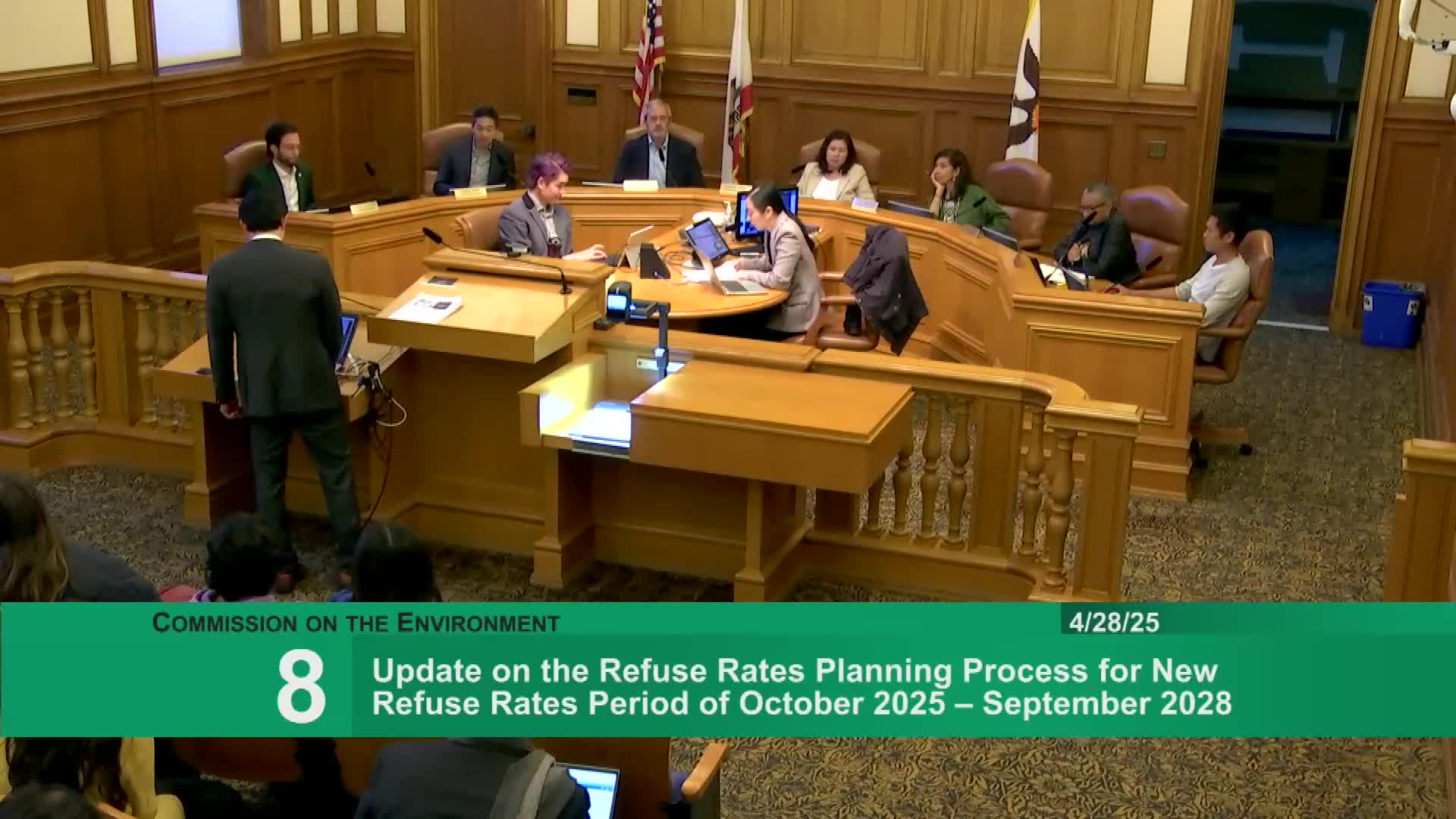
The San Francisco Controller's Office presented its proposed refuse-rate order on April 28, recommending lower rate increases than those requested by private hauler Recology and proposing a partial package of new funding for Environment Department programs while deferring some requests pending further legal review.
Jay Liao, refuse rates administrator in the Controller's Office, summarized a multi-year comparison of rate proposals. He said Recology had originally asked for an 18.18% increase in rate year 2026; the controller's proposal adjusted that down to 12.59%, a roughly 5.6 percentage-point reduction that Liao said would save about $2.63 per month for a single-family customer. In 2027 and 2028 the controller's numbers differed from Recology's application; the controller said its package still represented approximately $50 million in rate savings compared to the company's original filing.
Liao described a series of structural factors driving rate pressure, including flat tonnage and revenue compared to prior growth assumptions, a prior-year $23 million correction that was rebated to ratepayers, and increased business taxes tied to Proposition M. He also said the office declined to include a contingent $35 million schedule in Recology's application for a proposed local trash-processing facility because the office lacked sufficient information to validate that cost.
For department programs, Liao said the Environment Department requested roughly $3 million in new rate funding; the Controller's proposal included $1.1 million of that request and proposed $200,000 per year for a trash-processing pilot and study (split across the rate years). He said most of the outstanding difference was due to timing: detailed line-item requests arrived late and the controller's office had not yet received a nexus determination from the City Attorney's Office on whether certain program costs could be funded by rates. Liao said the City Attorney expected to complete that review in the coming week.
Commissioner Austin Hunter sponsored a separate resolution (Item 9) asking the commission to express support for the Environment Department's refuse-rate funding request; Hunter said the $3 million was "a must-have" to meet zero-waste mandates and to fund enforcement, reuse networks, repair clinics and outreach. Commissioner Thomas moved the resolution and Vice President Sullivan seconded. The commission opened the item for public comment (31 emailed comments were received and a student from SFSU spoke in favor). A roll-call vote recorded ayes from President Wong, Vice President Sullivan, Commissioner Ahn, Commissioner Vermejo, Commissioner Bermejo, Commissioner Hunter, Commissioner Tompkins and Commissioner Yuan; the resolution passed.
Liao also described new regulatory tools the Controller's Office will add to the rate order: documented service-level agreements, cost-variance reviews for variances above 5%, baseline operating metrics, cost caps on certain categories and a balancing account designed to cap Recology's profit margin at 9%. Liao said the office intends those mechanisms to improve transparency, standardize accountability and reduce the risk of future rate shocks tied to large capital projects such as shop consolidations, zero-emission fleet purchases (estimated between $360 million and $440 million) and potential pier or facility relocations (estimates ranging up to $100 million).