Get Full Government Meeting Transcripts, Videos, & Alerts Forever!
Get email alerts on the E Bike Pilot topic
No spam. Unsubscribe anytime.
City updates e-bike delivery pilot: reduced collection period, expanded participants, early emissions and miles benefits
Summary
San Francisco Environment Department and partners presented early findings from an e-bike delivery pilot, reporting eliminated vehicle miles, lower emissions, and lower operating costs for riders; the pilot will expand cohorts and include small businesses and cargo bikes under DOE funding.
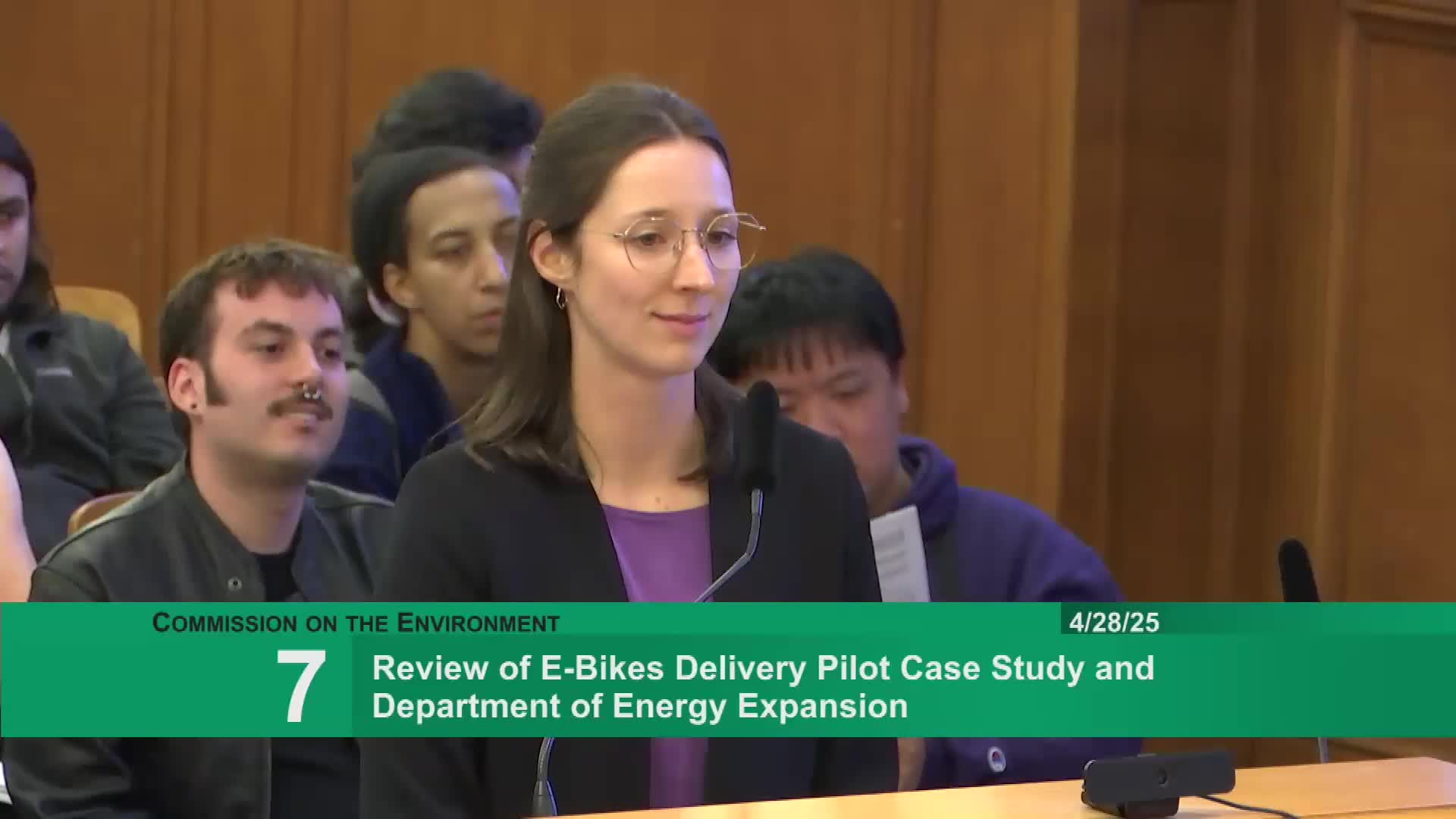
City staff and partners on April 28 updated the Commission on the Environment about San Francisco's e-bike delivery pilot, reporting preliminary data on emissions, vehicle miles traveled and participant experience and outlining design changes for a federal Department of Energy expansion.
Anna Charuto, clean transportation specialist at the San Francisco Environment Department, said the pilot offers no-cost e-bikes, accessories and safety training to delivery workers in exchange for delivery data. The pilot stemmed from a 2019 San Francisco Local Agency Formation Commission study; Charuto said the city has enrolled about half of an intended cohort and has analyzed roughly 1,000 e-bike deliveries and 2,500 car deliveries to date.
Linda Kamushian of Grid Alternatives, who presented findings from the California Energy Commission-funded phase, reported that the first two cohorts (June 2023'March 2024) eliminated an estimated 2,296 vehicle miles traveled among recorded deliveries and that e-bikes emitted a fraction of the carbon dioxide-equivalent emissions of car deliveries. Kamushian also said e-bike participants reported fewer hours worked and fewer completed deliveries but benefited from substantially lower maintenance and operating costs.
Speakers noted that app-based platform practices — beyond the city's control — affected earnings. Maya Chaffee, Grid Alternatives outreach fellow, said participants reported increased confidence on bikes and growing use of e-bikes for errands after the study period, and that the team will run additional cohorts, now including small businesses and community-based organizations with interest in cargo e-bikes.
Program changes announced include shortening the data-collection period from four months to one month to reduce attrition, procuring bike models with increased range and cargo capacity sourced from local businesses, and expanding participant types beyond app-based food delivery to parcel and organization-based deliveries.
Commissioners asked about the DOE grant timeline and data limitations. The presenters said the DOE grant is a three-year award and that the program is in year two; they acknowledged a federal funding risk but said work is underway and partial payment has been received. Staff said certain app-platform metrics (for example, driver idle time and backend dispatch logic) were not available, and prior formal data-sharing requests to transportation network companies were denied; the team intends to continue recruitment efforts through platform outreach and to explore alternative data-collection approaches for organization-based deliveries.
No formal action was taken; the item was presented for discussion and feedback.