Get Full Government Meeting Transcripts, Videos, & Alerts Forever!
Get email alerts on the Intergovernmental Relations topic
No spam. Unsubscribe anytime.
Leavenworth and county leaders discuss property-tax lid, 9-1-1 funding and regional economic development
Summary
City and county officials met at a joint session to discuss a proposed state constitutional amendment to cap annual property valuation growth, options for county solid-waste services, coordinating economic-development efforts, regional transit and proposals to fund an upgraded countywide radio/9-1-1 system.
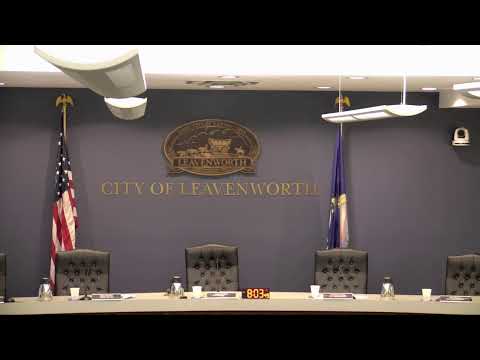
City and county officials met in a joint session during the May 25 Leavenworth City Commission meeting to discuss several policy priorities including a property-tax lid constitutional amendment, options for the county solid-waste transfer station, coordination of economic development efforts and possible regional transportation and public-safety communications funding.
The discussion opened with county representatives asking the city to consider a letter of support for a proposed constitutional amendment that would cap the annual increase in assessed valuation for individual residential properties (the county said draft caps discussed previously were in the 3–4% range). County officials said the idea would require a statewide constitutional amendment and that versions of the proposal have passed the state senate but not the house in past sessions. County representatives suggested a city study session ahead of next year’s legislative cycle to walk commissioners through the different bills and the pros and cons the League of Municipalities has circulated.
The county and city also discussed the county transfer station and how Leavenworth and neighboring jurisdictions might coordinate solid-waste services. County staff said the transfer station currently operates as an enterprise fund (not subsidized by property tax) and that hauling to regional landfills is the single largest cost. County staff described three options under consideration: (1) fully privatize hauling and operations; (2) keep an internal transfer station; or (3) contract with a local private operator planning to build a transfer station. County staff said they are compiling a full cost breakdown (transportation, staffing, fuel) and offered to share those numbers with city leaders.
Economic development was a major subject. County and city officials agreed to consider a refreshed approach and tighter coordination among existing actors, including the Leavenworth County Development Corporation (LCDC), the Port Authority and city economic-development efforts. County officials said past attempts to share a single, county-level economic director had not produced the scale of activity needed and emphasized evaluating new governance or funding models. Commissioners on both sides asked for follow-up meetings, including inviting county and city economic-development stakeholders to the city’s standing economic-development roundtable.
Transit and regional mobility drew discussion as well. City officials described the Ride LB pilot and asked whether county partners wanted to join or explore countywide coordination. County participants noted existing countywide services provided through the Council on Aging and the Guidance Center and said any regional plan would need clarity about who leads and how services would be funded.
County leaders raised a separate funding question tied to public safety: an upcoming, costly upgrade to the county radio and 9-1-1 console infrastructure. County staff said state and federal 9-1-1 fee collections have declined in recent years because of changes to how telephone and cell-plan fees are assessed and because of technology shifts; that decline is producing a funding shortfall for necessary system upgrades. The county described options that included a countywide sales tax dedicated to the radio/9-1-1 upgrade (which would require cooperation from cities to allow the county to retain their portion of a countywide sales tax for the project) or a per-user/agency charge. County officials said the replacement would cost in the millions and that a sales-tax approach could reduce the tax rate needed if city portions are pooled.
The joint session produced several follow-up items: city staff and county staff agreed to share the transfer-station cost report; both sides asked their economic-development boards (LCDC, Port Authority, Main Street) to meet with commissioners to explore governance and funding options; and the county asked the city to consider a letter of support for the property-tax lid in the next legislative session. County officials also extended an open invitation for regional leaders and state legislators to brief both bodies in a future study session.
The joint session was framed as preliminary; no formal city policy changes or financial commitments were made. Commissioners on both sides said they wanted more data before acting and asked staff to set study-session dates and share the materials discussed.
Ending: City and county officials agreed to continue the conversation in follow-up briefings and study sessions, with staff tasked to provide detailed cost and policy analyses on the solid-waste options, economic-development structures and 9-1-1/radio funding choices.