Lifetime Citizen Portal Access — AI Briefings, Alerts & Unlimited Follows
Committee backs amending vehicle law to add email and text reminders, adopts 31‑day notice change
Loading...
Summary
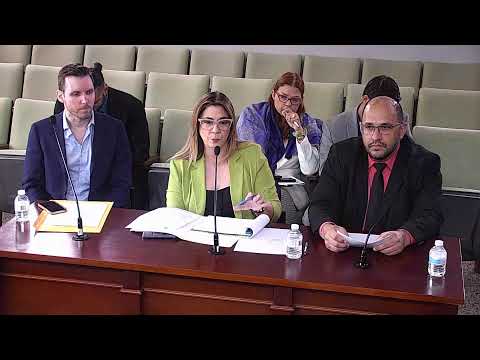
A House of Representatives Transportation and Infrastructure committee hearing considered Proyecto de la Cámara 491, a proposal to amend Article 23.01 of Law 22-2000 (the Vehicle and Traffic Law) to require electronic reminders — by email and/or text message — to vehicle owners ahead of marbete expiration. Testimony from DTOP and PRITS officials outlined operational, cybersecurity and fiscal issues and the committee accepted an amendment to send the first notice 31 days before expiration instead of 30.
A House of Representatives Transportation and Infrastructure committee hearing considered Proyecto de la Cámara 491, a proposal to amend Article 23.01 of Law 22-2000 (the Vehicle and Traffic Law) to require electronic reminders — by email and/or text message — to vehicle owners ahead of marbete expiration. Testimony from DTOP and PRITS officials outlined operational, cybersecurity and fiscal issues and the committee accepted an amendment to send the first notice 31 days before expiration instead of 30.
The bill as introduced would require the secretary of the Department of Transportation and Public Works to send at least two notices — one 30 days and one seven days before a marbete expires — using contact information available in DTOP’s official records. Mary Fuster, director of driver services at DTOP, told the committee the department already sends notifications through the SESCO Digital application at 45, 30, 15 and 0 days, and that push notifications and email delivery are being developed. DTOP recommended making the law effective 90 days after enactment to allow time for implementation and noted it cannot be responsible if contact information in its database is missing or out of date.
Rubén Quiñones, subdirector at PRITS, said PRITS supports the measure as consistent with government digitalization policy (citing Law 75) and cybersecurity oversight (citing Law 40). Quiñones recommended changing the first notice to 31 days before expiration so reminders align with the current renewal eligibility window — vehicles are eligible for renewal 31 days before expiration — and he urged adherence to cybersecurity standards for handling personal data.
Committee members pressed DTOP and PRITS for fiscal and operational details. DTOP estimated a one‑time implementation cost of about $90,000 and provided annual SMS cost ranges tied to message volume: roughly $34,500 for 3,000,000 texts, $57,500 for 5,000,000 texts, and $80,500 for 7,000,000 texts. DTOP said the implementation timeline to enable SMS delivery would be about three months once funded, and that the agency is working to add email notifications in coordination with PRITS, with programmatic changes expected by summer.
DTOP gave counts from its records for planning purposes. Testimony listed about 2,029,499 validated email addresses (a later near-duplicate figure was read back as 2,029,449), 1,712,867 phone numbers (not validated), approximately 2,661,071 digital marbetes currently active, and 48,234 physical "pegatinas" in circulation for certain vehicle types. The Puerto Rico Police (absent from the hearing) sent written data the committee cited showing traffic-enforcement removals: 31,109 infractions for expired marbetes in 2023, 54,282 in 2024 and 31,903 through April 29, 2025.
Committee members raised equity and outreach concerns for older residents who may not use email or smartphones. The vice president of the House and other members asked whether the law should mandate providing a phone number at registration; DTOP responded that requiring a phone number in the past caused transactional problems when citizens declined to provide one, so collection was left optional. Members asked DTOP to supply regional data on marbete removals and counts by jurisdiction; the committee requested that DTOP and PRITS deliver the requested counts and related fiscal-impact information by 4:00 p.m. the same day.
The committee accepted the technical amendment proposed by PRITS to change the first notice to 31 days before expiration. The committee chair said the intention is to prepare an informational report and to consider final approval of the project next week. No roll-call vote on the bill was recorded at the hearing.
"Sin lugar a duda, el DTOP siempre estará comprometido en cumplir con la política pública proveniente de la ley de gobierno electrónico," Mary Fuster testified, emphasizing the department’s intent to follow applicable digital-government laws and to pursue improvements "dentro del marco de nuestras posibilidades económicas."