Get Full Government Meeting Transcripts, Videos, & Alerts Forever!
Get email alerts on the Education Budget topic
No spam. Unsubscribe anytime.
Guam Department of Education asks Legislature for $306 million as federal ARP reimbursements remain unresolved
Summary
At an April 30 public hearing, Guam Department of Education officials defended a $306 million FY2026 request, warned that pandemic-era federal funds used for recurring costs have ended, and described risks to utilities, maintenance and school construction if American Rescue Plan reimbursements are delayed or denied.
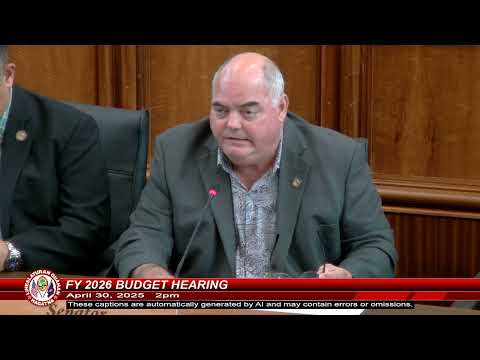
Deputy Superintendent for Finance Morgan “Wade” Paul told the Guam Legislature on April 30 that the Guam Department of Education is asking for $306 million in local appropriations for fiscal year 2026 and that much of the department’s previous operating relief came from pandemic-era federal grants now expended or difficult to draw.
“The funds we receive in this arena are just insufficient to take care of the major projects required in all of our schools,” Paul said. “Everything in this budget is absolutely necessary.”
The request breaks down in Paul’s presentation to the Committee on Finance and Government Operations as roughly $260.4 million for personnel, $25 million for general operations, $17.56 million for utilities and about $380,000 for capital outlays. Department officials said personnel accounts for about 86% of the request.
Why it matters
GDOE officials told senators that they relied on ARP and other federal pandemic-era funds for recurring costs such as utilities and large service contracts in recent years. Those funds are now largely exhausted or must be drawn down on a reimbursable basis, leaving the department to seek local appropriations to avoid service interruptions. Officials warned that delays or denials of federal reimbursements could force GDOE to draw local general-fund monies to keep schools open and systems running.
Key details
- Federal funds and reimbursements: Paul said GDOE submitted a $51 million reimbursement request to the U.S. Department of Education and is awaiting a decision. Senators and department staff described a larger, fluid aggregate of ARP/ESSER funds at stake — figures mentioned in the hearing ranged into the tens of millions to more than $100 million — and said final federal guidance will affect how urgently local appropriations must be used to bridge shortfalls.
- Utilities and operating risk: GDOE estimated utilities at about $1 million per month and said it may need to pull roughly $5 million from its general fund before Sept. 30 if federal reimbursements are not available.
- Staffing, substitutes and benefits: The department presented a staffing picture of roughly 2,286 school-based positions and 159 central-office positions (figures taken from a December 31, 2024 staffing pattern). Paul said teacher reclassification, increasing health and dental insurance costs and higher retirement contributions are the main drivers of increased personnel costs. On-call substitute funding was discussed as a significant line item: Paul said fully funding substitute coverage for 41 campuses would cost about $7.7 million.
- Maintenance and capital needs: GDOE described a plan to add maintenance teams (electricians, plumbers, carpenters) to provide about two “wrench turners” per school and to stock a warehouse of common supplies. The department said the governor’s maintenance proposal of roughly $8.2 million would fund annual maintenance teams but that current capital needs — including major repairs and gym floors — exceed the small capital-outlay request in the operating budget. Officials said the department had encumbered some of a $10 million supplemental appropriation for materials, equipment and limited hires (about $2 million on materials and roughly $1.5 million encumbered for utilities to date).
- School construction and repairs (FBLG and others): Officials discussed an active contract for a school complex often referred to in testimony as FBLG. Department staff said the outstanding remainder on that contract was about $6.7 million, collateral equipment costs near $3.3 million, and a change order of roughly $3.5 million. At one point Paul summarized the total current estimate for FBLG as roughly $14 million after adjustments; Senator-level back-and-forth produced slightly different figures but confirmed the project remains a multi‑million-dollar priority. Senators also asked about mold‑mitigation and fencing money from a prior $20 million appropriation; Paul said about $11 million remained for mold mitigation and $3 million for fencing and that some contracts were in protest or pending with the Guam Department of Administration or GSA.
- Athletics and extracurriculars: Paul said interscholastic sports funding was short by several million dollars in the current fiscal year and that elementary-level interscholastic activity is not normally budgeted; senators urged the department to quantify costs if the Legislature wanted to expand support.
- Grants, vendor payments and audit status: Justin Castro, GDOE general accounting supervisor, told the committee the department has not completed its financial audit and is making “period 13 adjustments” needed to finalize the audit that will feed into the government-wide closing. Paul and Castro described reconciliations required to correct federal grant accounting entries, including a $51 million journal entry to the U.S. Department of Education that GDOE must reverse to reconcile federal expenditures.
- Aspire and other program payments: Paul said the department had delayed Aspire (an after‑school remediation/enrichment program) instructor payments because of process and documentation delays and instructed payroll to issue those payments the following day. Paul characterized the payment delays as systemic and pledged to shorten processing times.
What senators pressed for
Members repeatedly requested a revised budget that distinguishes local general-fund requests from federal grant-funded staff and expenses, and they sought clearer project-by-project accounts for capital needs, vendor payables and any contingency plans if federal reimbursements are withheld. Several senators asked for written follow-ups on vacancies, teacher counts, precise encumbrances of the $10 million supplemental appropriation and the status of specific contracts (FBLG, mold mitigation, fencing).
Direct quotations and attributions
- “Everything in this budget is absolutely necessary,” Morgan “Wade” Paul, deputy superintendent for finance and administrative services, told the committee.
- “We are still making period 13 adjustments to finalize our CAFR, which is needed to finalize the financial audit,” Justin Castro, general accounting supervisor, told senators when asked about audit completion.
- “My instructions to payroll today was we need to pay them out tomorrow for the Aspire,” Paul said when asked about late payments to after‑school instructors.
Context and limits
GDOE officials said the operating budget presented to the committee was the board-approved local operating request and did not include most capital improvement project (CIP) requests, which the department said historically has submitted separately. Officials and senators discussed options including debt financing or seeking alternate funding sources for major capital needs; several senators urged GDOE to convert CIP estimates into a debt-service schedule for legislative consideration.
Looking ahead
Committee members asked GDOE to submit a revised budget with line-item clarity distinguishing local and federal-funded positions and obligations, an updated audit status, and a detailed list of encumbrances and outstanding vendor obligations. Senators said the committee and the Office of Fiscal Management and Budget will work with the department and consider adjustments before the floor session. The hearing was recessed at 4:54 p.m.
Ending
Department leaders said they will return requested detail to the committee; senators emphasized the urgency of resolving federal reimbursement questions and completing the financial audit before final appropriations are decided.