Get Full Government Meeting Transcripts, Videos, & Alerts Forever!
Get email alerts on the Higher Education topic
No spam. Unsubscribe anytime.
Minnesota House passes higher-education finance bill after heated debate over North Star Promise eligibility
Summary
The Minnesota House on a recorded vote passed House File 2431, the Higher Education Finance and Policy bill, as amended, by 120-14 after extended debate and multiple roll-call votes on amendments.
The Minnesota House on a recorded vote passed House File 2431, the Higher Education Finance and Policy bill, as amended, by 120-14 after extended debate and multiple roll-call votes on amendments.
The bill, described on the House floor by Representative Zach Wolgamott, author of the measure, and co-chair Representative Marion Rarick, funds higher-education priorities and addresses large shortfalls in the state grant program. "I am proud to present to you House File 2431, the higher education finance and policy bill," Wolgamott said on the House floor.
Why it matters: members said the package balances holding harmless the University of Minnesota and Minnesota State while filling part of a $239,000,000 shortfall in the state grant program that the committee identified. Lawmakers debated eligibility for the North Star Promise program, restorations for rural medical training and workforce programs, and targeted supports for foster youth, student parents and paramedic training.
Most significant floor votes and outcomes
- Amendment A9 (moved by Representative Schultz): Sought to restrict eligibility for the North Star Promise program by excluding people without lawful immigration status. The House recorded a roll-call vote; there were 66 ayes and 67 nays. The amendment did not prevail.
- Subsequent amendment (moved as the Coulter amendment, explained on the floor by Representative Ginny Coulter): Sought to restore funding for several targeted programs including large-animal veterinarian loan forgiveness, agricultural-education loan forgiveness, a paramedic scholarship, the student parent support initiative and additional support for the Fostering Independence Grant (FIG) program, and proposed removing for-profit colleges from the state grant program. The transcript records floor debate, a call of the House and a recorded roll call on the amendment; the transcript does not include an explicit tally for that amendment in the excerpt provided.
- Final action: On third reading the House passed the bill "as amended". The clerk reported the final tally as 120 ayes and 14 nays, and the bill's title was agreed to.
What lawmakers debated
Eligibility for North Star Promise: Representative Schultz (Morrison) introduced Amendment A9, arguing the change would ensure state tuition benefits prioritize Minnesotans "here legally." Schultz said the amendment would "close the eligibility requirement loophole" and prevent people who "came to our country and to our state and broke our laws" from receiving benefits under the North Star Promise.
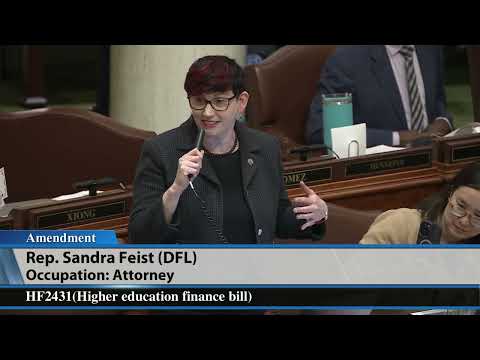
Opponents called the amendment discriminatory and argued it would harm students who complied with federal processes. Representative Emma Hanson (Dakota) called the proposal "devoid of humanity" and said it targeted students who are following federal requirements while they await immigration processes. Representative Steve Feist (Ramsey) urged a no vote and cited research and state economic data, saying immigrants contribute taxes and fill critical workforce needs in health care, construction and other sectors. Feist quoted reports showing immigrants paid about $6,200,000,000 in taxes in Minnesota and have substantial spending power; he urged lawmakers to consider those economic impacts when deciding eligibility rules.
State grant shortfall and tradeoffs: Committee co-chair Marion Rarick (co-chair) and bill author Wolgamott said the higher-education committee faced a $239,000,000 hole in the state grant program and worked under a "zero" budget target for new ongoing spending. Rarick described a line-by-line review of appropriations and said the committee narrowed the shortfall to roughly $62,000,000 through policy changes and cuts. The authors emphasized that some favored items were cut because of those constraints and that remaining differences will be negotiated in conference with the Senate.
Restorations and program funding: Representative Ginny Coulter (Hennepin) presented an amendment aimed at restoring funding for a set of programs and shifting grant eligibility away from for-profit institutions. Coulter described the amendment as a choice to prioritize foster youth, single-parent student supports, rural medical training and paramedic scholarships over continued funding to some for-profit programs. Supporters, including Representative Pam Hicks (Olmstead) and Representative Julie Liebling, recounted personal experience with student-parent supports and the FIG program to argue the restorations would directly affect students' ability to complete college.
Rural medical training: Multiple members pressed that the bill balances investments in rural medical education. Representative Liebling said the Mayo Family Medicine Residency funding was cut in favor of a new investment in a Saint Cloud medical training partnership; co-chair Rarick and others said the bill includes a $1,500,000 investment in a partnership between the University of Minnesota Medical School and CentraCare for a Saint Cloud medical training site and that funding decisions weighed Mayo's large financial capacity against expanding statewide training capacity.
Paramedics and workforce programs: Supporters of restoring paramedic scholarships argued the program produces front-line emergency responders and cited studies on survival rates when advanced life support reaches trauma scenes. Coulter and others said paramedic scholarships and loan repayments help supply ministers of emergency medical services across Minnesota.
How lawmakers framed the trade-offs
Proponents of amendments that restored program funding framed the measures as investments that prevent larger downstream costs and that fulfill promises to vulnerable students, including foster youth and single parents. Opponents and bill authors repeatedly framed the debate as constrained by the committee's zero target and the need to prioritize backfilling the state grant shortfall.
Next steps and implementation
Because the House passed the measure "as amended," the bill will proceed to the Senate and, if enacted, will require final conference negotiations to resolve differences between the chambers. Several lawmakers said remaining changes and restorations would be pursued in conference committee.
Quotes (selected)
"I am proud to present to you House File 2431, the higher education finance and policy bill," Representative Zach Wolgamott said when he introduced the measure.
"People came to our country and to our state and broke our laws," Representative Schultz said while explaining Amendment A9.
"I personally still find it to be devoid of humanity," Representative Emma Hanson said in opposition to the A9 amendment.
"We had a $239,000,000 hole" in the state grant program, Representative Marion Rarick said in describing the committee's fiscal constraints.
What the record shows and what is not specified
- The transcript records the roll-call result for Amendment A9 (66 ayes, 67 nays) and the final House passage of HF 2431 as amended (120 ayes, 14 nays). - The transcript records floor debate, a call of the House and at least one roll call associated with the Coulter amendment, but the excerpt does not include an explicit final tally for that amendment; the final bill passed "as amended," indicating at least some floor changes were adopted.
Background and context
House File 2431 is a biennial higher-education finance and policy omnibus bill that the House higher-education committee reported after a line-by-line review of appropriations. Members repeatedly described working under a zero new-funding target and prioritizing backfilling a major shortfall in the state grant program. The bill includes policy changes to the state grant program, a $1,500,000 partnership investment for medical training in Saint Cloud, and other targeted funding and cuts described on the House floor.
Ending note
With the House passage, HF 2431 moves to the Senate for consideration and likely conference negotiations. Lawmakers signaled that remaining disputes — particularly over eligibility for North Star Promise and targeted restorations — will be resolved in interchamber negotiations.