Get Full Government Meeting Transcripts, Videos, & Alerts Forever!
Get email alerts on the Carbon Capture Pipelines topic
No spam. Unsubscribe anytime.
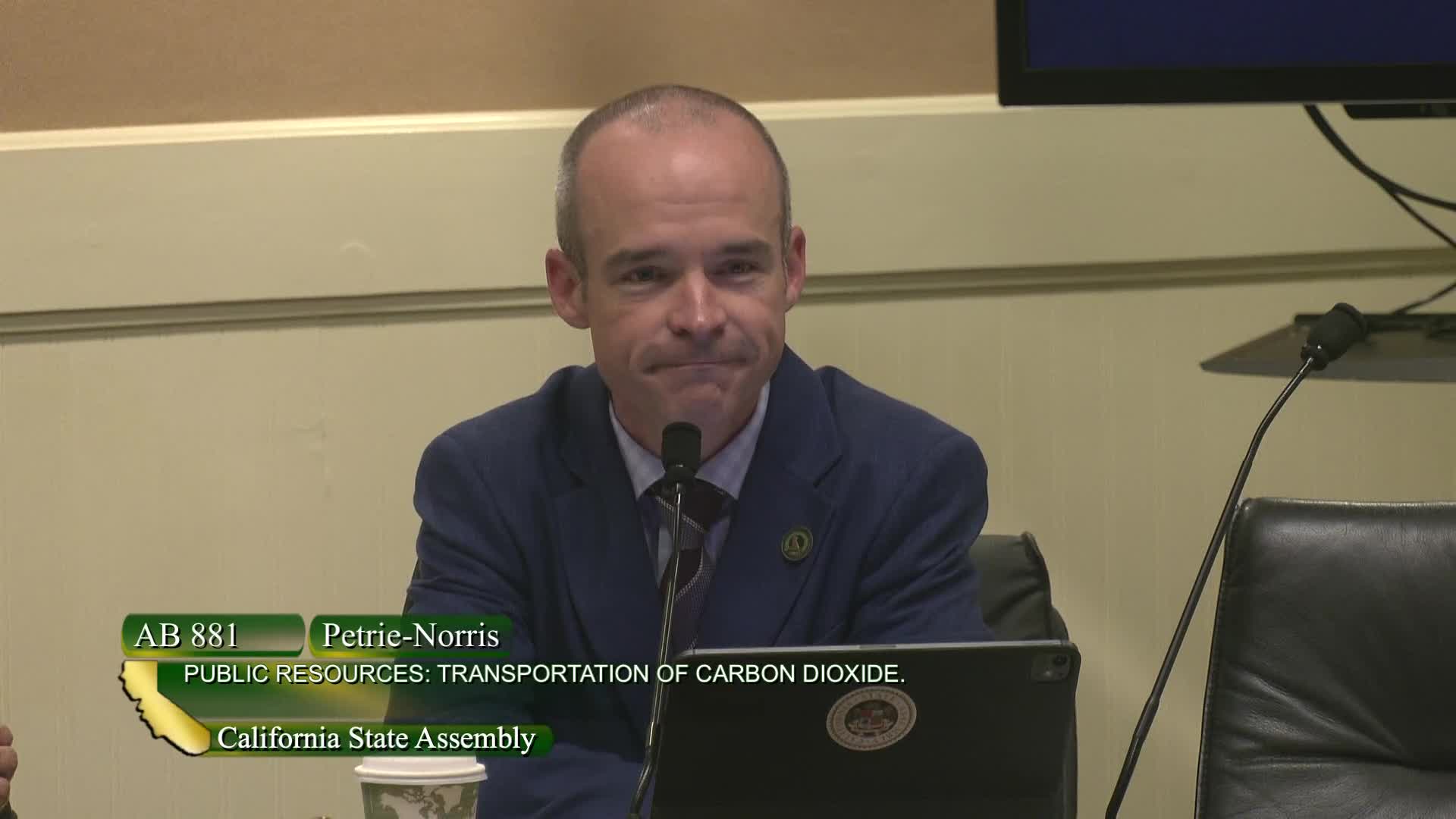
Committee advances bill to set state safety standards for CO2 pipelines as federal rulemaking stalls
Summary
AB 8 81 would direct the State Fire Marshal to adopt safety regulations for carbon‑dioxide pipelines to enable carbon capture and sequestration projects while the federal rulemaking timeline remains uncertain; supporters say standards are needed to access federal funds and meet climate targets, opponents want stronger community protections.
The Assembly Committee on Utilities and Energy advanced AB 8 81, a bill to establish state safety standards for carbon‑dioxide (CO2) pipelines to allow carbon capture and sequestration projects to proceed in California while federal rulemaking timelines remain uncertain.
The bill would direct the State Fire Marshal to prepare regulations using draft federal pipeline safety standards as a baseline and, if needed, strengthen them to protect communities. Supporters said federal rulemaking under the prior administration had produced draft regulations but that the process has stalled, creating uncertainty that could block projects and related federal funding.
Laura Lewis, chief legal and government affairs officer for the Sacramento Municipal Utility District, said SMUD’s partnership with Calpine to retrofit a natural‑gas plant for carbon capture depends on clear state pipeline rules. Scott Wetsch, representing the California Carbon Solutions Coalition and several labor groups, said the legislation is critical to access federal funds and to meet state sequestration targets in the climate scoping plan.
Environmental justice and community groups voiced opposition or “oppose unless amended” positions, urging higher safety thresholds and stronger community protections. Eliana (last name not given) of the Central California Environmental Justice Network said the draft PHMSA rules that are being used as a template lacked key implementable details, for example requirements for leak‑detection precision and the use of odorants or colorants to help detect leaks. Community witnesses from Kern County also urged more stringent protections and clearer emergency‑response requirements.
Committee members emphasized engagement with affected communities; the sponsor said she accepted committee amendments and committed to continued negotiations. The committee voted to advance AB 8 81 to Natural Resources with the commitment to take amendments. The motion passed (yes: 17; no: 0).