Get Full Government Meeting Transcripts, Videos, & Alerts Forever!
Get email alerts on the Consumer Protection topic
No spam. Unsubscribe anytime.
Senate advances commerce omnibus after contentious debate over cannabis grants, consumer protections and insurance provisions
Summary
Senate File 2216, an omnibus commerce and consumer protection bill, passed after floor debate and multiple amendment votes. Major floor fights centered on CANRenew social-equity grants, Office of Cannabis Management funding, consumer protections for HOAs and medigap/62J insurance mandate language.
Senate File 2216, the omnibus commerce and consumer protection budget and policy bill, passed the Minnesota Senate after extended floor debate and several recorded amendment votes.
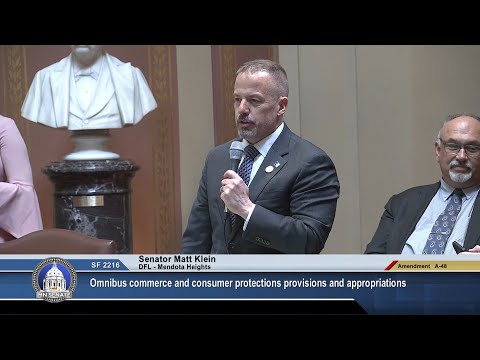
Senator Klein, chairing the Commerce Committee, presented the measure as a broad package that would regulate insurance, consumer protections, telecommunications and business practices. He described new provisions to establish an HOA registry and an ombudsperson, strengthen oversight of investment broker fraud and set standards for water provision at large entertainment venues. "This bill will establish a registry and an ombudsperson for HOAs to ensure fairness and transparency," Klein said on the floor.
Significant debate focused on the bill's cannabis-related provisions and ongoing social-equity grant funding. Several senators objected to moving cannabis-related appropriations and grant decisions into the commerce omnibus and raised concerns about the Office of Cannabis Management's (OCM) rollout, grant administration and oversight. Senator Rasmussen and others argued that funds should go to public-health education programs cut in prior appropriations, while bill supporters defended CANRenew grants and the social-equity focus.
Key recorded amendment outcomes on the floor included: - A54 (carryforward for OCM funds): adopted, 33 ayes, 30 nays. The amendment allowed the Office of Cannabis Management to carry forward $6,000,000 of prior biennium funds for current use. - A43 (menstrual product labeling requirement): adopted by roll call (sponsors characterized the amendment as a labeling requirement for menstrual products containing certain synthetic ingredients). - A49 (Gruenhagen: reduce OCM spending): rejected, 30 ayes, 34 nays. - A48 (Croon: cancel CANRenew grants to general fund): rejected, 30 ayes, 34 nays.
Proponents of preserving CANRenew argued the grants were designed to direct resources to communities disproportionately affected by prior cannabis enforcement; opponents argued the ongoing $15,000,000 annual appropriation should be paused given the state's budget deficit. Senator Croon framed his A48 amendment as a prioritization choice in light of an estimated $6 billion projected deficit: "We need to be responsible legislators and we need to make good priority decisions with finite taxpayer dollars," he said.
Other substantive floor discussions included medigap/62J language (reform proposals debated and some amendments withdrawn), changes affecting long-term care incentives, consumer protections for salvage titles and insurance access, and a measure to ban retail sales of nitrous oxide for products associated with huffing by children. Senator Rasmussen withdrew some amendments after discussion and signaled willingness to continue negotiations in conference.
After additional debate and a final roll call on third reading, the Senate recorded the bill as passed; transcript reporting shows the final tally as 35 ayes and 29 nays on final passage following a reconsideration motion recorded on the floor.
The bill now proceeds along the legislative process for reconciliation with the House version, where conference committee negotiations were referenced in floor remarks.