Get Full Government Meeting Transcripts, Videos, & Alerts Forever!
Get email alerts on the Municipal Budget topic
No spam. Unsubscribe anytime.
Lakeville leaders weigh three FY26 budget scenarios, tap stabilization fund to cover debt payment
Summary
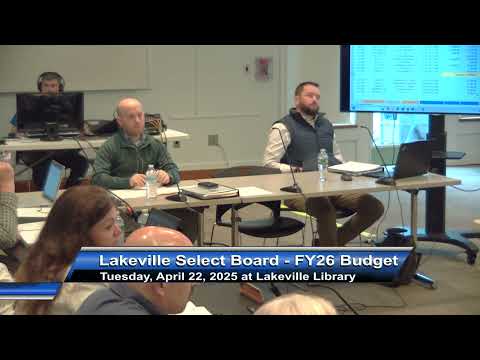
The Lakeville Select Board and finance staff on April 22 reviewed three scenarios for the town's fiscal 2026 budget and discussed staffing requests and funding trade-offs, including tapping $376,000 from the town's capital stabilization fund to cover a debt payment and using a limited amount of certified free cash for one-time needs.
The Lakeville Select Board and finance staff on April 22 reviewed three scenarios for the town's fiscal 2026 budget and discussed staffing requests and funding trade-offs, including tapping $376,000 from the town's capital stabilization fund to cover a debt payment and using a limited amount of certified free cash for one-time needs.
Town Administrator Andrew opened the conversation by saying the presenters "put together 3 scenarios for you guys tonight" and asked for questions before moving into the details. Town finance staffer Mike walked the board through the three templates, saying, "In all 3 scenarios, I took estimated new growth down by $25,000" and describing how revenue and one-time sources were adjusted across the options.
Why it matters: the board faces a choice between funding new or ongoing positions and preserving reserves ahead of a likely multiyear squeeze that includes regional school and capital pressures. Board members repeatedly noted the risk of relying on one-time sources and said they want more detail before committing to any hiring requests.
Key features of the scenarios - All three scenarios assume using $376,000 from capital stabilization to cover the fiscal 2026 debt payment for the Assawamset (as named in the presentation) windows-and-doors project, a payment that would otherwise have come from the operating budget. Mike said this shift "gets us" money to address several enhancements in the most expansive scenario. - Scenario 1 funds the largest set of enhancements: it would add four firefighters into the operating budget (previously funded from one-time federal ARPA/CARES monies), cover associated fringe costs, and include housekeeping items and select salary changes. That scenario also uses about $165,005 from free cash in addition to the stabilization transfer. - Scenario 2 is a minimal "housekeeping" approach that moves several previously expense-line items into salary lines, retains fewer enhancements and seeks to wean the town off free cash usage; it still relies on the $376,000 stabilization transfer for the debt payment. - Scenario 3 is an intermediate plan that restores the town planner position (salary shown in the packet), funds several housekeeping items and a Council on Aging enhancement, and likewise does not use free cash for structural balancing but still uses the stabilization transfer.
Staffing and service requests discussed - Fire department: Board members and staff discussed adding four firefighters, a change previously funded with one-time federal funds. Mike said the personnel request included a fringe estimate of about $54,084.40. Members asked for more detail from Fire Chief O'Brien on overtime, sick coverage and exact fixed-cost impacts; the board also asked staff to present a clearer 2-vs-3-vs-4-shift cost comparison before a vote. - Emergency medical services (EMS) revenue: Staff increased EMS receipts to an estimated $1.2 million in FY26 (an increase of roughly $70,000 from prior estimates). Mike said last-year actuals were about $1,026,000 and the town is currently "on pace" to collect roughly $1,236,000 through June, which supports part of the fiscal picture but requires state justification if used to inflate estimates. - Police staffing and dispatcher request: Board members requested more information on the ask for two additional police officers and one part-time dispatcher (one packet line showed a $54,000 estimate for a part-time dispatcher). The board asked Chief Perkins to provide detail on duties, fixed costs and operational impacts of added positions. - Town planner: The Select Board debated hiring a full-time planner versus contracting planning services. Several members favored a contracted, tiered approach (short-term consulting plus targeted senior consulting) to control costs while covering immediate project needs. - Grants and contracted services: Staff described a proposed grant-writer contract with Stephanie Hall (Middleborough grant consultant) at roughly $100 per hour up to $10,000 per year, to be paid only on successful awards. Staff framed that as a low-cost investment to pursue larger grant opportunities.
Funding sources, reserves and policy concerns - Cell tower/stabilization funds: Board members revisited a prior town decision that placed a $2.1 million one-time cell tower payment into capital stabilization. Speakers said that payment now represents a large portion (about 75%) of the stabilization balance; estimates in the meeting put the overall stabilization balance near $2.8'$2.9 million and the tower-related interest at roughly $90,000 to $120,000 per year. One Select Board member proposed using interest earnings rather than principal to replace an operating revenue stream that had been removed when the lump sum was taken. - Free cash: The packet and discussion showed a certified free cash baseline and how each scenario would draw on or preserve portions of free cash. Scenario 1 used about $165,005 of free cash; other scenarios aimed to be free-cash neutral while still using the stabilization transfer for the debt payment. - Bond rating and policy: Board members asked about the potential bond-rating implications of using stabilization funds to cover operating debt payments; staff said the move "wouldn't be in our favor per se" and recommended consulting the town's financial advisor and adopting clear financial policies if the board wishes to use stabilization in this manner.
Questions and follow-ups requested Board members asked staff to return with: - A detailed cost comparison for hiring two, three or four firefighters, including overtime and fringe impacts and recent turnover/retention analysis from HR and the chief; - A breakdown of the EMS revenue estimate and the supporting documentation that the state requires for certifying higher local receipts; - Clarification on the parks/lodge utilities revenues and the Clear Pond (Loon Pond) season-pass revenue assumptions; staff said they would monitor early FY26 receipts to verify large increases; and - Options and quotes for contracting planning services at tiered levels rather than immediately funding a full-time planner.
No final votes were taken on any scenario; board members directed staff to bring refined figures and supporting documentation back to the board (and the Finance Committee, which convened by call during the meeting) for a future decision.
Context and next steps: Select Board members repeatedly emphasized that the town is not structurally balanced for the long term and that using one-time sources is a short-term fix. Staff said they plan to return to the board with more granular cost details, and to circulate the scenario documents electronically so members can prepare for a potential vote at an upcoming meeting before the May/November town-meeting cycle.
Ending note: Residents and board members flagged larger, external fiscal pressures — regional school facility proposals and potential future capital assessments (Old Colony, MSBA projects were mentioned) — as reasons to preserve reserves. The board signaled interest in a cautious approach and more information before committing to permanent staffing increases.