Get Full Government Meeting Transcripts, Videos, & Alerts Forever!
Get email alerts on the Information Technology topic
No spam. Unsubscribe anytime.
City IT director: 428 applications tracked; DPU customer‑information system replacement due next year, Windows 10 upgrades underway
Summary
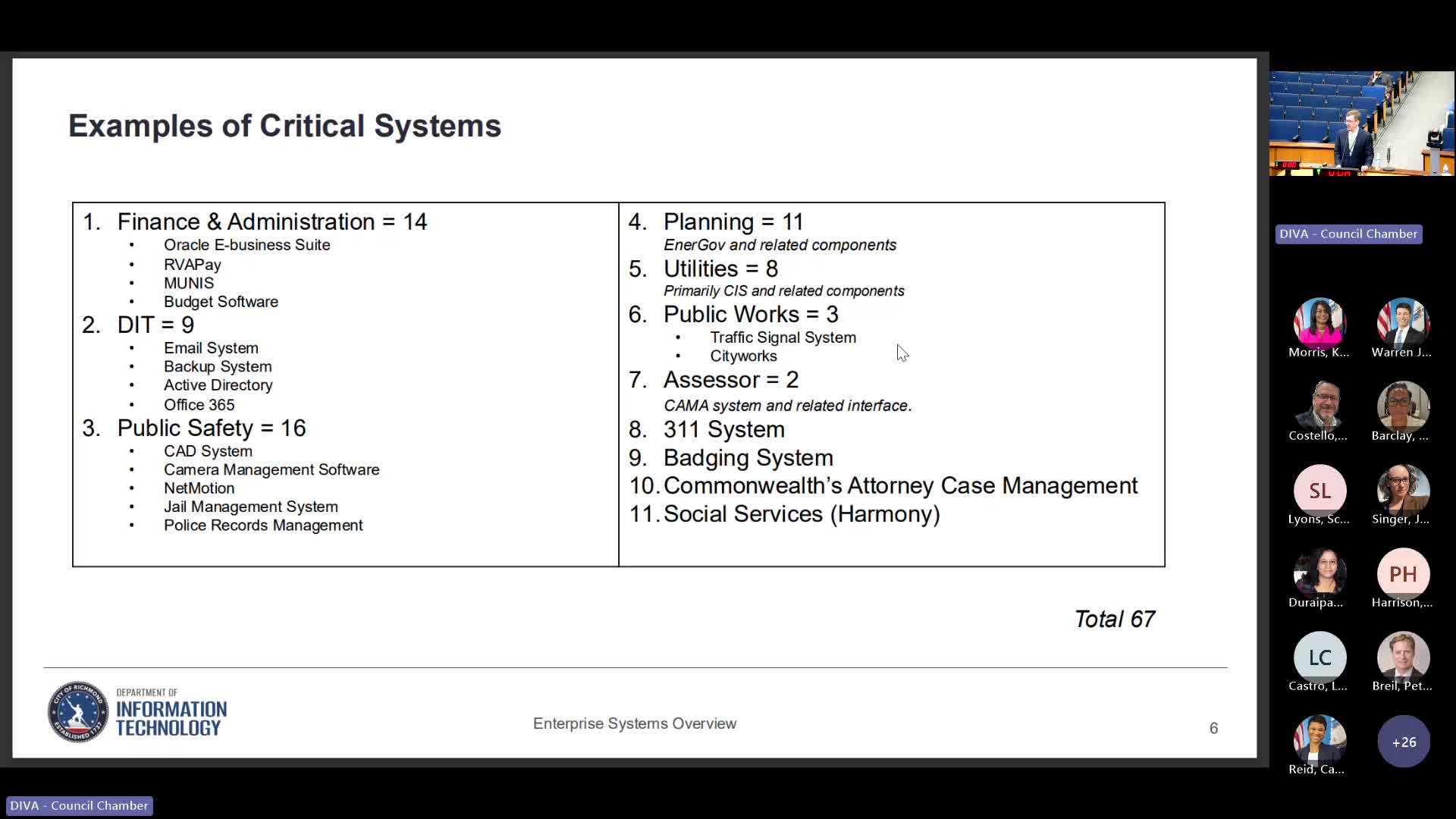
Department of Information Technology director Charles Todd told the Government Operations Committee the city tracks 428 applications, classifies 67 as high‑criticality, and highlighted major upcoming projects including a DPU customer information system replacement (targeted next February) and a phased Windows 10 upgrade for city computers.
Charles Todd, director of the Department of Information Technology, briefed the committee on the city’s application inventory and several major projects and budget needs.
Todd said DIT currently tracks 428 applications in the city inventory and classifies 67 of them as high‑criticality — software whose unavailability would quickly disrupt core city functions. He highlighted several enterprise projects in active planning or procurement: the Department of Public Utilities’ customer‑information system replacement (a multi‑year project slated in committee remarks for completion in February next year), a city planning/permits replacement procurement (EnerGov replacement RFP under review), and a planned replacement for legacy revenue software (moving from Munis to an Oracle‑based solution labeled RVA Pay).
Todd flagged a Windows‑10 lifecycle issue: about 2,000 of roughly 5,000 city desktops remain on Windows 10; the department plans phased replacements with most devices replaced by October and remaining machines coordinated with DPU system changes that require extended vendor support.
Budget and procurement notes
Asked about DIT’s budget increase, Todd described two components: roughly $2 million in baseline contract and license inflation and roughly $3.2 million to cover identified capital and operating items (examples discussed: end‑of‑term vehicle/computer leasing for Richmond Police Department in‑car systems and print shop equipment replacements). Todd said lease and replacement costs were higher than expected and noted DIT will continue to refine individual line‑item explanations if the council wants more granular detail.
Software governance and consolidation
Todd described the city’s application life‑cycle process (emerging → core/supported → decline → retired) and said DIT is working to avoid unnecessary duplication while providing agencies the systems they need. He noted tools such as Oracle E‑Business Suite, EnerGov, and customer systems for utilities and public safety remain among the city’s most mission‑critical systems. Todd also reviewed open IT audit recommendations and said staff are working to close a set of medium‑priority and documentation items with the auditor.
Why it matters
The DIT overview identifies where the city’s technical dependencies are concentrated and why scheduled hardware and software replacements and licensing increases are now driving near‑term budget requests. Committee members asked for more detail on resident feedback channels and on how citizen experiences (for example, payment portal usability) feed into procurement decisions for future systems.
Next steps
Todd offered to provide more detailed line‑item budget explanations and follow up on citizen feedback channels; DIT will continue to coordinate system upgrades with agencies that have linked dependencies (DPU, Public Safety, Planning).