Get Full Government Meeting Transcripts, Videos, & Alerts Forever!
Get email alerts on the Water Quality topic
No spam. Unsubscribe anytime.
Richmond DPU outlines plan to locate and remove lead service lines; warns private‑side funding gap
Summary
Department of Public Utilities officials presented a multi‑phase plan to identify and replace lead service lines, said federal rules require expanded action by 2027, and said the city cannot use ratepayer funds for private‑side replacements, requiring grant funding or other financing.
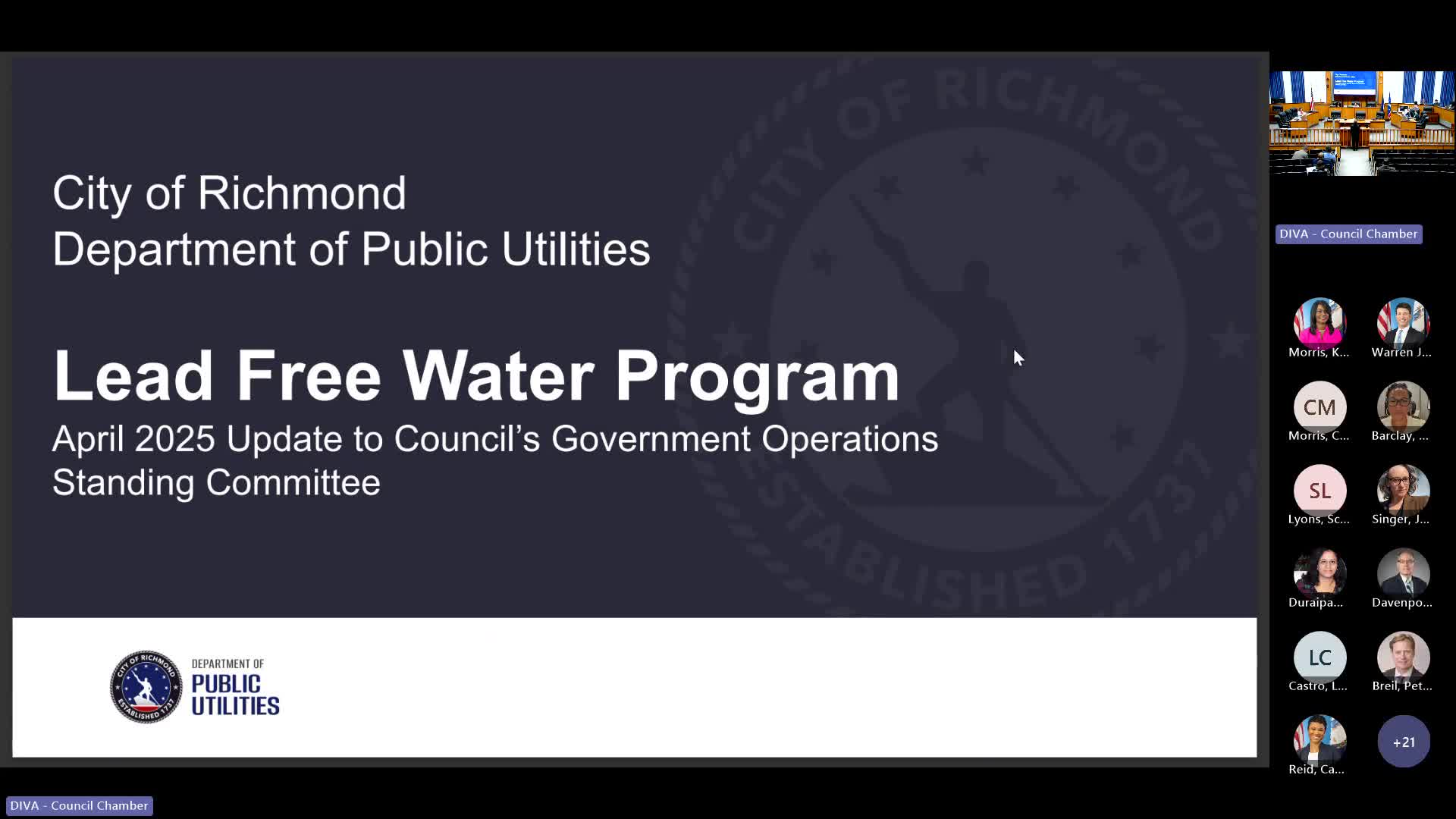
Deputy Director Laura Bender Nagel and Director Scott Morris of the Department of Public Utilities gave the Government Operations Committee a detailed update on Richmond’s lead service line program, the regulatory drivers shaping it and the practical obstacles the city faces in finding and replacing private‑side lead service lines.
Bender Nagel summarized the health risks of lead exposure and described the service‑line inventory the department has posted publicly. DPU officials told the committee they have definitively identified roughly 2,000 lead service lines and about 13,691 properties confirmed to have non‑lead service lines on both sides of the meter; however, roughly 66,000 private‑side service lines remain “unknown” and must be identified before replacements can be scheduled.
Regulatory framework and deadlines
DPU staff reviewed three federal rule milestones: the original Lead and Copper Rule (1991), the 2021 Lead and Copper Rule Revision (LCRR), and an upcoming Lead and Copper Rule Improvements package (LCRI) that expansion of requirements and sample collection. Committee discussion cited the LCRR requirement to publish a public service‑line inventory and noted that LCRI will require utilities to locate and remove lead service lines within a multi‑year compliance horizon (presenters described the compliance timeframe as a 12‑year horizon, which the department framed as target planning through the mid‑2030s). The LCRI obligations will also expand sampling requirements for daycare centers and schools and lower the action threshold for lead in drinking water (committee presentation: from 15 parts per billion to 10 ppb).
Program approach and funding constraints
DPU said city crews will continue corrosion control at the treatment plant and sampling to verify effectiveness. For removal, the department is shifting from a customer‑initiated grant model toward a block‑by‑block pilot approach. Under the block program, DPU staff will dig small test pits at consecutive houses on a block to determine service‑line materials, conduct outreach to obtain owner authorizations, and then perform contiguous replacements where a high participation rate is obtained. DPU said the customer‑initiated grant program will be paused for the current funding phase because new state and federal grant rules carry Buy America / Build America (BABA) requirements that the current program cannot meet without redesign.
DPU officials emphasized a key funding constraint: DPU enterprise (ratepayer) funds cannot be used for private‑property work. The department is pursuing Virginia Department of Health funding phases (DPU is applying for phase 5 and phase 7 grants) and treating the loan portion of new funding formulas as an obligation to be repaid by the utility (which imposes constraints on how those funds can be used on private property). DPU said the program budget will scale up substantially; staff contrasted historical funding of roughly $500,000 per year with projected work that could reach about $20,000,000 per year at scale.
How residents can help and next steps
DPU has a public service‑line inventory with an online survey tool residents can complete, and an enrolled‑plumber program for one‑to‑four‑unit residential properties: participating local plumbers perform a zero‑cost inspection and are reimbursed by DPU. The department is rolling out predictive models (machine learning) to prioritize likely lead locations, will release IFBs tied to the block‑by‑block pilot, and intends a sampling event in June covering 50–100 properties to validate corrosion control. Staff asked council members to promote the plumber program and the survey and said residents who replace their own private side may coordinate with the city so the city can replace the public side afterward.
Audit and program status
Scott Morris provided an audit update alongside the program presentation. DPU reported several warehouse‑related audit recommendations are in the final review stage with the Office of Internal Audit and that two items recently closed. Remaining high‑priority audit items largely relate to inventory procedures and are linked to work on improving warehouse controls at utility facilities; DPU said it expects several of those items to be closed in the coming weeks once auditors confirm the submitted procedures.
Why it matters
Committee members pressed staff on equity and outreach: because older neighborhoods carry the highest density of unknown or lead service lines, the program’s design and funding flow will shape which residents receive earlier replacements. The private‑side funding limitation is the key implementation constraint; without state or federal grants or alternative financing for private work, the utility cannot unilaterally replace all private‑side pipes.
What the committee requested
Council members asked DPU to investigate on‑bill financing or other mechanisms to spread private‑side replacement costs for homeowners who cannot pay the full upfront cost, and they sought updates on grant applications and the block‑by‑block pilot as those elements develop.