Get Full Government Meeting Transcripts, Videos, & Alerts Forever!
Get email alerts on the Parking Ordinance Rv Boat Commercial Vehicles topic
No spam. Unsubscribe anytime.
Cooper City workshop reviews parking code for RVs, boats and commercial vehicles; commissioners back online permit and 36‑hour limit
Summary
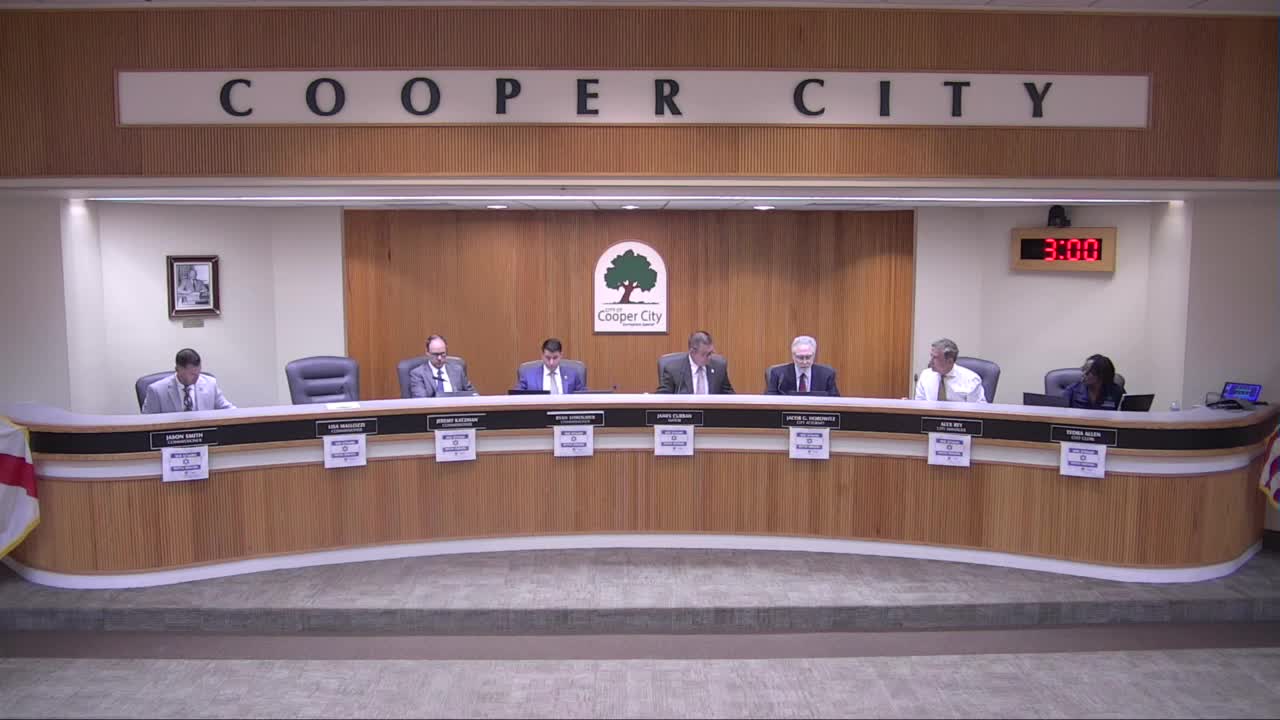
At a Cooper City commission workshop, residents and commissioners debated limits and enforcement for parking recreational vehicles, boats and commercial trucks. Commissioners discussed keeping a 36‑hour allowance, requiring online notification or registration, and stricter behind‑fence height limits.
The Cooper City Commission held a workshop on parking regulations for recreational vehicles, boats and commercial vehicles, focusing on code section 25‑10 and neighborhood enforcement. City staff presented a history of changes to the ordinance and residents described repeated citations, concerns about swale enforcement and privacy issues related to large RVs parked adjacent to homes.
The workshop matters to residents because the code determines when and where residents may park boats, RVs and work trucks on private property and on the city-owned swale next to sidewalks. Commissioners discussed clarifying the time window for front‑yard parking, creating an online notification or permit system, and tightening height and storage limits for vehicles visible above privacy fences.
City staff member Jason opened with a historical overview of 25‑10, noting the code’s evolution from the 2005 ordinance to an ordinance adopted after a 2021 workshop. Jason summarized key points of the existing code: boats and RVs may be stored behind a six‑foot privacy fence up to specified heights, vehicles visible above the fence must be registered if they exceed the fence height, and the front‑yard allowance currently reads as a time‑limited exception for “actual active and uninterrupted” loading, unloading, repair or maintenance. Jason said the 2005 code allowed up to 10 feet behind fences; the 2021 revision defined commercial and recreational vehicles more narrowly, removed the “form‑fitting cover” requirement, and changed the front‑yard allowance to a 36‑hour window for limited purposes.
Residents described enforcement problems and the effect on daily life. Cesar Ortiz asked whether HOA rules or city code govern parking; staff replied both apply and HOAs can be stricter. Several residents said they had received tickets shortly after bringing a boat or RV home and described midnight door knocks when officers left citations. Resident Sam Rojas told the commission he had been fined for a boat in the swale and called the practice “very unfair.” A resident who identified herself as living next to a large RV said the vehicle sits three inches from her fence and has cameras pointed toward her property; she said code enforcement had told her to pursue the HOA, which she said had been slow to act.
Sergeant (Broward Sheriff’s Office, enforcement) explained how BSO enforces the time limit: “Typically, if we go out and we do a sweep on a Tuesday night, Thursday, and a Saturday ... if we go out on Tuesday night and we see that there is a boat or an RV at the house, that's when the 36 hours begins. We do not come back out again until that Thursday night, which is 48 hours.” He added officers photograph and time‑stamp sightings and generally issue a warning before a citation.
Commissioners and staff discussed several possible changes: (1) keep a 36‑hour total allowance in a seven‑day period for a single front‑yard vehicle but require an online permit or registration to remove ambiguity; (2) limit front‑yard allowances to one vehicle per property; (3) retain a separate behind‑fence standard and revert to a 10‑foot visible height cap for vehicles stored behind a six‑foot privacy fence (commissioners discussed excluding rooftop HVAC units from the measured height); (4) require annual registration for vehicles that exceed the fence height (a registration provision already appears in the code for vehicles visible above six feet); (5) prohibit utility hookups and living in stored vehicles; and (6) allow washing of boats or RVs on private lawn or swale where appropriate, while recognizing that separate ordinances or enforcement language may be required for swale versus front‑yard activities.
Commissioner Smith criticized the method of some enforcement contacts, calling a midnight door knock “unacceptable,” and asked staff to ensure officers use reasonable hours for warnings. Commissioner Mallozzi urged a practical, resident‑friendly notification system (an online permit, email or temporary call‑in) so enforcement officers can check time‑stamped notices before issuing citations. Commissioner Schroeder said he would support a registration or online permit system that functions like a parking app, where residents start and stop a time allowance; city staff said the city’s permitting platform could be adapted and that an interim email notification process could be used until an app is available.
Commissioners identified recurring enforcement and comprehension problems to address in draft ordinance language. They asked staff for data: the last six months of citations for RVs, boats and commercial vehicles and examples of recurring violations. The commission did not take final action in the workshop; a motion to close the workshop passed at the end of the session and commissioners asked staff to draft ordinance language and options for formal consideration on a future regular meeting agenda.
The commission also flagged swale enforcement and HOA limits as separate but related issues. Staff and commissioners noted that HOAs may be limited in enforcement tools (statutorily capped fines and complications with homestead property) and that municipal code enforcement remains the more enforceable avenue in many cases. Staff said the 36‑hour provision was adopted to accommodate practical notification timing for code officers; one city attorney or manager comment noted that when two code provisions conflict, the later ordinance controls.
The commission directed staff to prepare draft language and supporting materials for a future meeting that would: clarify the start and stop of the front‑yard time window, propose an online notification or temporary email/process for residents until an app is implemented, reaffirm registration requirements for vehicles visible above the six‑foot fence, propose a one‑vehicle limit for front‑yard allowances, and tighten storage and living‑use prohibitions for stored vehicles. Commissioners asked for enforcement data and examples from the past six months to inform drafting and outreach.
What’s next: staff will produce draft ordinance language and cite recent enforcement data for council review at a future meeting; no ordinance changes were adopted at the workshop.