Get Full Government Meeting Transcripts, Videos, & Alerts Forever!
Get email alerts on the Student Growth Special Ed topic
No spam. Unsubscribe anytime.
River Falls presents midyear student-growth data and rising special-education needs
Summary
District staff reported midyear progress on a district-wide WIG (Wildly Important Goal) focused on student growth percentiles, explained use of state-mandated and local screening tools, and described an increase in special education students and vacancies affecting staffing needs.
River Falls School District presented midyear data on a district-wide Wildly Important Goal (WIG) to raise student growth, and administrators said they are seeing an increase in students identified for special education services.
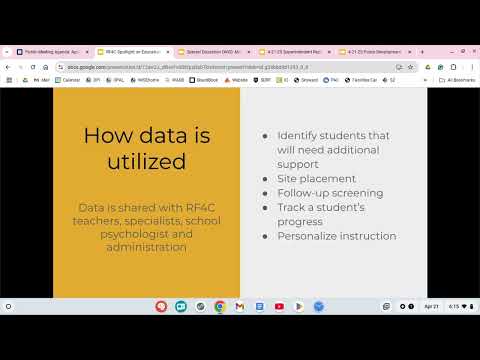
Student Services Director Mark (last name not specified) reviewed the WIG target: "80% of our students will have above average growth based on that student growth percentile of 65 or greater from fall to spring," and outlined how the district is measuring growth across grades with different screeners. He said the district uses the state-mandated AIMSweb early literacy screener for early grades and uses FastBridge and STAR measures in other grades; student growth percentile (SGP) metrics allow some cross-measure comparisons.
Mark said midyear SGPs show variability by grade and assessment, with many measures in the 40–50 percent range for high-growth counts and specific kindergarten submeasures needing deeper analysis. He cautioned against overreacting to one round of data and said the district will return with fuller spring results in June for a more robust comparison.
Board members and administrators also discussed staffing and special education trends. Mark and board members said the district has seen an increase of about 75 students identified with a disability over five years; staff described a rising number of students with "heavier needs for support" that requires different staffing configurations rather than simply adding general classroom teachers.
Officials noted workforce impacts: the personnel committee reported roughly 19 vacancies at the time of the meeting, with about six vacancies tied to special education roles. Board members highlighted the district's recruiting efforts and said recent applicant pools for special education positions were unusually strong.
Mark and other administrators described planned next steps: additional data analysis to compare interventions (pull-out vs. co-taught models), continued monthly PLCs, and ongoing evaluation of specially designed instruction and delivery models. The district will present updated and more comparable spring-to-fall data at a later board meeting.