Get Full Government Meeting Transcripts, Videos, & Alerts Forever!
Get email alerts on the Early Childhood Screening topic
No spam. Unsubscribe anytime.
River Falls district pilots mass 4K screener at public library to spot early needs
Summary
River Falls School District staff described a district-run mass screening for incoming 4K students that uses observations, parent-completed Ages & Stages questionnaires and vision/hearing checks at the River Falls Public Library to identify early developmental and health needs and connect families to services.
River Falls School District staff described a mass screening program for children entering 4-year-old kindergarten (4K) that aims to identify developmental, speech, hearing and vision concerns and connect families with resources.
The district runs 30-minute screening sessions at the River Falls Public Library that pair classroom observations with two parent-completed questionnaires, staff said. "What is the screener? It's just a quick check on the child's development," the early childhood teacher leading the presentation said, describing stations for vision, hearing, fine and gross motor skills and social interaction. Parents complete the Ages & Stages Questionnaires (ASQ-3) and a social-emotional screener.
The program pairs classroom teachers, speech-language pathologists, occupational therapists and early childhood special education staff with volunteers and college students to run stations. Vision checks are provided by the Lions Club; an audiometer is used for hearing checks, staff said. Each child receives a "Jump Start" bag with books and simple activities as an incentive, and families participate in an exit interview with the district school psychologist to review screening results and next steps.
District Student Services Director Mark (last name not specified) said the screenings produced immediate follow-up for several children: "For example, we had seven students who flagged as failing the vision test this year. These are seven kids who are now at least getting into the doctor to get their vision evaluated." He framed the effort as both an early-identification strategy and a way to begin partnerships with families who have not previously engaged with district schools.
Board members asked how many incoming children the screenings reach. The early childhood teacher said registration covered about 80% of expected students and the program is supplemented with information collected from childcare partners and the ASQ forms when families cannot attend. Staff noted screenings are for children who will be 4 by Sept. 1 and that the district continues a separate three-year-old screening process through special education services.
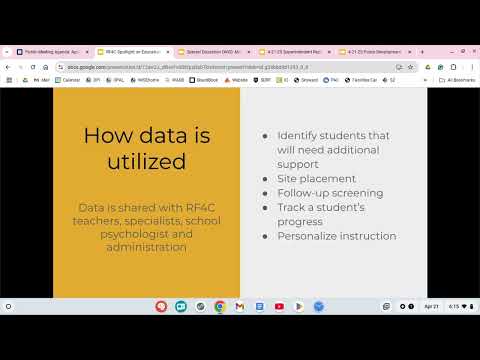
Officials said data from the screenings feed fall follow-up plans: some children are rechecked in the fall for speech or hearing; others are referred to pediatricians or to district evaluations if the screening indicates concern. Staff emphasized the screening is intended to be a quick snapshot to guide early interventions and family engagement, not a diagnostic exam.
The district is coordinating logistics with the public library and reported using paraprofessionals for registration, college students and teachers to staff stations, and speech, OT and PT staff to observe. Staff said they plan to continue refining recruitment and registration strategies to reach children not yet registered in the district.
The program drew positive remarks from board members, who noted the screenings help teachers plan and engage parents before preschool or kindergarten entry.
Looking ahead, staff said they will continue to track screening outcomes into the fall and use the information to target follow-up testing and interventions.