Get Full Government Meeting Transcripts, Videos, & Alerts Forever!
Get email alerts on the Committee Rules Governance topic
No spam. Unsubscribe anytime.
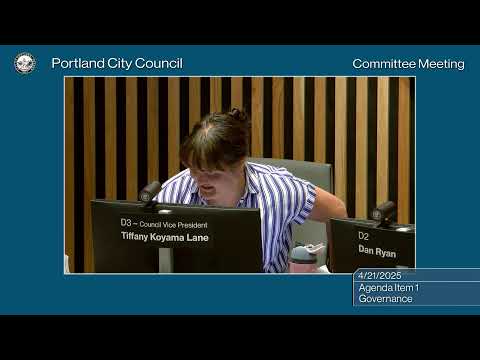
Portland governance committee adopts clarity changes to committee rules, scheduling and staff materials
Summary
The Portland City Council’s Governance Committee on April 21, 2025 approved multiple amendments to proposed committee rules clarifying quorum counting, private deliberations, scheduling deadlines and staff report contents; the committee also accepted technical edits from the clerk’s office and set follow-up work on process and impact analyses.
The Portland City Council’s Governance Committee on April 21, 2025 debated and approved a package of amendments to proposed committee rules that clarify who counts toward quorum, restrict private deliberations by a committee quorum on subjects within committee jurisdiction, tighten voting thresholds for official committee action and add requirements about what staff summaries and impact analyses should include.
The changes were adopted in a series of roll-call votes by the five-member committee. Committee members and staff spent much of the meeting parsing language about how nonmember councilors may participate, what constitutes prohibited private deliberation under the state public meetings law, and how committee-level recommendations should be recorded when they move to full council.
Committee members and staff said the changes aim to reduce uncertainty about committee process and to produce consistent materials for council and the public. "When the committee deliberates, that is for the committee to do," City Attorney Robert Taylor told the committee during legal guidance on how nonmembers may appear and what private gatherings of a quorum may legally discuss. Testifier Terry Harris told the committee he viewed the draft as "a strong draft at this point" that would provide clarity for committees.
Most amendments addressed process details rather than changing the council’s substantive authority. Major clarifications agreed to by the committee include: - Quorum and voting: Official committee action on an item must be taken by a vote of a majority of appointed committee members (the committee voted to make that explicit). The committee currently seats five members, so a majority of appointed members is three; the revised language was intended to prevent a bare majority of those present from being interpreted as sufficient when fewer members attend. - Private deliberations: The committee adopted language that a quorum of the committee "shall not meet privately to deliberate on matters within the jurisdiction of the committee," reflecting the committee’s and the city attorney’s reading of the state public meetings law. - Participation by nonmember councilors: The committee discussed options for how councilors who are not committee members may participate (for example, as an invited presenter or virtual panelist). The city attorney advised that allowing nonmembers to sit in the room is not in itself a violation of the public meetings law, but the committee should preserve the distinction that deliberations are for members only. - Committee staff materials and analyses: The committee added language distinguishing an "impact statement" prepared by the submitting office from separate "impact analyses" prepared by bureaus, service areas or city agencies as directed in code or council rules. The committee also required that, at a minimum, the staff summary that accompanies items to full council include the number of testifiers and a brief summary of any amendments adopted by the committee.
The committee also accepted several technical edits requested by the council clerk’s office (wording changes such as using "presenter" instead of "testimony" for certain types of participation, and posting/filing deadline clarifications). Council President Ryan said the changes would also encourage earlier filing by bureaus so councilors have more time to review materials.
Votes at a glance - Motion to add language that nonmembers "shall not deliberate" for quorum-counting language: approved (tally: yes 5, no 0). - Motion to clarify co-chair designee language (strike "1 or both" to read "a designee of the co-chairs"): approved (tally: yes 5, no 0). - Motion to require official action be taken by a vote of a majority of appointed committee members (explicit majority-of-appointed-members wording): approved (tally: yes 5, no 0). - Motion to add language distinguishing impact statements and impact analyses and to require that impact analyses be completed by the relevant bureau/service area or city agency as directed in code or council rules: approved (tally: yes 5, no 0). - Motion adopting three technical edits proposed by the council clerk (terminology, posting/filing deadlines and minutes language): approved (tally: yes 5, no 0). - Additional procedural edits (suspension threshold wording, motions formatting): approved (tally: yes 5, no 0).
Discussion, outstanding issues and next steps Committee members repeatedly returned to two themes: (1) how to let nonmember councilors participate without upsetting the formal deliberative role of the committee, and (2) how to balance preventing a chair’s unilateral gatekeeping with avoiding an overload of items on committee calendars.
Councilor Candace Avalos (District 1) framed several proposed amendments to create options for nonmember participation and to set expectations for committee behavior. Avalos said she was "not strongly" wedded to specific wording about having nonmembers sit at the dais but wanted clearer rules so councilors know how to engage with committees they are not appointed to.
Committee member Councilor Dunphy proposed a scheduling amendment that would have required committees to schedule any properly submitted legislative item within 90 days; Dunphy later withdrew that particular amendment after colleagues raised concerns about workload and the potential for excessive items on committee dockets. Dunphy did, however, press successfully for a staff-summary minimum that requires public-facing documentation of the number of testifiers and a summary of amendments adopted by the committee before items reach full council.
Robert Taylor, the city attorney, advised the committee on legal limits. He told members that allowing nonmembers to sit at the dais is not by itself a violation of public meetings rules but cautioned that where a quorum of members gathers to discuss matters within a committee’s jurisdiction, those gatherings are subject to the public meetings law. "I think that it is true under the law that... a quorum of the committee should not meet privately to deliberate on matters within the jurisdiction of the committee," Taylor said.
Committee members asked staff to continue working on the procedural materials that accompany the rules. Members flagged the distinction between impact statements (submitted by the sponsoring office) and impact analyses (technical reviews provided by bureaus such as the budget office or other city units) and asked council operations and the clerk to return with clarified processes and any technical website changes needed to display authorship or links to analyses.
The committee set follow-up work rather than finalizing all procedural guidance at the meeting. Council President Ryan said staff and council operations would continue to refine the document and that governance committee time could be used as a work session when needed for further debate.
The committee adjourned after completing the agreed amendments and scheduling the next governance committee meeting for May 5, 2025, at 2:30 p.m.