Get Full Government Meeting Transcripts, Videos, & Alerts Forever!
Get email alerts on the Haiti Security Humanitarian topic
No spam. Unsubscribe anytime.
U.N. special representative warns Haiti is nearing a 'point of no return,' urges immediate international security and humanitarian support
Summary
Maria Isabel Salvador, the U.N. Special Representative for Haiti, told the Security Council that gang violence, prison breaks and mass displacement have pushed Haiti toward a tipping point and called for urgent increases in funding and operational support for the multinational security support mission and humanitarian responders.
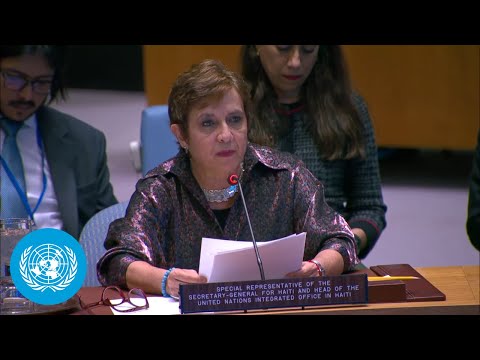
Maria Isabel Salvador, the United Nations Special Representative of the Secretary‑General for Haiti and head of the United Nations Integrated Office in Haiti (BINUH), told the U.N. Security Council on April 14 that Haiti is approaching “a point of no return” and urged member states to provide immediate operational and financial support to stabilize the country.
“The scale and duration of this violence overwhelmed the Haitian National Police,” Salvador said in a briefing, and she warned that “without timely decisive and concrete international assistance the security situation in Haiti may not change.”
Salvador told the council that coordinated attacks by criminal groups have expanded territorial control and undermined state authority in and around Port‑au‑Prince and in the West Center and Artibonite departments. She said gangs targeted the Kenskov road (described in the briefing as the last road out of Port‑au‑Prince not fully under gang control), advanced into Delmas, downtown Port‑au‑Prince and Pétion‑Ville, and that gangs most recently seized “Mirmale.” During one such attack, Salvador said, more than 500 inmates were freed, marking the fifth prison break in under a year.
She gave recent casualty and displacement figures: “In February and March alone, 1,086 people were killed and 383 others injured,” Salvador said, and she cited the International Organization for Migration (IOM) for displacement figures, saying IOM reported “over 60,000 were forcibly displaced in the past 2 months, adding to the 1,000,000 already displaced by December 2024.”
Salvador urged the council to increase support for the multinational security support mission and for Haitian security institutions, saying the Haitian National Police, with backing from the Armed Forces of Haiti and the multinational mission, has been unable to reverse the recent upsurge in violence. She commended Kenya for its leadership of the multinational security support mission and asked other member states to scale up contributions, including funding and operational capacity. She specifically called on the council to consider the proposals in the Secretary‑General’s 24 February letter to the council.
On operations and humanitarian access, Salvador said suspension of commercial flights since November 2024 and blocked road access have isolated the capital and are the “greatest operational challenge.” She said the U.N. system in Haiti has adopted hybrid modalities and reduced presence in Port‑au‑Prince to maintain lifesaving support, but cautioned that “without sufficient and predictable funding even a minimal U.N. presence may become unsustainable.” She thanked the World Food Programme and other U.N. agencies for maintaining access under extreme constraints and urged continued, scaled‑up support.
Salvador also described recent Haitian government measures and limited political progress: she said the presidential transition council under Fritz Jean has reaffirmed a commitment to hold elections and that a revised national budget adopted on April 14 included support to the police and armed forces. She noted the installation of a National Commission for Disarmament, Dismantlement and Reintegration, work on a national community violence‑reduction strategy, a draft law on weapons and ammunition, and a government decree creating specialized judicial units on heinous crimes, financial crimes and corruption.
At the same time, Salvador cautioned about feasibility: she said security‑related deterioration has compromised essential preparations for a referendum and for inclusive, credible elections and urged that stabilization be aligned with realistic political and operational priorities. She said the U.N. political mission should prioritize core responsibilities — political dialogue, national capacity support, community violence reduction, human rights protection and enabling conditions for democratic renewal — where they can be most credible and sustainable.
Salvador called on the Security Council to renew engagement with the sanctions committee and the panel of experts, including “by adding names to the sanctions list and urging member states to fully enforce the arms embargo.” She detailed humanitarian concerns, saying the crisis has led to cholera outbreaks, widespread gender‑based violence in displacement sites, the closure of 39 health facilities and over 900 schools in Port‑au‑Prince, and urged support for the February 2025 humanitarian response plan.
In closing, Salvador appealed for “timely, decisive and concrete international assistance,” saying the National Security Forces need a unified strategic command structure free from political interference, more specialized anti‑gang units, better equipment and improved working conditions. She said BINUH “will spare no effort in supporting the Haitian‑led political process towards the restoration of peace and democratic institutions as soon as conditions are met.”
The meeting president thanked Salvador for the briefing.