Get Full Government Meeting Transcripts, Videos, & Alerts Forever!
Get email alerts on the Transportation Veterans Corridor topic
No spam. Unsubscribe anytime.
Charlotte County plans staged upgrades on Veterans Boulevard, debates full rebuild vs. phased fixes
Summary
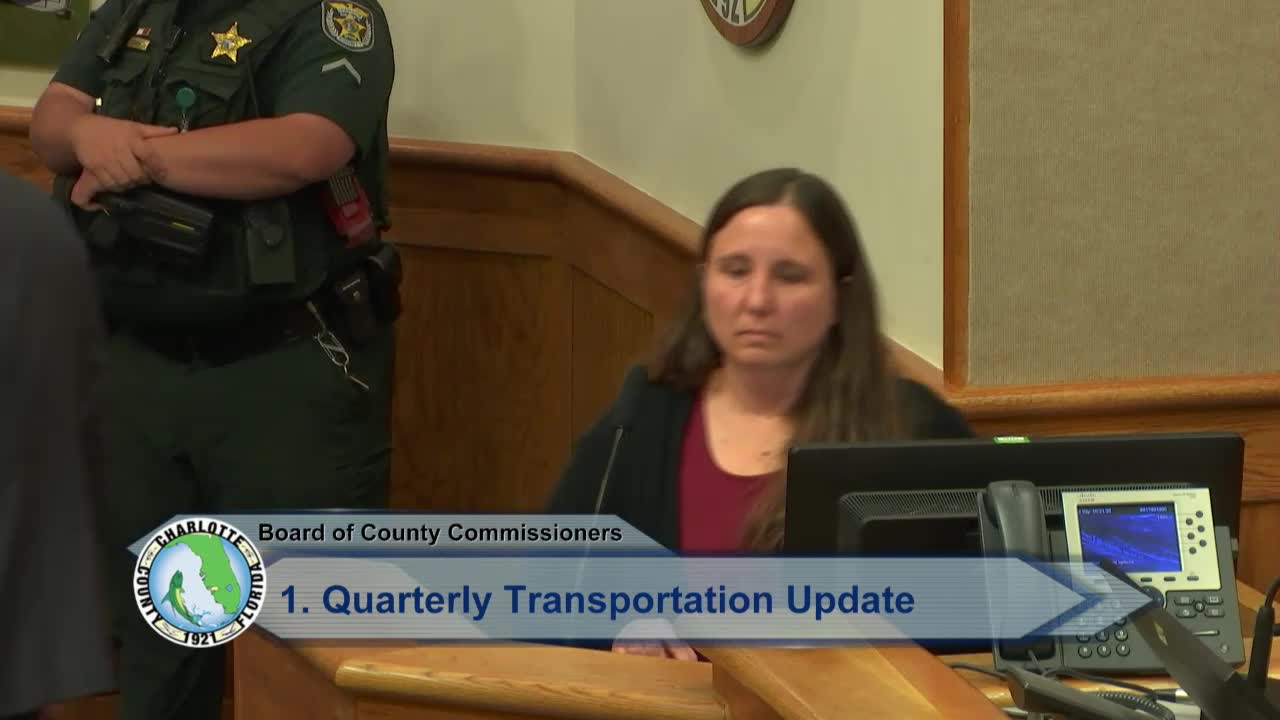
Charlotte County commissioners heard detailed plans Oct. 21 for intersection and corridor improvements along Veterans Boulevard and other county arterial projects, and pressed staff for crash-level analysis and cost options before committing to larger rebuilds.
Charlotte County commissioners heard detailed plans Oct. 21 for intersection and corridor improvements along Veterans Boulevard and other county arterial projects, and pressed staff for crash-level analysis and cost options before committing to larger rebuilds.
County Engineer Joanne Vernon and Public Works Director John Elias presented a corridor-by-corridor account of projects planned between U.S. 41 and Kings Highway, describing a package of immediate, warranted improvements (primarily additional turn and through lanes) and separate, later-stage work that staff says is not currently warranted and therefore is scheduled for future design and construction.
The county says funding constraints drive the sequencing: staff recommended constructing items currently warranted and saving future, higher-cost changes for when traffic growth requires them. Vernon said Veterans Boulevard is “just under 7 miles” and is a mix of signalized and unsignalized intersections; many intersections have design work complete while others are at 60% or earlier stages. John Elias noted some construction is already underway and highlighted a recent state appropriation of $3,300,000 for the Veterans/Cochran project.
Why it matters: Veterans Boulevard carries heavy daily volumes and a concentrated share of the county’s crashes; commissioners repeatedly emphasized the corridor’s safety risk and asked staff to prioritize solutions that will reduce the most severe crashes, not only add capacity.
Key facts and near-term projects
- Paulson/Burdock/Poulson area: staff proposed design contracts for the first three improvement items (additional southbound through lane, an east-leg right-turn lane and extended east-leg left-turn lane). Construction is estimated in 2027 with an initial cost estimate for those warranted improvements at about $1.2 million (design and final numbers vary by location and scope). Vernon said later-stage items (labeled 4 and 5 in the presentation) are not warranted for about 10 years and were scheduled for that later timeframe to avoid diverting funds from current needs.
- Veterans at Cochran: construction underway, estimated completion February 2026; project includes a westbound right-turn lane, two northbound through lanes, an exclusive right and other lane adjustments. Staff said the Cochran contract is under construction and the intersection received state appropriation funds noted above.
- Veterans at Atwater, Torrington, Orlando, Norman, Loveland and Yorkshire: a mix of right-turn lanes and turn-lane extensions with design status ranging from 60% to 100% complete. Cost estimates cited in the presentation include $1,250,000 for a package of Yorkshire-area improvements, $350,000 for Harbor, $610,000 for Orlando (design complete) and $680,000 for Norman; staff said the Orlando intersection could later require a signal or roundabout (signal estimated about $2,000,000; roundabout substantially higher).
- Corridor packaging: staff proposed bundling several completed designs into a single construction package to obtain better pricing. Vernon and Elias said some improvements were being coordinated with FDOT corridor-study recommendations.
Safety, speed and scope debate
Commissioners repeatedly pressed staff on whether the county should pursue full intersection reconstructions now rather than piecemeal turn-lane additions. Commissioner Ken Constance argued the corridor “probably should get done once and just get done,” while staff cautioned that many elements are not yet warranted by traffic counts and that funding is limited. Commissioner Constance and others asked staff to at least prepare preliminary right-of-way and design information for future phases so the board can judge whether to fund larger work now.
Speed limits drew sustained discussion. Commissioners reviewed historical speed postings and cited a 2009 county ordinance that altered speeds on segments of Veterans Boulevard. Vernon and others told the board the roadway was originally designed for 45 mph in many sections but later posted at 55 mph; guardrail and median geometry are not built to 55 mph standards without additional work. Commissioners asked staff to pursue a public hearing on lowering the posted speed between Cochran and Loveland back to 45 mph before advancing additional construction in that segment.
Crash data and requested follow-ups
Vernon and Elias presented collision heat maps and said the county counted 52 crashes on Veterans through August 2025 in the dataset shown. Commissioners asked staff to provide a more detailed breakdown of crash types and locations — specifically whether collisions are rear-end (which turn lanes address) versus angle/turn-related (which signalization, roundabouts or arc-cut changes address). Public Works committed to providing the crash-mechanism analysis and to mapping which countermeasures would best target the predominant crash types.
Right-of-way, funding and scheduling constraints
- Impact fees: Vernon said many of the corridor projects depend on impact-fee revenue tied to growth; staff asked commissioners to consider inserting project cost estimates into the county CIP so future impact-fee studies will reflect those needs.
- Harborview Road (phase 1): staff reported 53 total parcels identified and 47 parcels still needed for acquisition, with five currently under contract; the remaining acquisition budget was shown as $26,000,000. Vernon said some map updates from FDOT are required before real estate acquisition can proceed and that the county will need an extension of a LAP agreement that expires March 2026.
- Edgewater-Flamingo-Winding (phases 3–5): staff said 365 parcels were targeted and 354 had been acquired for phases 4–5; phase 3 design introduced new stormwater-pond footprints that added 29 parcels to the acquisition list. Staff said most of the remaining easements and parcels will require eminent-domain steps if voluntary acquisition is not successful.
Roundabout vs. signal decisions
Several intersections under study drew a cost-vs.-benefit debate. At Gasparilla Road and Rotunda Boulevard East staff reported a current 60% design for a signal (estimate $1.2 million) and a preliminary roundabout estimate of about $4 million. Commissioners asked staff to secure a tighter engineer estimate for the roundabout (50–60% level) and to report right-of-way needs and resiliency trade-offs at the next meeting. Some commissioners favored roundabouts for reduced crash severity and resiliency after storms; others said budget limits make signals the practical choice now.
What the board directed/staff next steps
- Staff will return with a crash-mechanism analysis for Veterans Boulevard showing how many collisions are rear-end, angle, turning or other types and which countermeasures best address those conflicts.
- Staff will prepare preliminary right-of-way and design sketched for the later-stage items so the board can decide whether to fund broader intersection reconstructions earlier.
- Commissioners directed staff to bring back options and legal steps for posting a public hearing to consider lowering the posted speed to 45 mph on the segment between Cochran and Loveland.
- For Gasparilla/Rotunda, staff will ask the engineer of record to produce a higher-fidelity cost estimate and right-of-way needs for a roundabout so commissioners can weigh the funding gap and grant options.
Ending
Commissioners and staff acknowledged constrained capital resources and the need to balance immediate safety-improvement warrants with long-range corridor fixes. The board emphasized a data-driven sequence — provide detailed crash mechanics and updated cost/right-of-way estimates — before committing additional funding for large-scale reconstruction.