
Franklin staff roll out annexation cost-analysis tool to quantify long-term costs of growth
Get AI-powered insights, summaries, and transcripts
Subscribe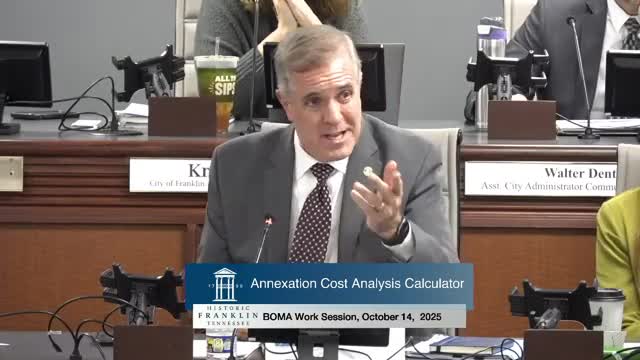
Summary
City staff presented an "Annexation Cost Analysis Calculator" (ACAC) to the Board of Mayor and Aldermen to estimate one-time and recurring fiscal impacts of proposed annexations and large developments; aldermen praised the tool but asked for integration with school impact data and broader public review.
City of Franklin staff presented a new Annexation Cost Analysis Calculator, or ACAC, on Oct. 20 to give elected officials standardized cost and revenue estimates for proposed annexations and major developments.
The tool, led by Michael Walters Young, the city’s chief budget performance officer, produces a project summary, recurring and one-time cost estimates, and implementation assumptions. "The detailed spreadsheet is designed to assist you and us determine how much growth will cost," Walters Young told the Board of Mayor and Aldermen, adding that the tool produces conservative tax estimates and quantifies recurring maintenance and personnel costs.
Why it matters: aldermen said the ACAC could reduce surprises that follow development approvals by summarizing recurring costs (roads, public safety, sanitation, water and sewer operations) and one-time revenues (impact fees, permit fees) in one place. Several aldermen asked staff to integrate school impact data and to make a simplified public-facing version available on the city website.
How it works: the spreadsheet estimates recurring revenues (property, sales, state-shared sales taxes) and recurring costs (maintenance, personnel, utilities) and one-time items such as road impact and parkland dedications. Walters Young said the calculator produces a full-buildout estimate and that accuracy depends on the level of detail provided early by developers.
Discussion highlights: aldermen and staff repeatedly raised three themes: (1) integration with county school impact fees and school-capacity estimates, (2) how to treat utilities and water/sewer capacity when the water management enterprise is separate from the general fund, and (3) public transparency on assumptions and inputs. Alderman Matt Baggett suggested the tool be shared with Williamson County and the school district for a “gut check” on educational impacts; Walters Young agreed to pursue integration with county school impact processes.
Several aldermen asked staff to show trends from quarterly development reports alongside ACAC outputs so officials and the public can compare current permit activity with prior years. Staff said that information is available and will be highlighted in future quarterly reports.
Staff emphasized limitations: the ACAC represents estimates that can change as projects are refined and noted that some funds—stormwater in particular—may show deficits depending on the proposal. Walters Young and planning staff said the tool should be refined and incorporated into the plan-of-services process and used as one input in policy decisions rather than a single “go/no-go” box.
Next steps: staff asked the board for feedback and permission to continue refining the calculator, to standardize developer data requests, and to present public-facing and stakeholder workshops to review assumptions. The city said it will continue integrating the tool into annexation analyses and infill evaluations and return with refinements based on board input.
Ending: Board members welcomed the tool as a step toward more data-driven decision-making, while cautioning that assumptions, especially for public safety staffing, school impacts and long-term maintenance, must be transparent and periodically reviewed.