Get Full Government Meeting Transcripts, Videos, & Alerts Forever!
Get email alerts on the Crime Prevention Funding Board topic
No spam. Unsubscribe anytime.
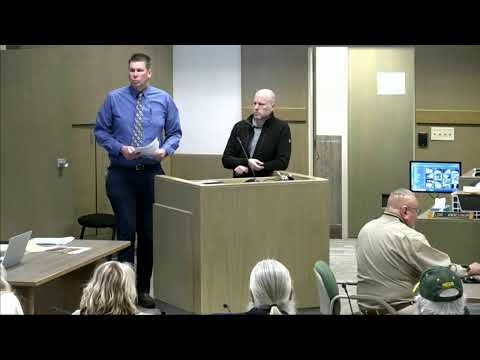
Rock County board approves ordinance creating crime-prevention funding board and $20 surcharge
Summary
The Rock County Board of Supervisors approved an ordinance to create a seven-member crime-prevention funding board and a $20 surcharge on qualifying convictions. The board will distribute collected funds to crime-prevention projects, with statutory direction that half the funds go to nonprofit organizations with stated crime-prevention purposes.
The Rock County Board of Supervisors on a 14-10 roll-call vote approved an ordinance to create a local crime-prevention funding board and a $20 surcharge to be assessed on qualifying convictions.
The ordinance (listed on the agenda as creating Rock County Ordinance 3.221) and a companion motion to establish the board passed after more than an hour of questions from supervisors about who would be charged, how money would be collected and managed, and what kinds of programs might receive grants.
District Attorney Sanders, who sponsored the proposal, told supervisors the law that authorizes the surcharge directs that “50% of funds given every year should go to not for profit organizations with a specific stated purpose of preventing crime.” Sanders said the board would be responsive to applications and that specific projects funded would depend on local requests: “if the Beloit Police Department wants a thousand dollars to help a human trafficking task force, then I'm assuming that would be a yes.”
Supervisor Schwartz pressed for technical clarifications, asking whether the $20 surcharge would apply per conviction and whether traffic forfeitures would be included. Sanders answered that the surcharge applies per conviction, that criminal traffic misdemeanors would count but routine traffic forfeitures such as speeding tickets would not, and that judges can and sometimes do waive court costs, which would affect actual collections.
County staff and legal advisers explained collection and accounting logistics. A staff member said the county treasurer must deposit collected surcharge receipts into a separate account before distribution; funds cannot be spent until collected. The county finance director and auditors were asked to determine whether the account should be treated as a fiduciary (pass-through) fund or as a county special revenue fund; that determination would affect whether future budget authority is required to allow spending.
Supervisors raised policy and equity questions. Several said they were uncomfortable adding another user fee to people convicted of crimes, noting that many defendants are low-income and that unpaid surcharges can become civil judgments. Others said the surcharge is a way to ensure funding remains in Rock County rather than being sent to state coffers and that the board’s composition — statutorily prescribed to include local criminal-justice officials and their designees — provides relevant oversight.
Public comment during the meeting included support for the proposal. Bill Flanagan, chair of the Literacy for Life program, said he supports efforts that invest in youth and community prevention and specifically endorsed the DA’s proposal. Earlier in the meeting, District Attorney Sanders had described the ordinance as “guaranteed to be reinvested in the community that already paid the cost of being a community wherein crimes were committed.”
The board first voted on the ordinance (agenda item 11c); that measure passed 14-10 on a roll-call vote. A separate motion to create the crime-prevention funding board (agenda item 11d) passed by voice vote later in the meeting.
The ordinance establishes the surcharge at $20 per qualifying conviction, sets up a seven-member board with statutorily designated officials or their designees, and directs the treasurer to receive and hold funds for disbursement on the board’s order. The county’s legal staff said the statute cited during the discussion is “Section 59 54 28” as read into the record, which staff said governs the creation and operation of such county crime-prevention funding boards.
Supervisors asked staff to return with written clarifications on several procedural points, including (1) the expected annual revenue under typical ordering and collection patterns (the DA estimated collection could range and earlier materials suggested a working estimate of roughly $15,000–$25,000 annually, though the DA said a hypothetical maximum if every conviction were charged and collected could be about $50,000), (2) whether the treasurer would treat the receipts as a fiduciary/pass-through fund or a county special revenue fund, and (3) how the board’s granting process and reporting would be documented for county oversight.
The ordinance and board creation take effect as provided in the ordinance text; county staff will return with any additional procedural clarifications requested by supervisors.