Get Full Government Meeting Transcripts, Videos, & Alerts Forever!
Get email alerts on the Ethics Complaints topic
No spam. Unsubscribe anytime.
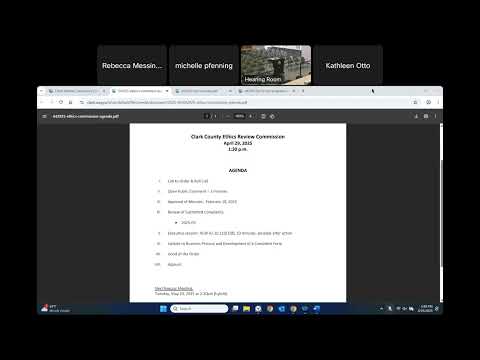
Clark County ethics panel declines to investigate complaint over C Tran board vote
Summary
The Clark County Ethics Commission voted unanimously that a complaint alleging procedural and Open Meetings Act violations over a Clark County Council vote to replace a C Tran board member did not rise to an ethics violation; the commission also approved updates to its business process and will allow remote testimony at an upcoming hearing.
The Clark County Ethics Commission voted unanimously that allegations in complaint 2025-03 do not constitute an ethics violation, and approved procedural changes and a plan to allow remote testimony at an upcoming hearing.
At a virtual meeting where no members of the public spoke, Adam Murray, chair of the Clark County Ethics Commission, said the complaint filed by Rob Anderson challenged procedures used by members of the Clark County Council when they voted to remove councilor Michelle Belcott from the C Tran board and replace her with councilor Fuentes. Murray said the commission's role at this stage is to decide whether the complaint alleges facts that could reasonably show a violation of the county ethics code.
"Mister Anderson's complaint does not allege misuse of a public position for personal gain," Murray said, adding that state law provides remedies for alleged Open Public Meetings Act violations and that the ethics commission is not an appellate body for council decisions. He said he planned "to vote in support of a motion to rule that the allegations here do not constitute an ethics violation."
The commission's decision turned on Clark County HR Policy 13.1, which the commission cited as defining unethical behavior primarily as using a professional role to pursue a personal interest. The commission also referenced Clark County Code section 2.07 0.01 sub 1 and the state Open Public Meetings Act as sources governing process and remedies.
Barbara Baskerville, commissioner, moved that "the matters addressed do not constitute an ethics violation, under our rules and state law." Darcy Rourke seconded the motion. All three commissioners voted in favor; the chair recorded the outcome as a unanimous vote that the allegations did not warrant an ethics investigation.
After the vote, Amber Smith, counsel for the commission, presented proposed changes to the commission's business processes and discussed developing a universal complaint form. Smith said she had consulted with "Miss Cook in our office" and county staff and planned to work with council and HR staff to create clearer timelines and a complaint form for ethics reviews. "I look forward to working with you all, and this commission and to help assist you in your business practices to make this the most efficient possible," Smith said.
The commission voted to approve and adopt the proposed changes as presented. The vote was recorded in the meeting as carried by all three commissioners.
Commissioners also discussed logistics for a hearing scheduled for the 20th of next month at 2:30 p.m. The commission considered whether to require in-person testimony or allow remote participation. Concerns were raised that remote technical issues have occurred and that in-person testimony can convey information differently, but commissioners noted fairness and accessibility concerns for witnesses with childcare or work conflicts. The commission decided that remote participation will be allowed for that hearing, with the understanding that future hearings may be held in person when practicable.
Votes at a glance - Approval of previous meeting minutes: carried (three ayes). - Motion that complaint 2025-03 does not constitute an ethics violation: carried, 3-0 (Baskerville moved; Rourke seconded). - Approval and adoption of proposed business-process changes and development of a complaint form: carried, 3-0 (motion moved from the chair).
The commission adjourned after confirming the decisions and assigned staff and counsel to follow up on procedures and hearing logistics.