Get Full Government Meeting Transcripts, Videos, & Alerts Forever!
Get email alerts on the City Budget Housing Investment topic
No spam. Unsubscribe anytime.
Hartford budget hearing: no tax increase; $5M neighborhood investment, $6.5M homeownership push with $2M state match
Summary
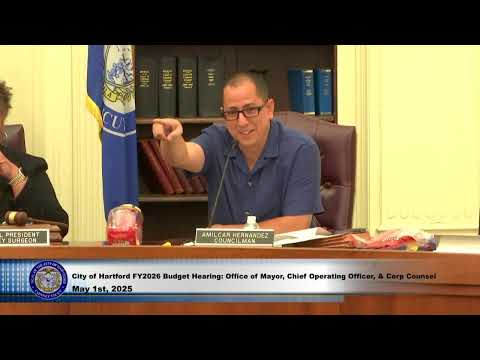
At a city budget hearing, the mayor’s office outlined priorities including a balanced budget with no tax increase, a $5 million neighborhood investment fund for commercial corridors, and a $6.5 million city commitment to a homeownership pilot leveraging $2 million in state funds.
The mayor’s chief of staff, James Wolf, told the Operations Management Budget & Government Accountability Committee that the proposed fiscal plan would not raise residents’ property taxes and that the administration is prioritizing neighborhood investment and housing initiatives.
“This budget includes no tax increases for residents,” Wolf said, describing a budget he said was difficult to assemble given regional mill-rate increases. He highlighted a $5,000,000 neighborhood investment fund aimed at key commercial corridors and said the city plans to commit $6,500,000 to programs to increase homeownership in Hartford, leveraging an additional $2,000,000 in state funding for a Neighborhood Homes Investment Act pilot.
The Neighborhood Homes Investment Act pilot will be run by the State Department of Housing (DOH), Wolf said. DOH will work with community development financial institutions to develop program rules; Wolf said more program details could appear this summer or into the fall. Wolf also said federal legislation to create tax credits is under discussion in Congress and that the pilot in Hartford is intended to test a grant-based approach quickly before any state tax-credit model is pursued.
Why it matters: the hearing framed the mayor’s budget priorities as investments in commerce and housing without raising residents’ tax bills. Council members pressed for timelines and eligibility details for the state-backed homeownership pilot; Wolf said programmatic specifics are still being finalized by DOH.
City priorities described: Wolf and Melinda Johnson, director of the Office of Community Engagement, said the administration wants to boost neighborhood safety through reinstated foot patrols and the mayor’s neighborhood investment initiative, which has funded small businesses and neighborhood projects. Wolf said the city funded “night gyms” that served more than 1,000 children last summer and intends to continue the program.
Renters’ protections and insurance: Council members asked about a renters’ insurance proposal the mayor has discussed. Wolf said the administration plans to pursue a renter’s insurance program after the budget process and “look forward to robust council input” on program design. He said options under consideration include a public option, partnerships with insurers, or targeted subsidies, but he did not provide cost estimates.
311 and community supports: Johnson told the committee the Office of Community Engagement administered roughly $34,000 in urgent supports during the first quarter through partnerships with United Way’s Rapid Release Funds, Operation Fuel and other nonprofits; those Rapid Release grants are typically up to $1,000 per occurrence and are distributed after in-person verification. Johnson said municipal ID services and other resident supports continue to be offered through the office and partner locations.
Council reaction and next steps: Council members pressed for more detail and quick timelines on the homeownership pilot and for expansion of the neighborhood investment program to other corridors. Wolf said pre-applications for the neighborhood investment program are underway and that selections and early pipeline projects could be visible about a year from the start of the application process. Wolf and Johnson said staff will share program updates and rollout details as they are finalized.
Ending: Committee members thanked the mayor’s office team for the presentation and asked for continued follow-up on program rules, timelines and staffing for the initiatives discussed.