Get Full Government Meeting Transcripts, Videos, & Alerts Forever!
Get email alerts on the Homelessness topic
No spam. Unsubscribe anytime.
Butler County directs 90-day plan to inventory homelessness resources while weighing separate Continuum of Care
Summary
At a county housing summit April 29, Butler County leaders introduced new executive director Julie Gilbert, directed a 90-day resource-inventory plan and discussed a petition to form an independent Continuum of Care to pursue HUD funding.
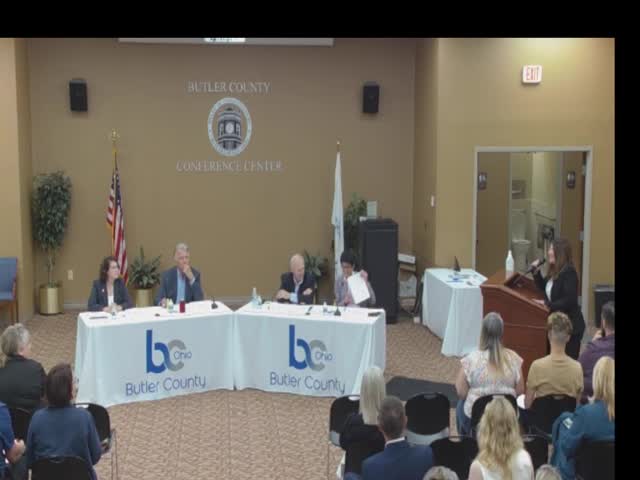
Butler County officials on Tuesday, April 29 convened a third housing summit and directed newly appointed Executive Director of Human and Social Services Julie Gilbert to develop a 90-day plan to inventory local housing and social-service resources and coordinate countywide work on homelessness.
The action follows months of work by a grassroots Butler County Housing and Homeless Collaborative that has petitioned to separate the county from Ohio's Balance of State Continuum of Care (CoC) so Butler County can apply directly for U.S. Department of Housing and Urban Development (HUD) homelessness funding. Commissioners and local officials at the summit discussed the potential benefits, funding questions and oversight concerns of an independent CoC.
Julie Gilbert, introduced at the meeting, told attendees she has “26 years of experience working for the county” and described her new role as executive director of human and social services for Butler County. She said her initial work will inventory county and community resources, reach out to stakeholders, and “be driven by data” to build a sustainable, countywide plan that reduces redundancy and respects taxpayer dollars.
The collaborative seeking independent CoC recognition argues Butler County currently receives a disproportionate share of HUD-funded projects because it is grouped with Ohio’s 80 rural counties under the Balance of State. A presenter at the summit said Butler County currently receives about $1,400,000 in Shelter Plus Care funding and noted nearby urban counties receive larger awards — the presenter cited roughly $13 million to Montgomery County and $25 million to Hamilton County. The collaborative says local management of HUD-funded projects would allow Butler County to set priorities, oversee coordinated entry and access local data through a Homeless Management Information System (HMIS).
Local officials and service providers said they support better local coordination but raised practical questions. Jessica Green of Oxford urged particular attention to people with severe, chronic mental illness who are not able to accept shelter; she also asked how new projects would be funded. Mark Welch of West Chester Township cautioned about unintended consequences of proposed initiatives, listing risks such as gentrification, stigmatization and overreliance on metrics.
Hamilton-area officials described locally developed housing proposals that they asked the county to support. A Hamilton official outlined “Build Back the Block,” a plan to rebuild infill owner-occupied housing in working-class neighborhoods, with a stated goal of 100 affordable homes by 2030 and a first phase of 10 homes in 2025. New Miami Mayor Jewel Hensley described an outreach effort she organized this winter that provided food, showers and shelter referrals to roughly 70 individuals; she described a range of needs from elderly residents on fixed income to people with trauma and substance-use histories.
Speakers explained technical responsibilities a local CoC would assume: naming an HMIS lead (the collaborative expects to ask Strategies to End Homelessness to serve as HMIS lead and collaborative applicant), overseeing coordinated entry, and annually selecting projects to submit to HUD. The presenters noted HUD funding rules restrict CoC funds to permanent supportive housing, rapid rehousing and transitional housing projects; acquisition and construction are not funded through CoC dollars.
Commissioners and several municipal officials stressed a recurring practical question: where operational and matching funds would come from. Summit participants cited other funding streams in the county — Community Development Block Grant money, opioid-related funds, public-assistance programs and a recent Ohio youth services grant that totals $5,000,000 with $250,000 routed to Butler County — but said a clearer inventory of resources is needed.
The summit concluded with the board’s decision to move forward with the new executive director’s initial work and to reconvene. Commissioners said they had given Gilbert a 90-day window to develop a plan and requested continued engagement from cities, townships and providers as that work proceeds. County Administrator Judy Boyko framed Gilbert’s role as a “steward or facilitator” of county and community resources rather than a standalone housing director.
What happens next: the county will collect input from the collaborative, providers and local jurisdictions while Gilbert completes the 90-day plan. Officials emphasized that any change in CoC status would require a formal HUD review and, if approved, could take more than a year to finalize. Summit speakers urged ready-to-launch project proposals and clearer estimates of local funding commitments before any larger structural change is finalized.