Get Full Government Meeting Transcripts, Videos, & Alerts Forever!
Get email alerts on the Eviction Prevention topic
No spam. Unsubscribe anytime.
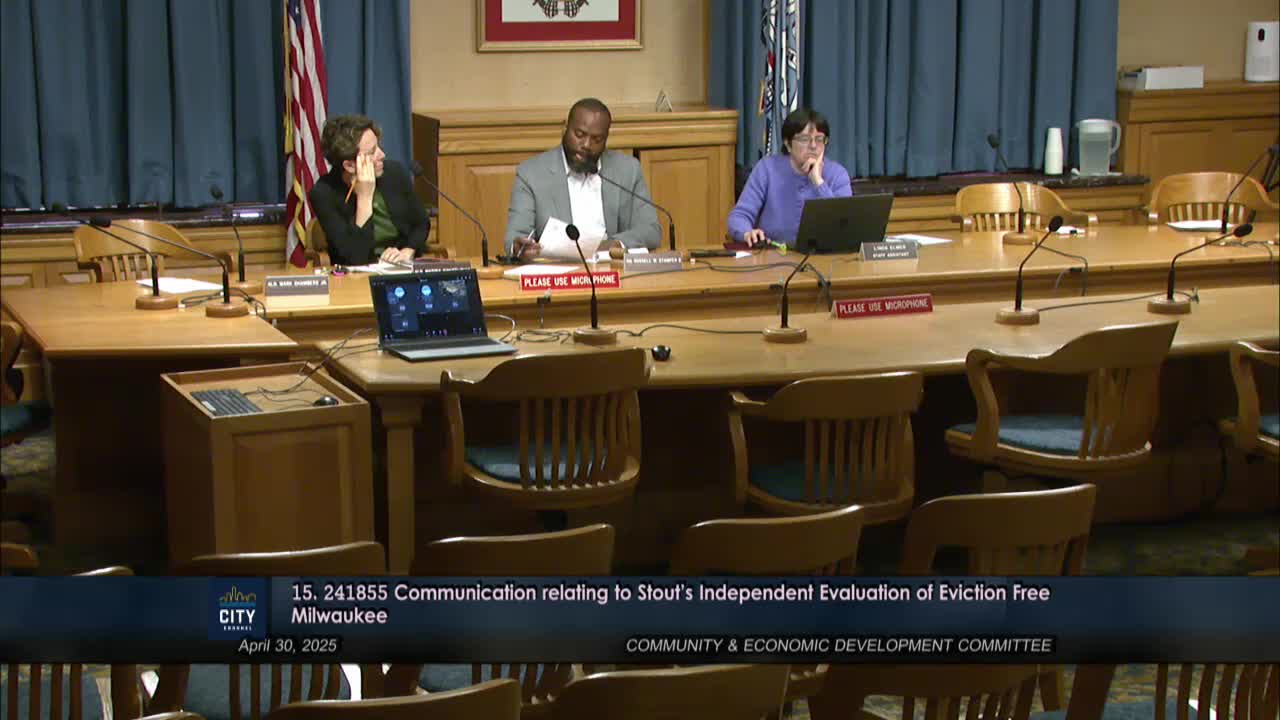
Independent evaluation finds Eviction Free MKE reached more than 10,500 households over three years; council places report on file
Summary
An independent evaluation of Eviction Free MKE reports the program assisted over 10,500 households from Sept. 2021–Sept. 2024 and calculates a roughly $4.66 public fiscal return for every dollar invested; the Common Council committee placed the report on file.
The Common Council’s Community Economic Development Board placed on file an independent three‑year evaluation of the Eviction Free MKE program after a presentation from the program’s attorneys and the report’s outside evaluator.
The evaluation, prepared by consulting firm Stout and presented by director Samantha DeDominico, concluded that more than 10,500 Milwaukee households — representing more than 15,000 adults and nearly 13,000 children — had been assisted by Eviction Free MKE during the report period, September 2021 through September 2024. DeDominico told the committee that the program’s demographic profile mirrors national patterns: clients disproportionately identify as female and Black or African American.
The report also presented a cost‑benefit estimate. “For every dollar that has been invested in EFM, the county and or the city has likely realized about $4.66 in fiscal benefits,” DeDominico said, citing avoided costs such as emergency shelter, out‑migration, school funding loss, and other social‑service impacts.
Why it matters: Program staff and their evaluator said the initiative has reduced the immediate harm of eviction filings and produced measurable fiscal benefits. Committee members and presenters discussed gaps that remain — including continued need for rental assistance and a short public notice period that can make pre‑filing intervention difficult.
Attorney Colleen Foley of the Legal Aid Society of Milwaukee, who manages the local program, said Stout’s work combined quantitative analysis with stakeholder interviews and community engagement. “For the past 3 and a half years, in large part due to funding from this body and the County of Milwaukee and other private sponsors, we’ve been able to operate the Eviction Free MKE program,” Foley said.
Committee members asked for more granular, district‑level turnout and housing data and for materials the council can share with constituents. The presentation also described ancillary legal work: eviction‑sealing clinics (more than 400 cases from March–December 2024) and an investigation that led to criminal charges in a wage‑garnishment fraud matter.
Action taken: Alderman Dimitri Revich moved to place the communication and Stout evaluation on file; there were no objections and the motion was ordered.
Outlook: Presenters told the board they will continue seeking sustained funding and noted that some peer cities have adopted ordinances guaranteeing counsel in eviction cases. Foley said the local program’s current funding is at risk of ending at the close of the year and that staff are pursuing federal and philanthropic grants to continue operations.