Get Full Government Meeting Transcripts, Videos, & Alerts Forever!
Get email alerts on the Grants And Funding topic
No spam. Unsubscribe anytime.
Newport staff propose tighter rules, peer review for civic support grants as $120,000 shortfall looms
Summary
City staff recommended a tightened, more objective process for awarding Newport’s civic support grants, including universal eligibility requirements, a tiered application structure and a peer-review scoring rubric to vet roughly 37 applications before council consideration on May 28.
City staff recommended a tightened, more objective process for awarding Newport’s civic support grants, including universal eligibility requirements, a tiered application structure and a peer-review scoring rubric to vet roughly 37 applications before council consideration on May 28.
The recommendation came during a City Council workshop where staff said applications now arrive as one- or two-page narratives and simple budgets, limiting the city’s ability to evaluate impact. Peter Bermonte, the city’s grants officer, told councilors that staff will request standardized documentation — for example, a 501(c)(3) determination letter, a Secretary of State certificate of good standing, a current board roster and, for organizations with budgets of $500,000 or more, audited financial statements — as an initial eligibility screen.
“We want to make sure that everything is being evaluated objectively, fairly, with a sense of alignment with the city's comprehensive plan objectives and those of the council,” Bermonte said.
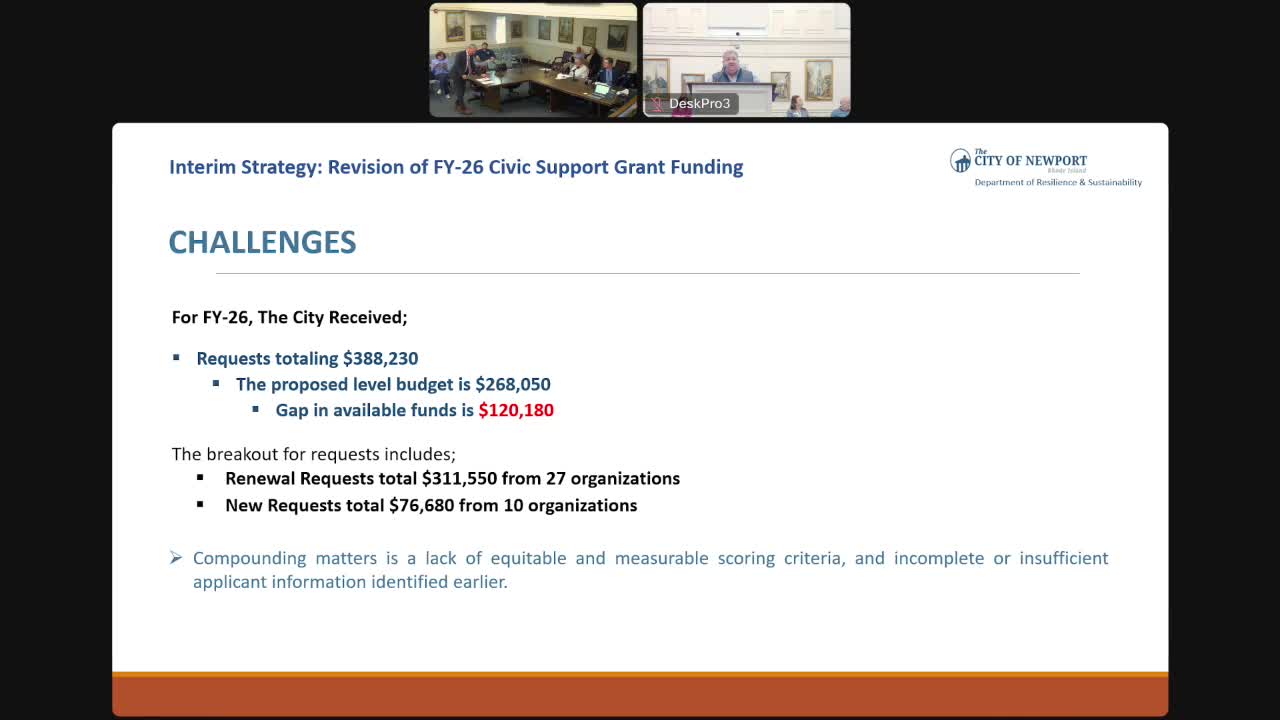
Why it matters: Applicants requested about $388,000 in total; the proposed civic support line in the draft budget is $268,000. At the workshop Jim (city finance staff) said the city has $163,000 available in the public improvement fund and $104,000 is proposed from the general fund for a $268,000 civic support total, leaving an approximate gap of $120,000 if the council confirms the proposed budget line. Jim explained the public improvement fund amount includes roughly $60,000–$65,000 of interest (calculated at 4%) plus a transfer from the Sears trust to reach the $163,000 figure.
Staff recommended a two-step approach in the short term: (1) an initial eligibility screen using the universal requirements, and (2) objective scoring of in-hand applications with a peer-review panel using industry-standard criteria. Bermonte said the interim screening will not require applicants to submit new narratives for the current round; it will confirm eligibility and then score existing submissions. If the initial screening removes ineligible applicants, the funding gap could narrow without changing the budget.
Councilors and nonprofit representatives pressed staff on operational details. Miss Pinnock asked whether site visits would be part of the evaluation; Bermonte said, “They are not at this point in time,” but added site visits could be added for the largest-tier awards if council wanted them. Councilors discussed whether organizations with an existing relationship with the city should be prioritized; staff said priority could be reflected in the scoring rubric if council directs it.
Nonprofit leaders at the meeting welcomed clearer criteria but asked for clarity about the immediate application round. Carmela Gear, executive director of Wiccan Hill Senior Center, said, “My head’s spinning a little bit because I don't know where we currently are for this application period,” and urged the city to clarify expectations so organizations can plan amid an active budget season. Susan Pietente, vice president of philanthropy at Newport Mental Health, described the agency’s reliance on civic appropriations and said the group serves about 2,400 clients with roughly 40% living in Newport.
Legal and policy constraints were a recurring subject. Councilors and staff noted the original Sears trust and other dedicated trusts have language governing allowable uses; those restrictions could limit how much the city can repurpose trust income for civic support. Multiple councilors asked the solicitor to clarify legal limits and whether the trust language constrains the council’s policy choices.
What staff will do next: Staff said they can vet eligibility documents and run applications through the proposed rubric, present scored recommendations to council for the May 28 meeting and prepare a memo summarizing available trust funds, recurring trust distributions and restrictions. That information would inform whether some organizations should instead be funded through contracts rather than discretionary civic support grants.
Community context and constraints: Staff proposed a tiered application burden so very small awards (for example, $500–$5,000) would not require the same documentation or reporting as requests up to $50,000. Bermonte also proposed stronger post-award reporting — grantees would submit a post-grant report within 30 days of the close of the grant period — and staff said peer reviewers would include local subject-matter experts.
Next steps: Council asked staff for a memo listing the city’s trusts and recurring distributions and for a legal review of trust restrictions. Staff will proceed with the eligibility vet and scoring plan if the council confirms the proposed civic support budget line; final awards will depend on council direction and available funds.