Get Full Government Meeting Transcripts, Videos, & Alerts Forever!
Get email alerts on the Egle Budget topic
No spam. Unsubscribe anytime.
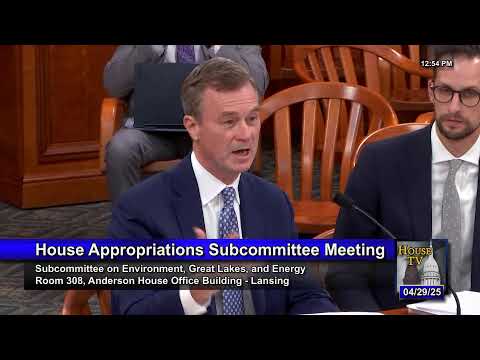
EGLE director outlines $1.04 billion budget, highlights lead-pipe removal, tipping-fee proposal and records digitization
Summary
Director Kevin Roos of the Michigan Department of Environment, Great Lakes, and Energy (EGLE) presented the department's fiscal 2025 results and the governor's fiscal 2026 executive recommendation to a Michigan House subcommittee, emphasizing lead service-line removal, a proposed tipping-fee increase to fund contaminated-site cleanup and a $39 million records-digitization request.
Director Kevin Roos of the Michigan Department of Environment, Great Lakes, and Energy (EGLE) told a Michigan House subcommittee that the department's current budget and the governor's fiscal 2026 proposal prioritize drinking-water investments, contaminated-site cleanup and modernization of records and permitting systems.
Roos said EGLE's fiscal 2025 gross budget is $1.04 billion with $261 million in general funds and that federal grants currently make up roughly 45% of agency funding. "Over the past few years, the agency on behalf of the administration ... has invested $5,300,000,000 in upgrading that infrastructure," Roos said, citing water infrastructure investments and saying those projects have supported an estimated 75,000 jobs.
The presentation focused on four priorities in the proposed fiscal 2026 executive recommendation: water infrastructure (with a particular emphasis on lead service-line removal), preventing and cleaning up contamination (including brownfield redevelopment), strengthening energy infrastructure and supporting local communities, and modernizing and improving transparency through records digitization.
Roos described the lead-service-line proposal in the executive recommendation as a combination of one-time and ongoing general-fund support: $50 million one-time and $30 million ongoing aimed specifically at projects tied to lead service-line work. He said the department is "trying to draw down every dollar of federal money that's available for lead service lines," and noted more stringent federal lead-and-copper rules have shortened the timeline for completing work.
On contaminated-site cleanup, Roos said Michigan has "over 26,000 known contaminated sites in the State," with roughly half for which the state is the responsible party. He proposed a multi-pronged approach: raising the state's solid-waste surcharge (tipping fee) to $5 per ton and returning about 45% of proceeds back to local governments; using $15 million in interest from the Clean Michigan Initiative bond fund for brownfield cleanup; and seeking other fee adjustments in hazardous-waste, water-resources and underground-gas-storage programs. "The Brownfield redevelopment program returns $45 in private investment for every dollar we put into it," Roos said.
On the tipping-fee proposal, Roos said Michigan's current surcharge is among the lowest in the Upper Midwest and that low rates have helped make the state a destination for out-of-state municipal solid waste. The proposed increase is intended both to discourage out-of-state trash and to fund recycling, waste-management prevention and additional contaminated-site cleanup capacity.
Roos also outlined a $39 million one-time records-digitization request to speed public access to permit and remediation records, reduce FOIA processing and improve service. He said roughly 30—5% of relevant records are already digitized in certain divisions and that increased digitization could save roughly $4 million in direct costs.
EGLE officials noted a heavy reliance on federal funds and one-time federal programs in recent years: Roos and Deputy Director Travis Bosco said the department has administered large federal grants (including the Bipartisan Infrastructure Law State Revolving Fund dollars and a $129 million federal Climate Pollution Reduction/ Renewables Ready Communities grant) that will taper unless renewed at the federal level. Bosco said the FY26 request anticipates the last year of certain federal water-infrastructure funds unless federal programs continue.
Committee members questioned specific elements of the proposal. Rep. Cara Stackloff asked whether school districts are included among local governments that would receive a share of the tipping-fee return; EGLE staff said local governments often allocate funds internally and that school districts are generally part of municipal budgets in some places. Stackloff also asked about the timeline for lead-line replacement; Roos confirmed EGLE's completion target and timeline align with recent federal requirements (committee discussion referenced completing remaining work by 2037).
Rep. Natalie Price and other members pressed EGLE on the consequences should federal funding decline. Roos said categorical federal grants support delegated regulatory functions and that loss of federal support would reduce EGLE's ability to carry out delegated EPA duties and to fund water infrastructure projects that have been substantially supported by recent federal programs.
Members asked about fee increases proposed for hazardous-waste oversight and for regulation of gas-storage wells (oil-and-gas monitoring fees). Roos and Bosco said fee increases would fund additional staff and compliance and inspection capacity in those programs, and argued fee adjustments are meant to align costs with those who benefit directly from the regulated activities.
The subcommittee recorded two formal, procedural actions during the meeting: Rep. Price approved the April 22 meeting minutes by unanimous consent, and Rep. Steckloff moved to excuse absent members, which likewise prevailed by unanimous consent.
The presentation closed with EGLE officials offering to follow up on detailed figures for drawing federal lead-service-line dollars and on program-specific cost estimates; lawmakers signaled further review and potential adjustments during budget deliberations.