Get Full Government Meeting Transcripts, Videos, & Alerts Forever!
Get email alerts on the Elections Budget Administration topic
No spam. Unsubscribe anytime.
Cochise County Board reviews elections office budget, staffing and mail‑in procedures
Summary
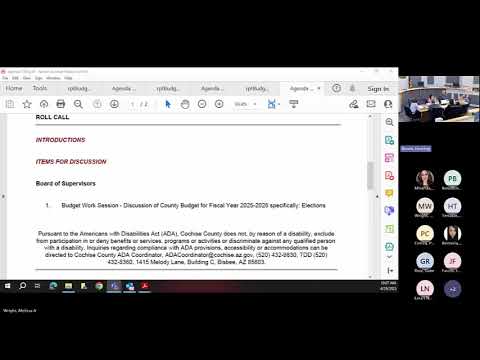
At a work session the Cochise County Board of Supervisors discussed the elections office budget for fiscal 2025–26, a search for an elections director, options for special‑election voting methods, reimbursement rates for intergovernmental agreements and ballot processing logistics.
At a work session, the Cochise County Board of Supervisors reviewed the elections office’s proposed budget and staffing plans, including a finalist interview for an elections director, requested wage adjustments and operational issues related to special elections and mail‑in voting.
The conversation centered on keeping the elections budget largely flat from the prior year while recognizing wage increases for staff. Presenting staff said they have enough in the amended budget to cover salaries for existing employees and to proceed with a finalist interview for the elections director position; the posting was described in the transcript as “a hundred and 10,” which staff presented but did not fully clarify as a dollar amount. Staff asked the board to approve adjustments that reflect current salary needs so the office’s pay lines are “true to where we’re at now.”
Board members and staff discussed the county’s role when small special districts request all‑mail elections. Elections staff said small special‑district contests are often conducted entirely by mail in off‑year cycles and that the decision can depend on whether other elections are occurring at the same time. Staff also described the county’s intergovernmental‑agreement (IGA) reimbursement formula for jurisdictions that use county election services, saying the board previously approved a rate of $0.75 per registered voter; staff said that rate was set years earlier and may merit review given rising postage and printing costs.
Officials noted several cost drivers: postage for outbound ballots, printing and programming work performed by an external vendor, and processing logistics. Staff described a printing and data‑processing subtotal of about $454,000 that covers vendor printing and related services. Ballots are printed and mailed from an out‑of‑area facility (identified in the transcript as Runbeck/Runback; county staff described the vendor and Phoenix as the regional processing point), and the county must route mail and returned ballots through that chain, which affects turnaround and cost.
The board discussed voter access and legal compliance for very small precincts. Members referenced past court decisions that limit hand counts or precinct‑level processes when a precinct contains very few voters because individual ballots could be attributable; staff said the county must be mindful of those requirements when setting vote‑center and mail‑ballot procedures for small districts.
Facility and security needs for ballot storage drew questions. Facilities staff identified building requirements for a secure vault to store ballots, describing reinforced construction details discussed in the meeting (county discussion referred to a six‑inch reinforced concrete wall and a steel door with a combination lock as an example of the type of secure construction the county has considered). Staff said a vault requirement will be checked against official standards and returned to the board with specifics.
Other budget details discussed included a cash carryforward of roughly $28,000 that staff identified as available this fiscal year, and a nearly $60,000 contribution mentioned in connection with IGAs for running local elections. The office reported 12 precincts in the county and described staffing levels and the practical challenge of running multiple small precincts.
The board did not take formal action during the work session. Staff said they would return with refined numbers, clarifications about the posted director salary, and any recommended adjustments to the IGA rate or ballot‑printing and postage estimates. The supervisors scheduled follow‑up budget sessions on risk management and information technology.