Get Full Government Meeting Transcripts, Videos, & Alerts Forever!
Get email alerts on the Complete Streets topic
No spam. Unsubscribe anytime.
Lakewood council refers Complete Streets ordinance amid heated Bunce Road debate; residents, students press safety concerns
Summary
City council referred a joint Complete Streets ordinance and a proposed Complete & Active Streets education and advisory board to committee after lengthy discussion and dozens of public comments focused on the proposed multimodal path on Bunce Road, where residents, students and some council members raised safety, tree and maintenance concerns.
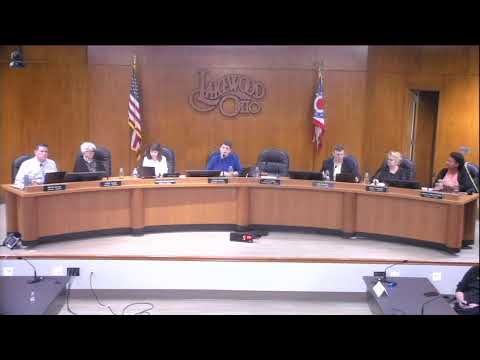
Lakewood City Council on April 21 voted to refer a jointly drafted Complete Streets ordinance and a companion ordinance to create a Complete & Active Streets education and advisory board to the Committee of the Whole and the Planning Commission after extended debate and extensive public comment focused on a proposed shared‑use path on Bunce Road.
The communication and ordinances, introduced by council leaders and the mayor, would codify a complete‑streets framework to guide transportation projects and establish a citizen advisory board to support education, shorter‑term mitigation and community engagement between large capital projects. The ordinance divides projects into tier 1 (major routes and intersections that require public input and planning‑commission review) and tier 2 (other transportation projects that should nonetheless consider complete‑streets elements).
Why it matters: Council and the administration said the ordinance will create an accountability structure to implement the city’s Active Transportation Plan and to guide choices that affect pedestrian, bicycle and vehicular safety near schools and neighborhood corridors. Opponents said a proposed multimodal path on Bunce Road — the focus of much of the evening’s public testimony — increases the number of driveway and intersection conflict points, would remove mature street trees, and raises concerns about maintenance and emergency access.
What was discussed - Ordinance goal and structure: The proposed ordinance implements section 901.23 of the Lakewood Codified Ordinances (Complete Streets) and splits projects into tier 1 and tier 2; tier 1 projects will require submissions to the Planning Commission and public input before implementation, the communication said. - Public comment and planning process: Planning staff and the director of public works told council they held a public comment period and presented the Bunce Road alternatives to Planning Commission; staff said the public comment and the Planning Commission process favored a shared‑use path (planning staff said they made adjustments after public comment). Director Gordon said plans were posted and that the planning process included the Planning Commission’s recommendation. - Resident concerns: Dozens of residents and several students testified against the Bunce Road shared‑use path alignment. They cited: (a) the high number of driveways and intersections along Bunce Road (95 driveways and 16 intersections cited by speaker Amy Herberger), (b) collision risk where a shared path meets frequent curb cuts and commercial driveways, (c) the loss of mature trees along the route and associated climatic and property‑value impacts, (d) emergency access and maintenance burdens, and (e) a perceived lack of meaningful early engagement of Bunce Road residents. - Support for complete‑streets goals: Other speakers urged the city to adopt a complete‑streets framework, citing pedestrian and cyclist safety, equity and household cost savings from modal shift. Emily Lindberg, a resident of Lauderdale Avenue, told council a safe network will help families reduce transportation costs and that “a network of complete streets that are both safe and convenient…will allow residents in Lakewood to be economically resilient.”
Notable public testimony - Matt Herberger (Bunce Road resident) described the process as top‑down and said the community felt excluded; he urged more early engagement and cited the Ohio Department of Transportation multimodal design guidance on context‑sensitive design and public engagement. - Amy Herberger (Bunce Road resident) cited federal and academic studies that, she said, show shared‑use paths have higher intersection crash rates than separated facilities and said the Bunce alignment “does not meet the city’s own definition of a complete street.” - Danica Herberger (an eighth‑grade student living on Bunce Road) said many students avoid Bunce Road because it “feels unsafe and uncomfortable” and that quieter side streets are preferred. - Emily Lindberg (1651 Lauderdale Ave.) supported the ordinance and urged the city to accept that improving safety may reduce convenience for some motorists.
Council and staff response - Several council members said they supported stronger public engagement and tools for mid‑project adjustments. Council Member Boat and Council Member Bullock said the ordinance will create standards and a long‑term framework for project sequencing and design decisions. - Director Gordon and planning staff said the Bunce Road process included public comment and Planning Commission review and that they took public input into account; the Planning Commission recommended the shared‑use path based on that record. - The mayor and council leadership said they welcome continued input as the ordinances move through committee and a joint meeting with Planning Commission.
Formal action Council voted to refer the joint Complete Streets communication and ordinance (and the companion ordinance to create a Complete & Active Streets education and advisory board) to Committee of the Whole and Planning Commission for further public discussion and review.
Ending: The referrals set up additional committee‑level hearings and a joint meeting with the Planning Commission where the public will have further opportunities to review technical reports, design options and staff analyses. Council members and staff said they will continue to examine safety tradeoffs, tree protections and maintenance funding as part of the committee process.