Get Full Government Meeting Transcripts, Videos, & Alerts Forever!
Get email alerts on the Referendum Budget topic
No spam. Unsubscribe anytime.
Eugene council discusses options for Referendum Petition 2025‑1; many favor November vote, staff to return May 14
Summary
The Eugene City Council continued April 28 its discussion of options for Referendum Petition 2025‑1 — including timing for a potential public vote, a possible temporary fee to stabilize services, and budget tradeoffs — and asked staff to return with draft materials and analysis at the May 14 meeting.
The Eugene City Council held an extended April 28 work session on options related to Referendum Petition 2025‑1, including the timeline for a possible public vote, alternative ordinance paths, and short‑term budget stabilization measures. No formal vote or ordinance was adopted; staff was directed to return with more information at a May 14 meeting.
City Manager Sarah (City Manager) reviewed the procedural deadlines and calendar options, telling council that if no action is taken the referendum would go to a November 4, 2025 ballot, but that an earlier vote would require an "emergency" election under Lane County rules. She described scheduling constraints: an August 26 special election is no longer available and the latest date to notify the county for an August 26 plan would have been July 10; an emergency election path could place a vote as early as late July if council acted immediately.
Sarah said any alternative ordinance path would require several parallel decisions: the fee’s target revenue, the methodology for assessing the fee (for example rate × square footage, water billing classes via EWEB, or a flat residential/commercial charge), the fee’s duration and a mechanism for accountability and community oversight. She noted the city’s proposed budget scenario included roughly $8,000,000 of stabilizing funds and $2,000,000 of new revenue and warned that shorter options carry financial risk.
"Between now and then there has to be a strategy to either reduce that or generate new revenue," Sarah said, describing the forecast the executive team uses to evaluate reserves and risk. She told council that the city’s adopted six‑year forecast shows a potential deficit in future biennia if a temporary fee were to sunset and not be replaced; the city manager and CFO estimated the next biennium could face a gap of roughly $17,000,000–$18,000,000 without corrective action, which equates to about $9,000,000 per year.
Staff said implementing any approved fee would take time: earlier presentations estimated roughly six to eight months to begin billing after an ordinance is adopted and systems or vendor arrangements are in place. Councilors noted that bridging ongoing services to a future vote without a known revenue source would deplete reserves and could harm the city's Moody’s credit profile. Councilor Kaczynski asked whether an August election would cost the city more than holding a November ballot; staff replied the costs were similar if no other races are on the ballot but that timing affects when the city must use reserve funds to bridge services.
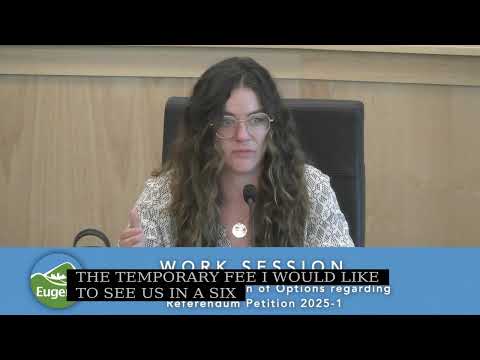
Council members expressed varied preferences. Councilor Yeh said she opposed the emergency path and favored November: "I don't particularly like votes that come out when people aren't expecting it," she said. Councilor Groves also favored taking more time and supported a November election. Councilor Leach said he prefers a six‑year temporary fee if the council chooses that route so the city can better manage budget forecasts; Councilor Keating objected to the use of the word "temporary" in branding and urged language emphasizing restoration of municipal services. Councilor Clark said her preference was to move toward November and not use reserves to "enable a bridge."
Other clarifying details discussed included: the city’s reserve for revenue shortfall (roughly $10,000,000 as cited in the adopted forecast), an approximate cost to bridge to a November vote of about $1,000,000 per month starting in July, and that unpaid vacancies and planned layoffs are already being considered in the amended budget (staff said the amended budget eliminates about 35–40 FTE). Staff also reiterated the procedural option to repeal the ordinance underlying the referendum any time before the county’s deadline (September 3) to prevent the question from appearing on the ballot.
Council did not take formal action on the referendum at the April 28 work session. The city manager said staff will develop materials and come back at the May 14 meeting; a draft ordinance would likely be required by around May 21 for consideration at a June 16 public hearing if the council chooses that route. Councilors requested more detailed cost modeling, vacancy and hiring reports, and options for outreach and community advisors to inform accountability for any temporary fee.
The council president closed the item with a plan to continue the discussion on May 14 and directed staff to provide the requested analysis and draft materials ahead of that meeting.